- Plants
- ›Vascular Plants
- ›flowering plants
- ›Dicots
- ›Nances, Willows, and Allies
- ›rafflesia family
- ›Rafflesia
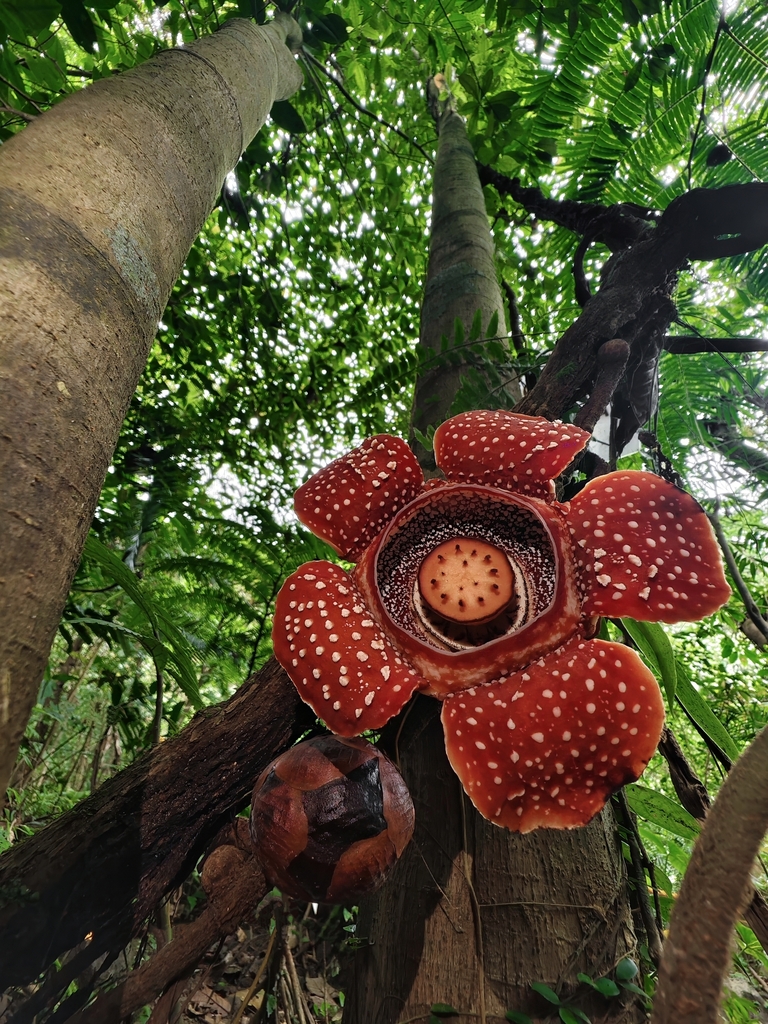
Rafflesia lagascae
Rafflesia lagascae (), named malaboô locally, is a species of flowering plant in the parasitic genus Rafflesia within the family Rafflesiaceae. It is only found growing in the rainforest of the island of Luzon in the Philippines. It is a parasitic plant that grows rather like a fungus, wholly within its host vine, Tetrastigma, and it cannot be seen except when its buds and flowers protrude through the stem or roots of the vine each year. It has no stem, leaves or roots. Plants in the Rafflesia species generally have the nickname "corpse flower" because they attract blowflies seeking carrion.
R. lagascae is the most common Rafflesia species in the Philippines and, compared with other Rafflesia species, it has comparatively small flowers. However, because R. arnoldi (endemic to Indonesia) is famous for having the largest flowers of any plant, people near Manila are willing to take a comparatively easy trek up Mount Makiling in the hope of finding a somewhat similar plant in flower. The diameter of R. lagascae's flower is 11 to 24 centimetres (4 to 9 inches) compared with R. arnoldi at up to 150 cm (59 in).
From the article Rafflesia lagascae on Wikipedia (CC BY-SA), quoted section by section
Description
The flowers of the species R. lagascae (the species name R. panchoana is also used) are similar in appearance to those of R. manillana that is now regarded as a different species. Confusingly, before 2013, specimens of R. lagascae were often described as R. manillana. The plant is an obligate endo-holoparasite.
Pollination. Rafflesia species flowers generally have a strong fetid smell, hence the name "corpse flower", and they attract carrion flies for pollination. Although there are some reports of R. lagascae having a foul or pungent smell, such claims do not seem to be confirmed (or denied) in the scientific literature. Many species of blow flies are attracted to the plant, entering and leaving the floral chamber. The metallic blue blow fly is the most common visitor but also a red-eyed flesh fly (probably a species of Sarcophagidae that deposits its maggots in the perigone), the greenish-blue fly (Lucilia fumicosta), the common housefly and vinegar fly have all been recorded.
Floral development. Tetrastigma is a genus of liana vine that is the only host that R. lagascae parasitizes. After growing in the form of threads wholly within the vine, i.e. as an endophyte, R. lagascae emerges from the vine's stem or roots to flower. When coming from a root of the host vine, it can appear to be growing directly out of the ground. R. …
Range & habitat
Rafflesia lagascae, or malaboô in the local Tagalog language, is endemic to the tropical rainforest of the island of Luzon in the Philippines where it is the most common species of Rafflesia. In a series of studies covering 36 sites it grew at elevations of 500–1,000 metres (1,600–3,300 ft) where precipitation is 2,500–3,000 millimetres (100–120 in) per year and where the mean daily temperature is 21–24 °C (70–75 °F) and fairly constant over the seasons. The area where the habitat is considered suitable for the species covers about 32% of Luzon and in Protected Areas about 68.0% is suitable. Such a habitat exists in many areas of southeast Asia but R. lagascae is only found on Luzon island and only in 12 quite limited areas that are widely separated across the island from north to south. The plant parasitizes only three species of Tetrastigma vine (T. ellipticum, T. loheri, and T. sp. A (sensu Pelser et al.), which are widely distributed over all three island groups of the Philippines. There are various suggestions as to why R. lagascae is so restricted in location and these theories are, somewhat in order of increasing likelihood: the plants do not bloom and are undetected; there are unconsidered environmental constraints; there are undiscovered genetic effects between host and parasite; there is very localised distribution of seeds. …
Wikipedia: “Distribution and habitat”
Where it lives
Recorded sightings
—
geo-referenced records in GBIF, from museums, herbaria and field observers.
Drag the globe to turn it. Dots are where records exist, not a range map; darker means more records.
In the stacks
Searching the stacks…
Every page naming Rafflesia lagascae in the Biodiversity Heritage Library →
This page is assembled live from iNaturalist, GBIF, Wikipedia, the Source Library and the Internet Archive. It is not yet part of the hand-edited codex. iNaturalist taxon 337590.