- Animals
- ›Arthropods
- ›Hexapods
- ›Insects
- ›Winged and Once-winged Insects
- ›Ants, Bees, Wasps, and Sawflies
- ›Narrow-waisted Wasps, Ants, and Bees
- ›Ants, Bees, and Stinging Wasps
- ›Bees and Apoid Wasps
- ›Bees
- ›Honey Bees, Bumble Bees, and Allies
- ›Apine Bees
- ›Honey Bees
- ›Apis
- ›Apis
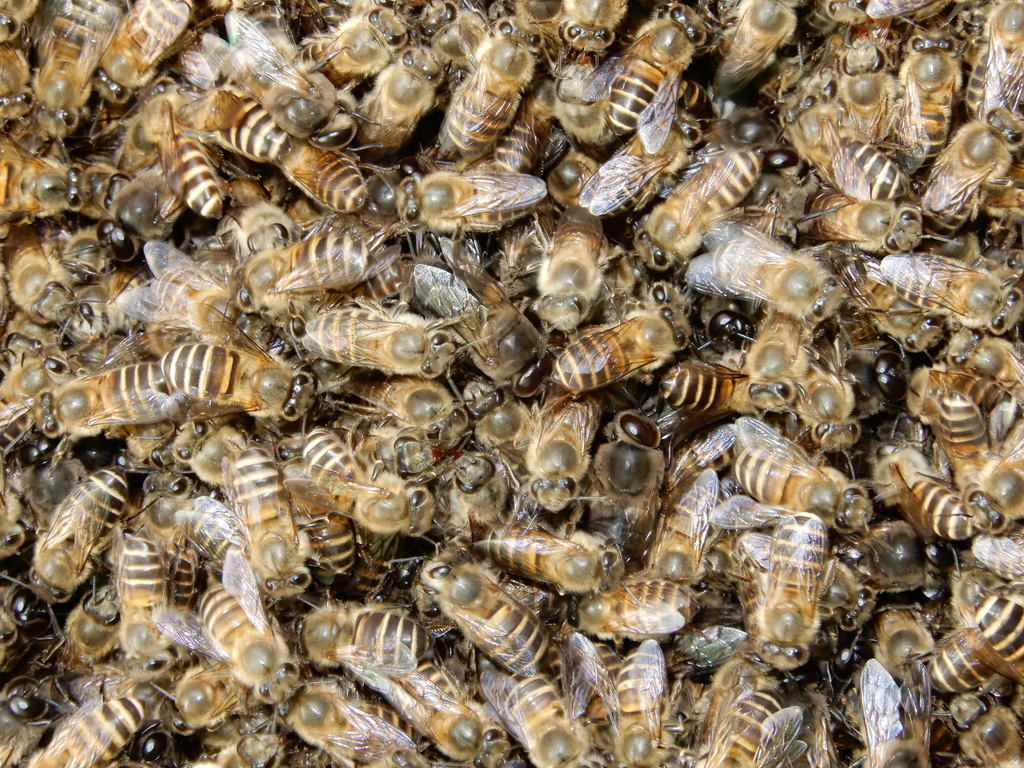
Asian Honey Bee
Apis cerana
Apis cerana, the eastern honey bee, Asiatic honey bee or Asian honey bee, is a species of honey bee native to South, Southeast and East Asia. This species is the sister species of Apis koschevnikovi and both are in the same subgenus as the western (European) honey bee, Apis mellifera. A. cerana is known to live sympatrically along with Apis koschevnikovi within the same geographic location. Apis cerana colonies are known for building nests consisting of multiple combs in cavities containing a small entrance, presumably for defense against invasion by individuals of another nest. The diet of this honey bee species consists mostly of pollen and nectar, or honey. Moreover, Apis cerana is known for its highly social behavior, reflective of its classification as a type of honey bee.
The terms Apis cerana indica and Apis Indica or Indian honey bee, is a historic term, with all Asian hive bees now referred to as Apis cerana.
From the article Apis cerana on Wikipedia (CC BY-SA), quoted section by section
Description
The physical characteristics of Apis cerana individuals are very similar to those of other species in the genus Apis. The individuals in this genus are defined by long, erect hairs that cover the compound eyes and assist in pollen collection, strongly convex scutellum, and a jugal lobe in the hindwing. Adult Apis cerana are black in color, with four yellow abdominal stripes. There are also distinctions between worker bees, queens, and drones. Worker bees are characterized by a pollen press on the hind leg to transport pollen, as well as a stinger in the place of an organ for laying eggs. Queens, which are the reproductive females, are typically larger than worker bees due to their enlarged reproductive organs. Drones, which are the males of the species, are defined by larger eyes, lack of a stinger, and a blunter abdominal shape.
Wikipedia: “Description and identification”
Range & habitat
Apis cerana encompass a wide range of climatic zones including moist tropical rainforests, wet-dry tropical savannas, mid-latitude steppes, dry mid-latitude grasslands, moist continental deciduous forests, and taigas. The natural range of Apis cerana extends from Primorsky Krai in Russia in the north, to eastern Indonesia in the south; and to Japan in the east, to as far as the highlands of Afghanistan in the west. Countries they are native to include Afghanistan, Bangladesh, Bhutan, Brunei, Cambodia, China, India, Indonesia, Japan, Laos, Malaysia, Myanmar, Nepal, North Korea, Pakistan, the Philippines, Russia, South Korea, Sri Lanka, Taiwan, Thailand, Timor-Leste, and Vietnam. It was introduced deliberately to New Guinea in the 1970s, and has since spread into the Torres Strait Islands into Australia and the Solomon Islands. Although the species was naturally clustered in East Asia, it has now expanded to various regions across the world as a result of human interference, with particular concern about its invasive potential in Australia as nests are found in a variety of environments, including both natural and man-made (see below).
Nest. As a type of honey bee, Apis cerana must collect and store around a third of its nectar in a concentrated form in order to ensure an adequate supply for consumption during the harsh winter. …
Wikipedia: “Distribution and habitat”
What it does
Within the honey bee colony, a queen bee typically mates with 10 or more males. This extensive mating is performed in an effort to secure a great range of genetic variation in her colony to cope with diseases, as well as respond to nectar sources and a wide range of external stimuli. Apart from the queen bee, the only other sexual members of the society are the male drones, whose only function is to mate with the queen, after which they will die. The exact time and place of Apis cerana mating is specific to the subspecies, often varying by local environment. For instance, in Sri Lanka, Apis cerana males typically aggregate beside a tree canopy as opposed to above a tree as is found in the Apis cerana subspecies of Japan. The most significant factor in determining mating time, however, is not ecological conditions, but rather the presence of drones of other species. Mating time decreases as the number of non-species drones present increases.
Reproductive swarming. In A. cerana, reproductive swarming is similar to A. mellifera. A. cerana reproductive swarms settle 20–30 m away from the natal nest (the mother or primary colony) and stay for a few days before departing for a new nest site after getting information from scout bees. Scout bees search for suitable cavities in which to construct the swarm's home. …
Wikipedia: “Mating behavior”
At the table
Asian honey bees are often infected by Chinese Sacbrood virus (CSBV) which also infects A. mellifera. Sacbrood viruses (SBV) primarily affect the brood of the honey bee and causes larval death. Infected larvae fail to pupate, and ecdysial fluid aggregates around the integument, forming the "sac" for which the disease is named. Infected larvae change in color from pearly white to pale yellow, and shortly after death they dry out, forming a dark brown gondola-shaped scale. SBV may also affect the adult bee, but in this case obvious signs of disease are lacking.
Wikipedia: “Viruses”
In human culture
The development of worker bees in a colony is typical of that for any insect that undergoes complete metamorphosis as it includes the four stages of egg, larva, pupa, and adult. The embryo grows inside the egg for 3 days, consuming the protein-rich egg yolk. Then it undergoes an 8-day larval stage, which is an intense feeding state involving honey, pollen, and brood food supplied by the adult bees. Finally, there is construction of a wax pupa which then matures and gnaws through the wax cap of the cell to emerge as a young bee.
Wikipedia: “Life history”
Listen
Looking for field recordings…
Where it lives
Recorded sightings
—
geo-referenced records in GBIF, from museums, herbaria and field observers.
Drag the globe to turn it. Dots are where records exist, not a range map; darker means more records.
In the stacks
Searching the stacks…
Every page naming Apis cerana in the Biodiversity Heritage Library →
This page is assembled live from iNaturalist, GBIF, Wikipedia, the Source Library and the Internet Archive. It is not yet part of the hand-edited codex. iNaturalist taxon 338194.