- Animals
- ›Arthropods
- ›Hexapods
- ›Insects
- ›Winged and Once-winged Insects
- ›True Bugs, Hoppers, Aphids, and allies
- ›True Hoppers
- ›Spittlebugs, Cicadas, Leafhoppers and Treehoppers
- ›Cicadas
- ›Typical Cicadas
- ›Largeclasper Cicadas
- ›Widehead Cicadas
- ›Aleeta
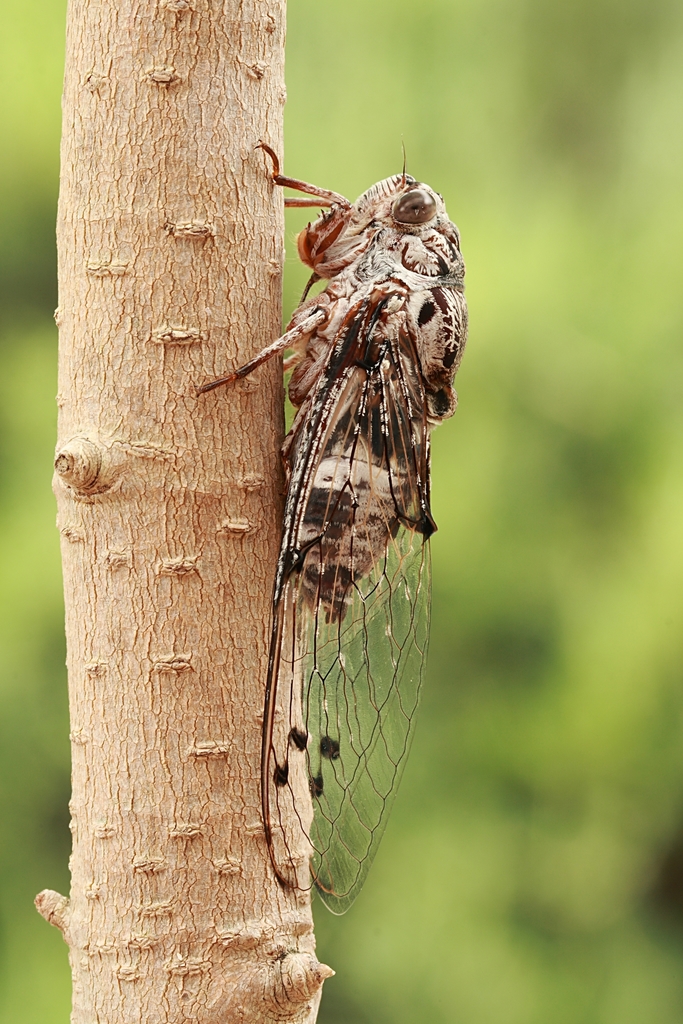
Floury Baker
Aleeta curvicosta
Aleeta is a monotypic genus of cicadas containing the species Aleeta curvicosta (commonly known as the floury baker or floury miller, known until 2003 as Abricta curvicosta), one of Australia's most familiar insects. Native to the continent's eastern coastline, it was described in 1834 by Ernst Friedrich Germar.
The floury baker's distinctive appearance and loud call make it popular with children. Both the common and genus name are derived from the white, flour-like filaments covering the adult body. Its body and eyes are generally brown with pale patterns including a light-coloured line along the midline of the pronotum. Its forewings have distinctive dark brown patches at the base of two of their apical cells. The female is larger than the male, although species size overall varies geographically, with larger animals associated with regions of higher rainfall. The male has distinctive genitalia and a loud and complex call generated by the frequent buckling of ribbed tymbals and amplified by abdominal air sacs.
From the article Aleeta on Wikipedia (CC BY-SA), quoted section by section
Description
With a body length of 2.9 cm (1.1 in), forewings between 3 and 5.1 cm (1.2 and 2.0 in) long, a wingspan of 9–10 cm (3.5–4 in) and weighing around 1.02 g (0.036 oz), the floury baker is a medium-sized cicada. Individuals markedly vary in size by region depending on local rainfall. Areas with an average annual rainfall of over 1,000 mm (39 in) – mostly coastal – have much larger individuals, with average forewing lengths about 1 cm (0.4 in) longer than those in low-rainfall areas.
The adult is brown with a white dusted appearance; white downy filaments cover much of the body, legs and some wing veins, but this silver body fur is easily rubbed off, and so is often substantially diminished in older adults and museum specimens. Individuals have a variety of body markings, but all have a pale midline on their pronotum. Their legs are brown, sometimes yellowish, but with no distinct markings. Their dry mass is on average 36.2% of their total bodymass, higher than most Australian cicadas, which suggests strong exoskeletal armour. Their eyes are dark brown. They have yellowish opercula that extend laterally well beyond the body. The female is slightly larger than the male, She has generally similar colour and markings, though can be slightly paler in some areas. Her ninth abdominal segment is long and dark reddish-brown, sometimes partly tending toward black. …
Range & habitat
The floury baker is found from the Daintree River in North Queensland to Bendalong in southern New South Wales. It is a highland species in the northern part of its range, restricted to the Atherton Tableland and Eungella National Park to the west of Mackay, but more a lowland species in the remainder of its range. It may be found in varied habitats, from rainforest margins to suburbs, even in the centre of Sydney.
Wikipedia: “Distribution and habitat”
What it does
Eggs are laid in a series of slits usually cut by the mother's ovipositor in live branches or twigs of their food plants. On average about sixteen eggs, among a total batch of a few hundred, are laid in each slit. The batch all hatch around 70 days later – usually within a day or two of one another – but take longer in cold or dry conditions. Oviposition has been observed on a wide range of native and introduced plant species and can weaken the branches of young orchard trees such that they cannot sustain the load of their fruit. After hatching, the nymphs fall from the branches to seek a crack in the soil where they can burrow, often to a depth of 10–40 cm (4–15.5 in), by digging with their large forelegs. Larger species of cicada like A. curvicosta are thought to spend 2–8 years underground, during which time they grow and feed through their rostrum on the sap from tree roots. They moult five times before emerging from the ground to shed their final shell. Although consistently taking place at night, the emergence of the population is diffusely spread over the season in comparison to the more high-density Australian species. The sex ratio is about 1.15 males to every female, consistent throughout the emergence. The metabolic rate over a period of about 6.5 hours during emergence of A. curvicosta is about 1.8 times the resting metabolic rate of the adult. …
Wikipedia: “Life cycle”
In human culture
The shells shed by the nymph, as with those of other cicada species, are often collected by children and sometimes attached to their clothing. Schoolchildren have been known to bring live adults into classrooms to startle the class with their "strident shrieking", typically to the observable displeasure of teachers. Children often climb trees to collect them, and keep them temporarily as pets in shoeboxes. They cannot easily be kept for longer than a day or two, given that they need flowing sap for food. A poem dedicated to the floury baker appeared in the Catholic Press in 1930, describing its life cycle to children.
Wikipedia: “In popular culture”
Listen
Looking for field recordings…
Where it lives
Recorded sightings
—
geo-referenced records in GBIF, from museums, herbaria and field observers.
Drag the globe to turn it. Dots are where records exist, not a range map; darker means more records.
In the stacks
Searching the stacks…
Every page naming Aleeta curvicosta in the Biodiversity Heritage Library →
This page is assembled live from iNaturalist, GBIF, Wikipedia, the Source Library and the Internet Archive. It is not yet part of the hand-edited codex. iNaturalist taxon 338899.