- Plants
- ›Vascular Plants
- ›flowering plants
- ›Dicots
- ›Nances, Willows, and Allies
- ›Spurge Family
- ›Euphorbioideae
- ›Hippomaneae
- ›Spirostachys
tamboti
Spirostachys africana
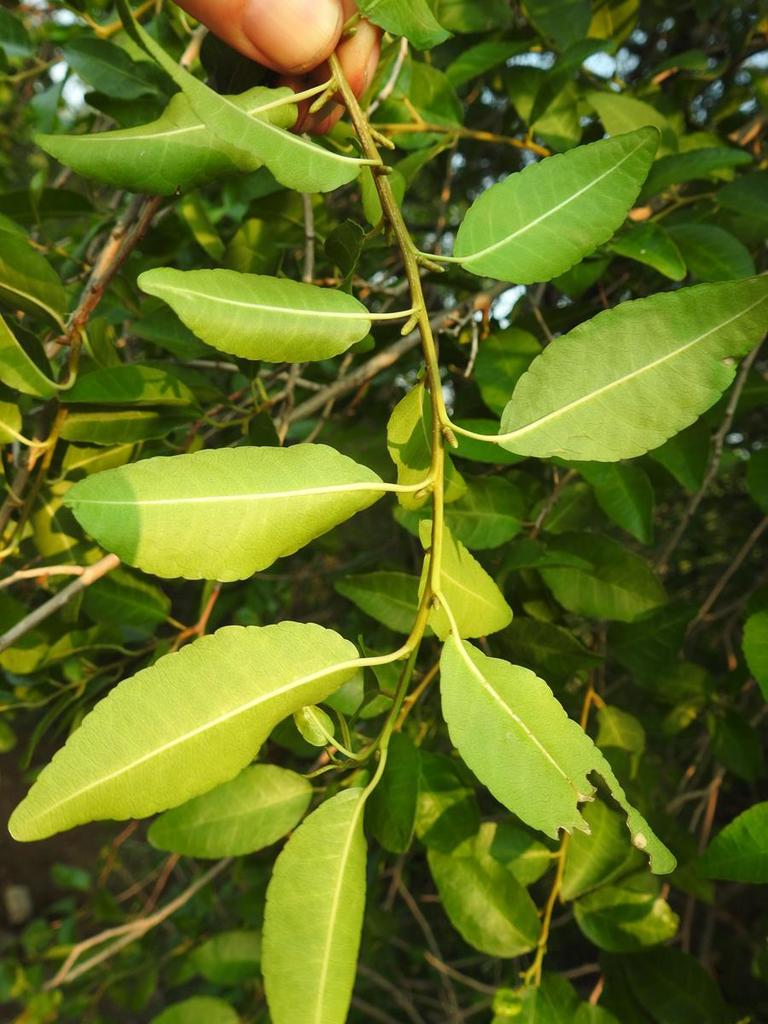
Spirostachys africana is a medium-sized (about 10 metres (33 ft) tall) deciduous tree with a straight, clear trunk, occurring in the warmer parts of Southern Africa. Its wood is known as tamboti, tambotie, tambootie or tambuti.
It prefers growing in single-species copses in deciduous woodland, often along watercourses or on brackish flats and sandy soils.
From the article Spirostachys africana on Wikipedia (CC BY-SA), quoted section by section
Description
The leaves are small, elliptic with crenate margins, and turn bright red in winter before dropping. The petiole has 2 small glands at the distal end. The grey-black rough bark is distinctively split into neat rectangles. The catkin-like flowers appear in early spring before the leaves. Male and female flowers are borne separately on the same tree (monoecious). The small 3-lobed capsules or schizocarps split into three equal indehiscent segments (mericarps or cocci) when ripe; on a warm day this splitting (dehiscence) can sound like a distant fusillade of shots. The seeds are globose with a chartaceous testa.
Toxicity
Despite it being prone to heart-rot, it is prized in the furniture industry for its beautiful, dense and durable timber, which is reddish-brown with darker streaks, a satin-like lustre and extremely fragrant sweet, spicy smell. The underbark exudes a white, poisonous latex when freshly cut, and campfires that burn tamboti fuel give off noxious fumes contaminating meat or other food grilled on the open flames or coals. The latex is used as a fish poison, is applied to arrow-tips and is used as a purgative by indigenous tribes.
Wikipedia: “Wood and toxicity”
Where it lives
Recorded sightings
—
geo-referenced records in GBIF, from museums, herbaria and field observers.
Drag the globe to turn it. Dots are where records exist, not a range map; darker means more records.
In the stacks
Searching the stacks…
Every page naming Spirostachys africana in the Biodiversity Heritage Library →
This page is assembled live from iNaturalist, GBIF, Wikipedia, the Source Library and the Internet Archive. It is not yet part of the hand-edited codex. iNaturalist taxon 340253.