- Animals
- ›Arthropods
- ›Hexapods
- ›Insects
- ›Winged and Once-winged Insects
- ›Butterflies and Moths
- ›Butterflies
- ›Brush-footed Butterflies
- ›Admirals and Allies
- ›Adoliadini
- ›Bebearina
- ›Euphaedra
- ›Euphaedrana
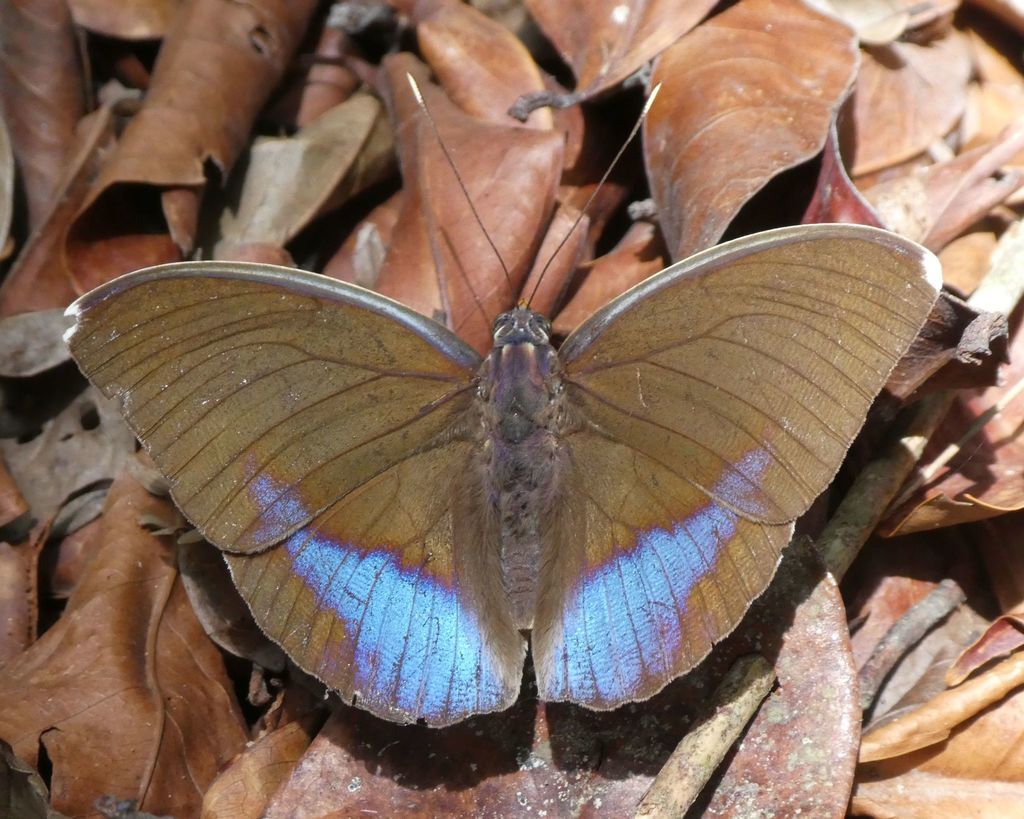
Common Blue-banded Forester
Euphaedra harpalyce
Euphaedra harpalyce, the common blue-banded forester, is a butterfly in the family Nymphalidae. It is found in Guinea-Bissau, Guinea, Sierra Leone, Liberia, Ivory Coast, Ghana, Togo, Benin, Nigeria, Cameroon, Equatorial Guinea Gabon, the Central African Republic, Angola, the Democratic Republic of the Congo, Sudan, Uganda, Rwanda, Tanzania and Zambia. The habitat consists of lowland forests, riparian forests and secondary forests.
From the article Euphaedra harpalyce on Wikipedia (CC BY-SA), quoted section by section
Description
E. harpalyce Cr. Both wings above uniform black-brown, with small white apical spot on the forewing and a bright blue transverse band on the hindwing, which is broad at the anal angle, anteriorly becoming narrower terminates at vein 6 or 7 and is sometimes continued more or less far on the forewing also. The under surface is rather uniform light green or grey-green with 1–3 black dots in the cells. In the type-form the subapical band of the forewing is entirely absent in the male and very narrow and yellowish in the female. Sierra Leone to Cameroons. In ab. lakuma Btlr. the subapical band of the forewing is very narrow in the male but in the female 4–5 mm. in breadth. E. spatiosa Mab.[synonym and subspecies of harpalyce] Both wings above uniform dark olive-brown, in the apical half of the fore wing blackish with yellow subapical band and white apical spot. The under surface is green with one black dot (occasionally 2 or 3) in the cells and two dull, dark, not very distinct transverse bands beyond the middle; the subapical band of the forewing only shows through faintly. The female may attain an expanse of 100 mm. and is the largest of all the Euphaedra species. Cameroons to the Congo and Uganda.
Listen
Looking for field recordings…
Where it lives
Recorded sightings
—
geo-referenced records in GBIF, from museums, herbaria and field observers.
Drag the globe to turn it. Dots are where records exist, not a range map; darker means more records.
In the stacks
Searching the stacks…
Every page naming Euphaedra harpalyce in the Biodiversity Heritage Library →
This page is assembled live from iNaturalist, GBIF, Wikipedia, the Source Library and the Internet Archive. It is not yet part of the hand-edited codex. iNaturalist taxon 341013.