 NL·0389
Herbarium of the Nature Library
- Name
- Crocodylus niloticus
- Family
- Crocodylidae
- Native to
- Sub-Saharan Africa, the Nile basin and Madagascar (the West African crocodile, Crocodylus suchus, is now treated as a separate species)
- Habitat
- Rivers, Lakes, Swamps, Estuaries
Nile crocodile
Crocodylus niloticus
Also calledMamba (Swahili) · Ingwenya (Zulu) · Timsah تمساح (Arabic) · Garwe (Shona) · Msḥ (ancient Egyptian)
Africa's largest predator in fresh water, famous for ambushing wildebeest and zebra at river crossings. It killed and inspired people throughout history and was worshipped in ancient Egypt as the god Sobek.
The Nile crocodile is a large crocodilian native to freshwater habitats in Africa, where it is present in 26 countries. It is widely distributed in sub-Saharan Africa, occurring mostly in the eastern, southern, and central regions of the continent, and lives in different types of aquatic environments such as lakes, rivers, swamps and marshlands. It occasionally inhabits deltas, brackish lakes and rarely also saltwater. Its range once stretched from the Nile Delta throughout the Nile River. Lake Turkana in Kenya has one of the largest undisturbed Nile crocodile populations. Wikipedia
What it can do
- iAmbushes large mammals at the water's edge and drowns them
- iiCan go many months without eating
- iiiFemales carry hatchlings to the water in their mouths
- ivGroups cooperate to feed on large carcasses, holding and spinning to tear meat
In the field
Field marks
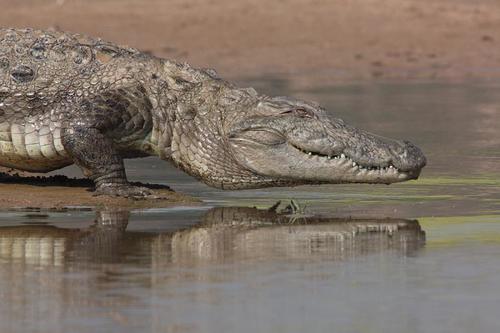
- aLarge, olive-bronze crocodile with dark bands on the tail
- bBroad, V-shaped snout
- cFourth lower tooth visible when the mouth is closed
- dBasks on sandbanks
- Not to be confused with
- The West African crocodile (C. suchus) is smaller and found mainly in West and Central Africa. The slender-snouted crocodile (Mecistops) has a long thin snout. Dwarf crocodiles (Osteolaemus) are small and dark.
- Where to see it
- Mara River crossings (Kenya, Tanzania), Kruger National Park, Lake Chamo (Ethiopia), Okavango Delta, Lake Nasser
- When
- Resident; wildebeest crossings July–October in the Mara
Life & habits
- Diet
- Fish, and mammals up to the size of wildebeest, zebra and buffalo
- Habitat
- Rivers, lakes, swamps and estuaries
- Size
- Males usually 3.5–5 m, exceptionally ~6 m; females smaller
Basks with its mouth open to cool down. Females bury eggs in sandbanks and guard them for about three months. It is thought to be responsible for more attacks on people than any other crocodile species.
Where it lives
Recorded sightings
—
geo-referenced records in GBIF, from museums, herbaria and field observers.
Native range
Sub-Saharan Africa, the Nile basin and Madagascar (the West African crocodile, Crocodylus suchus, is now treated as a separate species)
Drag the globe to turn it. Dots are where records exist, not a range map; darker means more records.
In the old herbals & bestiaries
No plate in the Source Library names this exact species, so these show its closest relatives as the old naturalists drew them: same genus, or the same kind of animal. Click a plate to read the page it came from, with translation.

Ortus sanitatis
Relative · 1491 · p.688

History of Animals, Book II: On Oviparous Quadrupeds
Relative · Conrad Gessner · 1586 · p.724

Museum of the Royal Society
Relative · Nehemiah Grew · 1681 · p.468

Recherche curieuse d'antiquités, venuës d'Italie, de la Grece, d'Egypte, & trouvées à Nimegue, a Sant...
Relative · Chevalier, Nicolas · 1714 · p.56

Unterhaltungen aus der Naturgeschichte / 3 Die Amphibien
Relative · Wilhelm, Gottlieb Tobias · 1794 · p.407

Unterhaltungen aus der Naturgeschichte / [Tafelband.]
Relative · Borkhausen, Moritz Balthasar (1760-1806) · n.d. · p.53

Ortus sanitatis
Relative · 1491 · p.540

Garden of Health
Relative · Jacob Meydenbach · 1491 · p.686

Garden of Health
Relative · Jacob Meydenbach · 1491 · p.538

Garden of Health (Hortus Sanitatis)
Relative · Jacob Meydenbach · 1491 · p.496
In the stacks
Searching the stacks…
Every page naming Crocodylus niloticus in the Biodiversity Heritage Library →
Marginalia
Ancient Egyptians worshipped the crocodile god Sobek at Kom Ombo and Crocodilopolis (Faiyum), where sacred crocodiles were kept, fed and mummified by the thousands. Herodotus wrote that the plover picked its teeth, a story still repeated today.
Curiosity
DNA from crocodile mummies from ancient Egypt showed that some were West African crocodiles, perhaps chosen because they are less aggressive and easier to keep in temples.
Kinship

Photographs: iNaturalist contributors under the licences shown. Records: GBIF.org. Historical plates: Source Library (CC BY-SA 4.0; originals public domain). Summary text: Nature Library editors and Wikipedia (CC BY-SA). Medicinal and edibility notes are historical and educational, not advice. iNaturalist taxon 341972.