- Plants
- ›Vascular Plants
- ›flowering plants
- ›Dicots
- ›Nances, Willows, and Allies
- ›St. John's wort family
- ›St. John's worts tribe
- ›Hypericum
- ›Androsaemum
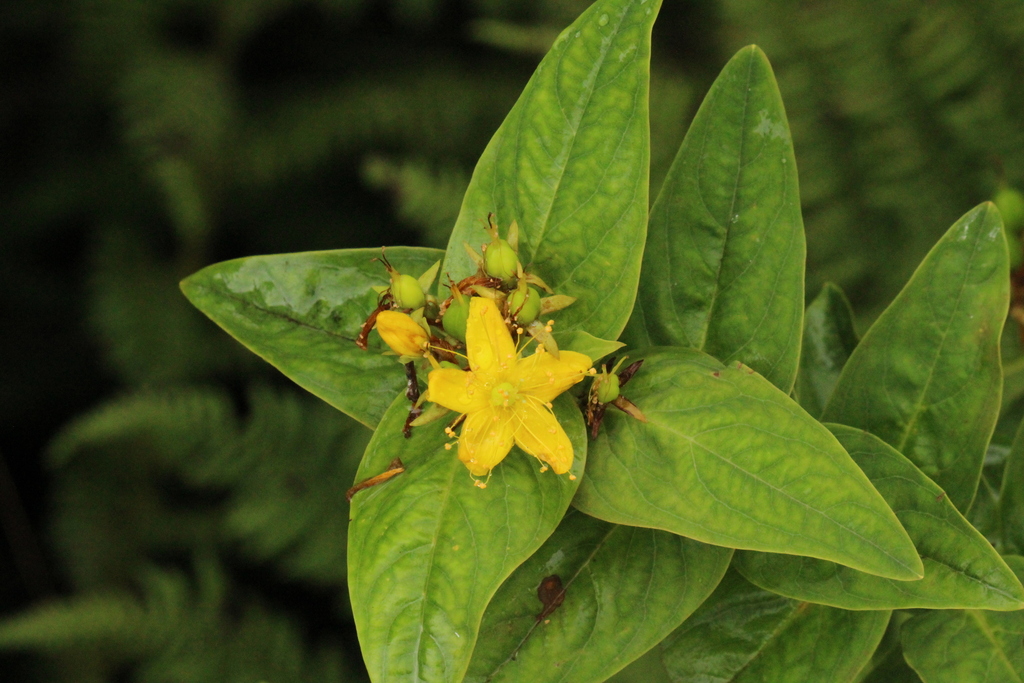
Azorean St. John's-wort
Hypericum foliosum
Hypericum foliosum, the shining St John's wort, is a species of flowering plant in the family Hypericaceae. It is a bushy shrub endemic to the Portuguese Azores Islands with golden yellow petals and many stems. The species was described by William Aiton in 1789 and was later placed into section Androsaemum of the genus Hypericum by Norman Robson in 1984. It has a diverse essential oil profile made up mostly of monoterpene hydrocarbons, and significant concentrations of various medicinally useful phenols and carotenoids. Populations of the plant are small in number, but quick to colonize cleared areas like groves, landslide areas, and volcanic ash deposits. It is parasitized by fungus and by moth species, but is not considered endangered by the IUCN. H. foliosum is used in traditional medicine on the Azores for diuretic, hepatoprotective, and antihypertensive purposes. It also has in vitro antibiotic and antioxidizing capabilities.
From the article Hypericum foliosum on Wikipedia (CC BY-SA), quoted section by section
Description
Hypericum foliosum is a perennial shrub that grows at least 50–100 centimeters (20–39 in) tall. It may be bushy, and its branches grow both upright and outwards from the center of the plant. It usually flowers in August.
Vegetative structures. The stems are notched, showing crenation, and are a yellow-brown color. The stems are flattened when the plant is young, but become more round as it matures. They are covered in bark covered in lengthwise ridges and dark pits that stand out against the lighter surface. The stem has an average width of around 0.35 cm, and there is around 2 cm of stem between leaves. When viewed in cross-section, there are four distinct rings in the stem. The outermost is a thick, reddish-brown cuticle of cork. The next two rings are an external and internal cortex containing secretory canals, vascular bundles, rows of phloem, and secondary xylem. The innermost ring is made of pith with starch grains in the cells.
The leaves are located on opposite sides of the stem and are shaped like an egg that is stretched to be longer, or similar to a lance. They are 3.5–6.0 cm (1.4–2.4 in) long and 1–3.2 cm (0.4–1.3 in) wide. Their texture is papery and they are a lighter color on the undersides. The edges of the leaf are smooth and lack notches, and the point tapers in a sharp angle. …
What it does
Hypericum foliosum is endemic to the Azores Islands in the North Atlantic, where it can be found on every island. It inhabits the laurel and juniper forests of the archipelago, especially in shady and damp areas of mountainous regions at elevations of 220–800 meters (720–2,620 ft). It also grows in stands of Pittosporum trees and is quick to inhabit volcanic ash deposits. In general, it is good at colonizing recently cleared areas like man-made clearings and landslide sites. Populations at a site are usually made up of only a few plants. Several parasites are hosted by the leaves of H. foliosum. The rust fungus Melampsora hypericorum takes the form of a pustule on the leaf, damaging the surface. Larvae of the moth Caloptilia aurantiaca mine into the leaves and later live under the folded tip of the blade. H. foliosum is not directly endangered by competition with invasive species or human actions; it was listed as Least Concern by the IUCN in 2016. However, it has been studied as a model for using micropropagation as a conservation method on the Azores. Micropropagation has previously been used in Hypericum perforatum and Hypericum canariense. A single node of the species that is propagated using this method can yield 2–4 new plants in around four months.
Wikipedia: “Ecology”
At the table
While no official pharmacological usage of Hypericum foliosum were recorded as of 2011, locals in the Azores describe the species as being used in traditional medicine in similar ways to other species in the genus. Some of these applications derive from the diuretic, hepatoprotective, and antihypertensive properties of its extract. Despite having more phenolic activity than H. undulatum and H. androsaemum, those two species are as or more common in Portuguese medicinal markets. H. foliosum has exhibited in vitro antibiotic effects on infectious bacteria like Staphylococcus aureus. Its carotenoid and phenolic oils give the plant's extract antioxidant properties. The lower parts of the plant like the stem, bark, and roots are the most effective.
Wikipedia: “Uses”
In human culture
The genus name Hypericum is possibly derived from the Greek words hyper (above) and eikon (picture), in reference to the tradition of hanging the plant over religious icons in the home. The specific epithet "foliosum" comes from the Latin word "foliosus" which refers to a leaf. In the Azores Islands, Hypericum foliosum is known as malfurada or furalha. In English, it is called the shining St John's wort.
Wikipedia: “Etymology”
Where it lives
Recorded sightings
—
geo-referenced records in GBIF, from museums, herbaria and field observers.
Drag the globe to turn it. Dots are where records exist, not a range map; darker means more records.
In the stacks
Searching the stacks…
Every page naming Hypericum foliosum in the Biodiversity Heritage Library →
This page is assembled live from iNaturalist, GBIF, Wikipedia, the Source Library and the Internet Archive. It is not yet part of the hand-edited codex. iNaturalist taxon 342998.