- Animals
- ›Arthropods
- ›Hexapods
- ›Insects
- ›Winged and Once-winged Insects
- ›Ants, Bees, Wasps, and Sawflies
- ›Narrow-waisted Wasps, Ants, and Bees
- ›Ants, Bees, and Stinging Wasps
- ›Bees and Apoid Wasps
- ›Bees
- ›Honey Bees, Bumble Bees, and Allies
- ›Apine Bees
- ›Stingless Bees
- ›New World Meliponini
- ›Tetragonisca
- ›Tetragonisca angustula
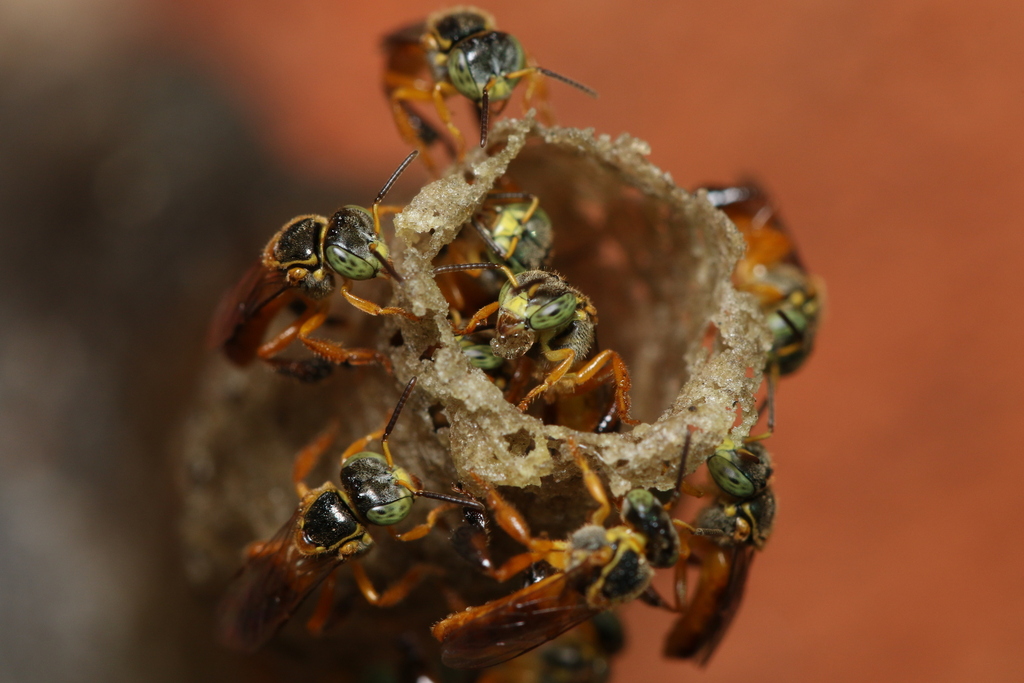
Narrow Stingless Bee
Tetragonisca angustula
Tetragonisca angustula is a small eusocial stingless bee found in México, Central and South America. It is known by a variety of names in different regions (e.g., jataí, yatei, jaty, virginitas, angelitas inglesas, españolita, mariola, ramichi, chipisas, virgencitas, and mariolitas). A subspecies, Tetragonisca angustula fiebrigi, occupies different areas in South America and has a slightly different coloration.
Tetragonisca angustula is a very small bee and builds unobtrusive nests, allowing it to thrive in urban areas. It also produces large amounts of honey, and is thus frequently kept in wooden hives by beekeepers. T. angustula hives are often overlooked, and since the bee lacks a stinger, it is not seen as a threat to humans.
From the article Tetragonisca angustula on Wikipedia (CC BY-SA), quoted section by section
Description
Tetragonisca angustula is an exceptionally small bee, about 4–5 mm. Along with all other bees in the tribe Meliponini, it is stingless and has a reduced wing venation and penicilla (bristles on the leg). The subspecies T. angustula fiebrigi has a light yellow mesepisternum, while T. angustula angustula has black. Guard bees, which make up about 1–6% of each hive, weigh more than foragers by about 30% and have smaller heads, as well as longer hind legs. Remarkable for the stingless bee clade, T. angustula has a pronounced size dimorphism between the queen and worker castes.
Wikipedia: “Description and identification”
Range & habitat
Tetragonisca angustula has a large habitat distribution across Central and South America. The species has been found as far north as Mexico and south as far as Argentina. It has been labeled "one of the most widespread bee species in the neotropics." The subspecies T. angustula fiebrigi is found more in the southern hemisphere, occupying parts of Brazil, Argentina, Paraguay and other southern countries. The subspecies T. angustula angustula has a larger presence in Brazil and is found more in the northern hemisphere, occupying Panama, Venezuela, Costa Rica, Nicaragua etc. Tetragonisca angustula distribution overlaps with many other stingless bee species, with an especially large correlation with Paratrigona subnuda distribution across Mesoamerica. In the Atlantic rainforest, deforestation for sugar cane plantations is extensive and contributes to the rarity of T. angustula in that area, as well as the stingless bee Melipona scutellaris. Nests for T. angustula are found in many different settings. Their nests are the predominant bee nests in recovering forest habitats, but are also present in structured forests, depleted forests, and urban settings. Like other stingless bees, T. angustula finds pre-existing cavities, such as holes in tree trunks, cavities in walls, or even abandoned ant or termite nests, for their new nest sites.
Wikipedia: “Distribution and habitat”
What it does
Tetragonisca angustula bees visit a large number of plants to find food. Stingless bees in general are very important in pollinating 30 to 80% of the plants in their biomes, and T. angustula is one of the most widespread stingless bees in South America. In one study in Brazil, T. angustula bees were seen at 61 different plants, 45 of them being visited by almost exclusively this species of bee. The most important food source for T. angustula is believed to be Schinus terebinthifolius in the Anacardiaceae. Plants from the Asteraceae and Meliaceae were also visited in large numbers. Pollen types from different plants vary in their size and surface texture, which makes T. angustula honey distinct compared to honey with different pollen grains.
Wikipedia: “Diet”
Listen
Looking for field recordings…
Where it lives
Recorded sightings
—
geo-referenced records in GBIF, from museums, herbaria and field observers.
Drag the globe to turn it. Dots are where records exist, not a range map; darker means more records.
In the stacks
Searching the stacks…
Every page naming Tetragonisca angustula in the Biodiversity Heritage Library →
This page is assembled live from iNaturalist, GBIF, Wikipedia, the Source Library and the Internet Archive. It is not yet part of the hand-edited codex. iNaturalist taxon 344445.