- Animals
- ›Arthropods
- ›Chelicerates
- ›Arachnids
- ›Spiders
- ›Typical Spiders
- ›Entelegyne Spiders
- ›Salticoid Spiders
- ›Jumping Spiders
- ›Typical Jumping Spiders
- ›Salticini
- ›Salticus
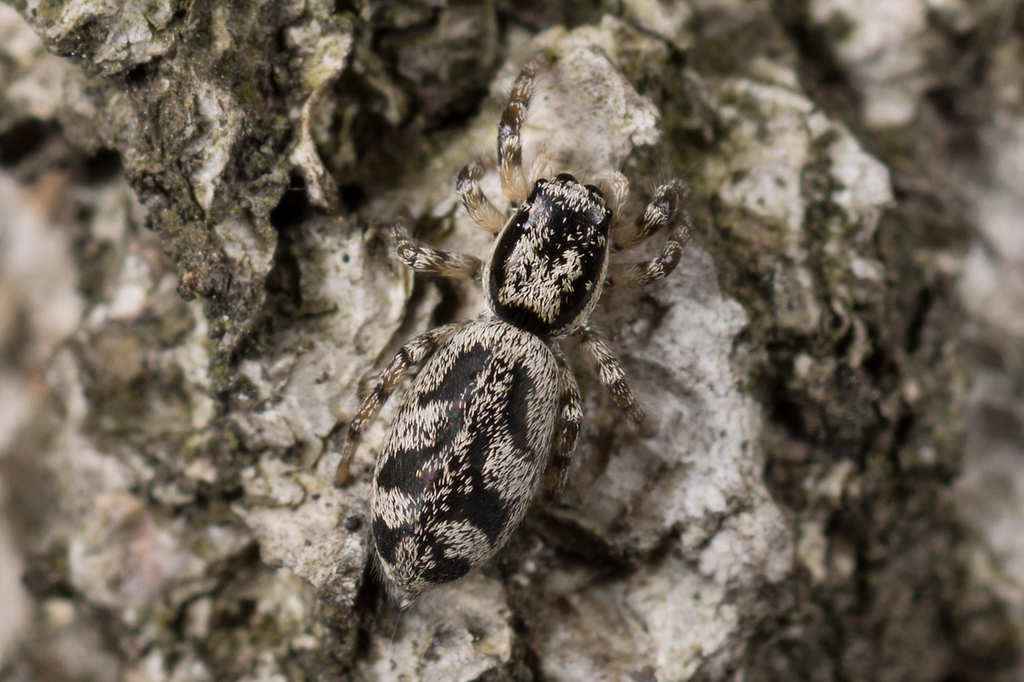
Salticus cingulatus
Salticus cingulatus is a Palearctic jumping spider of the family Salticidae.
From the article Salticus cingulatus on Wikipedia (CC BY-SA), quoted section by section
Description
The female Salticus cingulatus has a body length of 5.2–5.5 mm while the male's is 3.4–6 mm. On the male the palpal bulb is distally forked, with a long visible part. On the female the epigyne is strongly sclerotized, the anterior part opaque. The prosoma is black, with white spots, and the opisthosoma is black, but largely covered with white hairs. It is similar to Salticus scenicus but it is normally distinguished by being much paler due to more white hairs on the prosoma.
Range & habitat
The favoured habitat of Salticus cingulatus is old tree trunks and fence palings situated in sunny situations in or close to woodland, fens and heathland. It is frequently encountered on pines. It is occasionally encountered on buildings. Males are active in May and June, females mostly between May and July, but they occasionally persist until autumn.
Wikipedia: “Habitat and ecology”
Where it lives
Recorded sightings
—
geo-referenced records in GBIF, from museums, herbaria and field observers.
Drag the globe to turn it. Dots are where records exist, not a range map; darker means more records.
In the stacks
Searching the stacks…
Every page naming Salticus cingulatus in the Biodiversity Heritage Library →
This page is assembled live from iNaturalist, GBIF, Wikipedia, the Source Library and the Internet Archive. It is not yet part of the hand-edited codex. iNaturalist taxon 344761.