- Animals
- ›Arthropods
- ›Hexapods
- ›Insects
- ›Winged and Once-winged Insects
- ›Butterflies and Moths
- ›Curved-horn Moths
- ›Flat-bodied moths
- ›Depressariinae
- ›Agonopterix
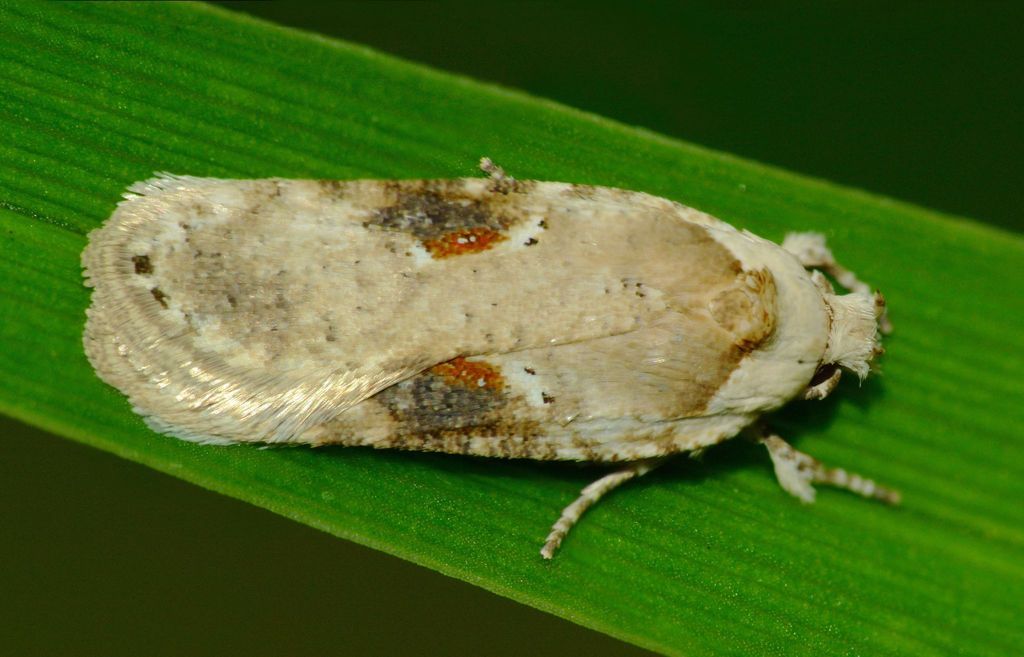
Poison hemlock moth
Agonopterix alstroemeriana
The hemlock moth (Agonopterix alstroemeriana), also known as the defoliating hemlock moth or poison hemlock moth, is a nocturnal moth species of the family Depressariidae. Of Palaearctic origin, it was first found in North America in 1973 when it was accidentally introduced. The moth is widespread throughout the northern half of the United States, southern Canada, northern Europe, and, more recently, New Zealand and Australia. The larval form grows to around 10 mm, while the adults wingspan is between 17 mm and 19 mm.
It is best known for its use in biological control of the lethal poison hemlock (Conium maculatum), which is eaten by its caterpillars (larvae). The toxicity of its host plant may actually benefit the caterpillar because it helps females recognize locations for oviposition. This species also uses the leaves of its host plant (C. maculatum) to form protective tubes around the caterpillar.
From the article Agonopterix alstroemeriana on Wikipedia (CC BY-SA), quoted section by section
Range & habitat
A. alstroemeriana is a wide-ranging species native to Europe, that has more recently spread to North America, Australian and New Zealand. In North America, it is most common to the northeastern and northwestern United States, as well as the southern regions of Canada. It has spread inland in both nations, and can now commonly be found in the Midwestern states of the U.S. as well. The first North American sighting of the hemlock moth was of a caterpillar seen in Tompkins County, New York in 1973. After that, Agonopterix alstroemeriana spread quickly throughout the United States. It was found in the Pacific Northwest in 1983–1985, possibly spread by the accidental shipping of dormant moths. The moth was seen in the Midwest starting in 1990, when it was discovered near Columbus, Ohio. It was established in Illinois in 1993, after being identified by the rolled leaves of Conium maculatum, a characteristic indication of the presence of A. alstroemeriana. The species has been breeding in New Zealand since 1986 and it is likely that the moth then spread from New Zealand to southern Tasmania, where its presence was discovered in 2019.
Wikipedia: “Range”
What it does
The effects that the alkaloids in Conium maculatum cause on the moth, both physiologically and behaviorally, are relatively unknown. Persons interested in the biological control capabilities of A. alstroemeriana see behavioral dependency on the host plant as an asset when using this moth as a biological control agent, because this reduces the possibility of the moth affecting other species besides the host plant.
Preliminary research has not found any negative physiological effects caused by the high alkaloid toxicity of poison hemlock. The moth may actually benefit from the alkaloids present in its feeding behavior.
Wikipedia: “Behavioral and physiological effects of alkaloids”
Listen
Looking for field recordings…
Where it lives
Recorded sightings
—
geo-referenced records in GBIF, from museums, herbaria and field observers.
Drag the globe to turn it. Dots are where records exist, not a range map; darker means more records.
In the stacks
Searching the stacks…
Every page naming Agonopterix alstroemeriana in the Biodiversity Heritage Library →
This page is assembled live from iNaturalist, GBIF, Wikipedia, the Source Library and the Internet Archive. It is not yet part of the hand-edited codex. iNaturalist taxon 345618.