- Animals
- ›Arthropods
- ›Hexapods
- ›Insects
- ›Winged and Once-winged Insects
- ›Butterflies and Moths
- ›Butterflies
- ›Brush-footed Butterflies
- ›Satyrs, Morphos, and Allies
- ›Alpines, Arctics, Nymphs and Satyrs
- ›Satyrina
- ›Satyrus
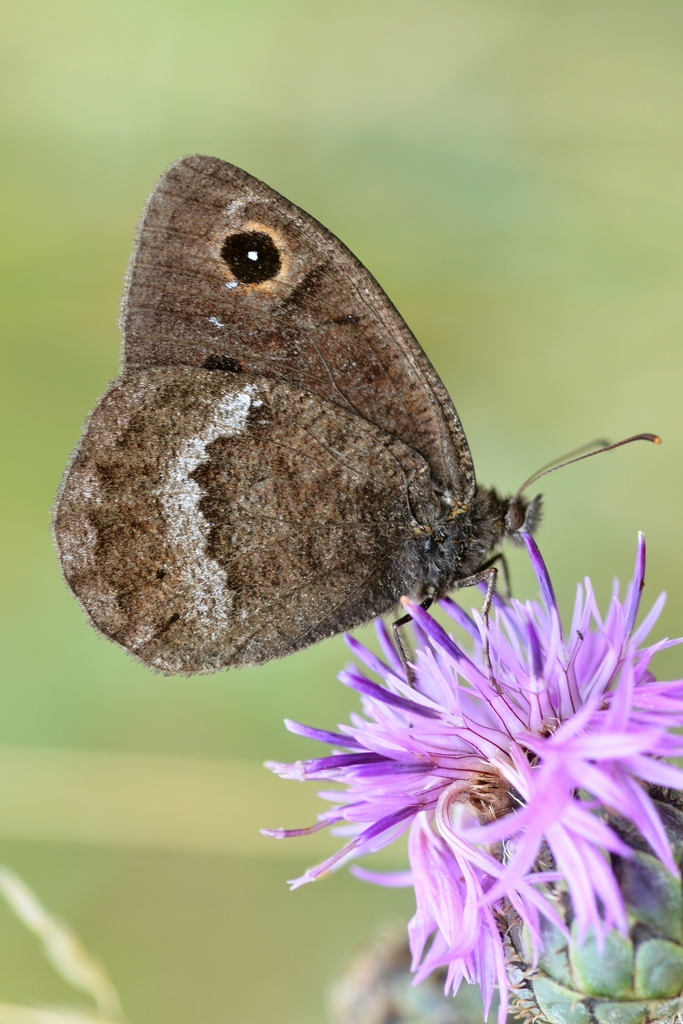
Great Sooty Satyr
Satyrus ferula
Satyrus ferula, the great sooty satyr, is a butterfly of the Nymphalidae family.
From the article Satyrus ferula on Wikipedia (CC BY-SA), quoted section by section
Description
The length of the forewings is 25 to 30 mm. This species shows an evident sexual dimorphism and the males are much more close to each other in appearance than the females. The wings of the males are usually dark brown on both surfaces, while in the female the wings are paler, with broad greyish bands on the undersides of the hindwings. On both sides of the forewings they have two-four black ocelli with white pupils, the first one much larger than the lower ones. The flight period extends from June to early September and the butterflies lay their eggs on the grass. The larvae are recorded as feeding on various grasses, including Stipa, Festuca, Bromus erectus and Deschampsia caespitosa. (Higgins, Riley, 1982)
Range & habitat
It is found in southern Europe, Morocco, Asia Minor, Iran, Kazakhstan, Central Asia, Transbaikal, western China and the Himalayas.
Wikipedia: “Distribution”
Listen
Looking for field recordings…
Where it lives
Recorded sightings
—
geo-referenced records in GBIF, from museums, herbaria and field observers.
Drag the globe to turn it. Dots are where records exist, not a range map; darker means more records.
In the stacks
Searching the stacks…
Every page naming Satyrus ferula in the Biodiversity Heritage Library →
This page is assembled live from iNaturalist, GBIF, Wikipedia, the Source Library and the Internet Archive. It is not yet part of the hand-edited codex. iNaturalist taxon 347298.