- Animals
- ›Arthropods
- ›Hexapods
- ›Insects
- ›Winged and Once-winged Insects
- ›Butterflies and Moths
- ›Fringe-tufted Moths
- ›Epermeniidae
- ›Epermenia
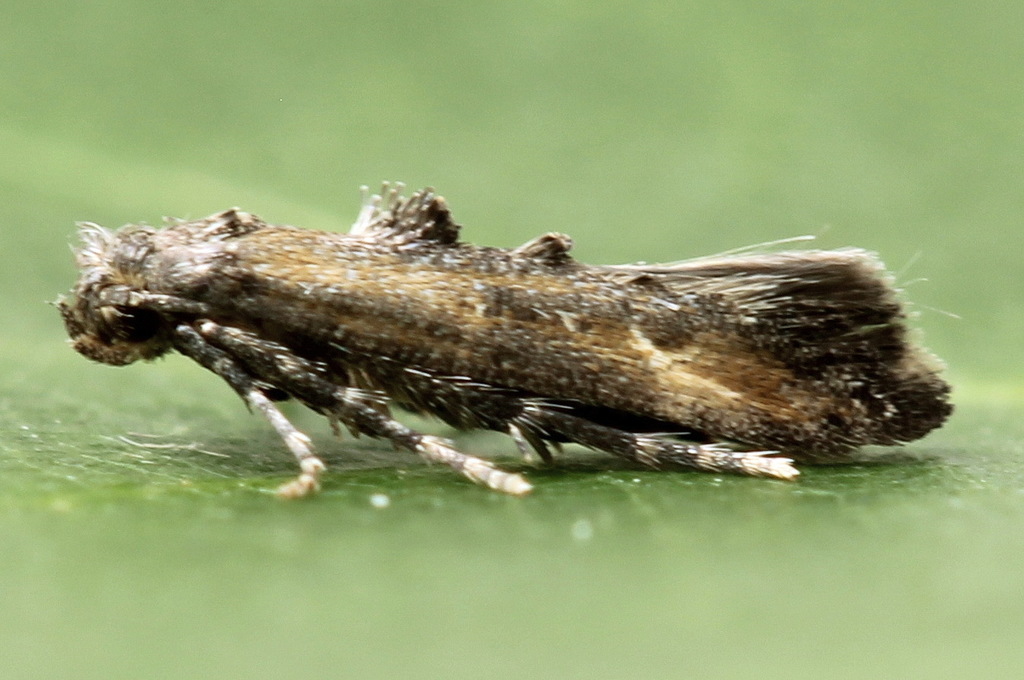
Golden Lance-wing
Epermenia chaerophyllella
Epermenia chaerophyllella, also known as the garden lance-wing, is a moth of the family Epermeniidae first described by Johann August Ephraim Goeze in 1783. It is found in all of Europe and Asia Minor.
From the article Epermenia chaerophyllella on Wikipedia (CC BY-SA), quoted section by section
Description
The wingspan is 12–14 mm. Adults are blackish, chestnut and whitish. There are two to three generations per year with the last generation of adults overwintering. Meyrick- Forewings brown, mixed with whitish and more or less sprinkled with black, on costa strigulated with black; a black inwardly oblique fascia from costa before middle, followed by a darker brown suffusion; beyond this two white dots placed longitudinally in disc, sometimes connected by a black spot; an irregular black spot on costa towards apex; four dorsal scale-teeth, first two ochreous brown, others black; dark line of cilia subfalcate at apex. Hindwings grey. Larva yellow-whitish or green-whitish; dorsal line whiter; spots brownish; head pale brown.Epermenia aequidentellus looks similar, but has narrower forewings without a hooked apex.
Ova Eggs are laid between April and September on the underside of a mature leaf of a plant from the Umbelliferae family, often near the edge. Larvae can be found from May to June and again from August to September. The body sometimes appear translucent and can be glossy white, yellow or greenish, with black or brown spots and a whitish dorsal line. The head is pale brown. There are five instars. Larva of Epermenia aequidentellus found on wild carrot (Daucus carota) have a dark dorsal line and a black head. Moths can be found in all months of the year. …
Listen
Looking for field recordings…
Where it lives
Recorded sightings
—
geo-referenced records in GBIF, from museums, herbaria and field observers.
Drag the globe to turn it. Dots are where records exist, not a range map; darker means more records.
In the stacks
Searching the stacks…
Every page naming Epermenia chaerophyllella in the Biodiversity Heritage Library →
This page is assembled live from iNaturalist, GBIF, Wikipedia, the Source Library and the Internet Archive. It is not yet part of the hand-edited codex. iNaturalist taxon 347430.