- Animals
- ›Arthropods
- ›Hexapods
- ›Insects
- ›Winged and Once-winged Insects
- ›Butterflies and Moths
- ›Owlet Moths and Allies
- ›Underwing, Tiger, Tussock, and Allied Moths
- ›Tiger Moths and Allies
- ›Tiger Moths
- ›Nyctemerina
- ›Nyctemera
- ›Nyctemera
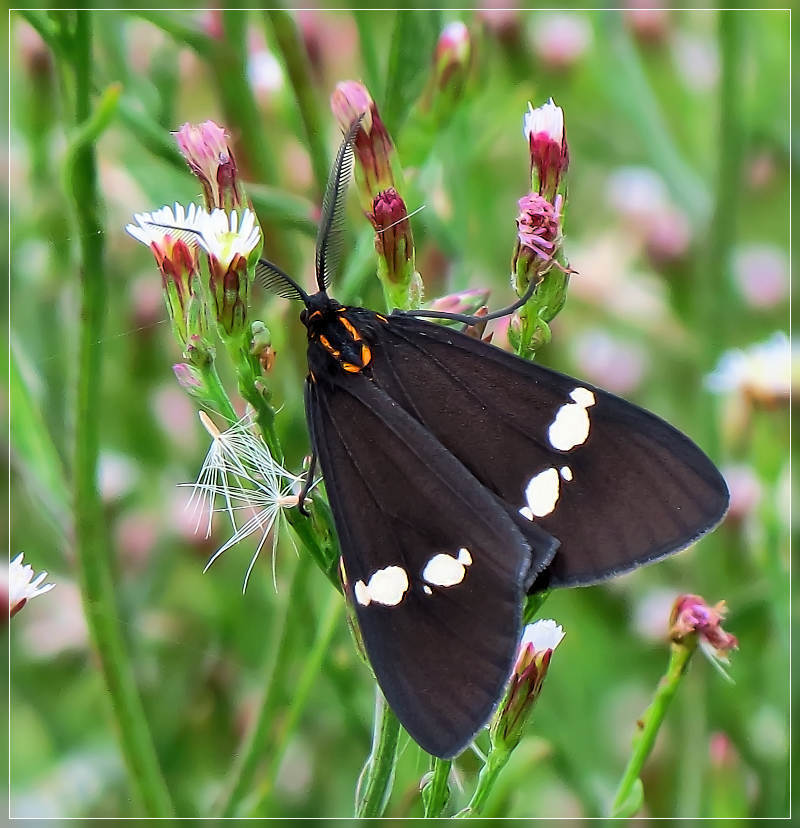
New Zealand Magpie Moth
Nyctemera annulata
Nyctemera annulata, the magpie moth, is a moth of the family Erebidae. The species was first described by Jean Baptiste Boisduval in 1832. It is endemic to New Zealand and found in all parts of the country.
From the article Nyctemera annulata on Wikipedia (CC BY-SA), quoted section by section
Description
The magpie moth's "woolly bear" caterpillars are around 35–38 mm when fully grown and predominantly black with lines of red down its sides and back, blue spots and tufts of hair on each segment. Its liking for the introduced ragwort causes its caterpillars to be sometimes misidentified as those of the cinnabar moth which was introduced as a biological control for ragwort. By contrast cinnabar caterpillars have smooth bodies with alternating yellow and black rings. The adult moth has black wings with white markings on both the forewings and hindwings. The forewings have two white spots that are more elongated while the hindwing only has a single spot near to the centre; the wingspan is 35–45 mm. The thorax and abdomen of the moth are black with bands of orange. The magpie moth is diurnal which, coupled with its colourful markings means it is often mistaken for a butterfly. It is most active from September to June in the mornings and evenings where it can be seen flying over the tops of host plants. Nyctemera annulata is closely related to Nyctemera amica, an Australian species which also occurs in New Zealand. The two species may be able to interbreed.
Range & habitat
Nyctemera annulata is found all over New Zealand, both in the North and South Islands as well as on smaller outlying islands. The N. annulata caterpillar have the ability to freeze themselves and survive. This tolerance of cold weather and freezing temperatures has ensured they are able to exist throughout New Zealand.
Wikipedia: “New Zealand range”
What it does
The life cycle of Nyctemera annulata takes 6–7 weeks to complete and requires warm weather with the winter being passed in the pupa stage. The moth will lay yellow eggs on the undersides of herbaceous Senecio species. The eggs gradually become dark and will hatch after approximately 6 – 7 days. Larvae in the first to third developmental stages (instars) feed on the surface of the underside of the leaves of the host plants and use silken threads to move to new fresh food sources or to get back to the plant should they fall off. Fourth and fifth instars feed in exposed positions on the top surface of the leaf and have well-developed setae compared to the earlier instars. The larvae will feed primarily on species from the genus Senecio and are able to migrate considerable distances to new food sources when necessary. When the caterpillar is fully grown it will be approximately 36mm long and at this stage it begins to look for a crevice in which to spin its cocoon ready for pupation to take place. Hairs from the caterpillar are incorporated into its silken cocoon. The cocoon becomes black and shiny with yellow markings and the pupa will stay like this for 12 – 35 days. The length of pupation is largely affected by temperature and the humidity also has an effect on the pupal survival. …
Wikipedia: “Life cycle/phenology”
At the table
Mokarakara is thought to be the name Māori used for N. annulata, their description being that it was a day-flying moth that was black with white spots (Miller, 1952). Lessiter (1989) recorded that Māori knew butterflies as pūrerehua and that they referred to the pupa as tūngoungou (meaning "to nod"). This was describing the pupa's abdomen as it bends back and forth and the pupae were sometimes used in a child's game. Grandparents would ask their grandchildren to hold the pupa between their thumb and forefinger and ask questions of it. An example would be "Am I a good girl?". The answer would depend on which way the pupa wriggled – up to indicate "yes" and down was for "no". There has been some research into the role of plant metabolites, particularly pyrrolizidine alkaloids that are sequestered by N. annulata. The alkaloids are produced by the plant as a defence against herbivory and the larvae of the moth take them up, potentially also as a form of defense suggested by the high levels of toxin found in the moth. This may be another reason there is not much predation of either the larvae or moth.
Wikipedia: “Cultural uses”
Listen
Looking for field recordings…
Where it lives
Recorded sightings
—
geo-referenced records in GBIF, from museums, herbaria and field observers.
Drag the globe to turn it. Dots are where records exist, not a range map; darker means more records.
In the stacks
Searching the stacks…
Every page naming Nyctemera annulata in the Biodiversity Heritage Library →
This page is assembled live from iNaturalist, GBIF, Wikipedia, the Source Library and the Internet Archive. It is not yet part of the hand-edited codex. iNaturalist taxon 348515.