- Animals
- ›Arthropods
- ›Hexapods
- ›Insects
- ›Winged and Once-winged Insects
- ›Butterflies and Moths
- ›Butterflies
- ›Brush-footed Butterflies
- ›Satyrs, Morphos, and Allies
- ›Alpines, Arctics, Nymphs and Satyrs
- ›Coenonymphina
- ›Coenonympha
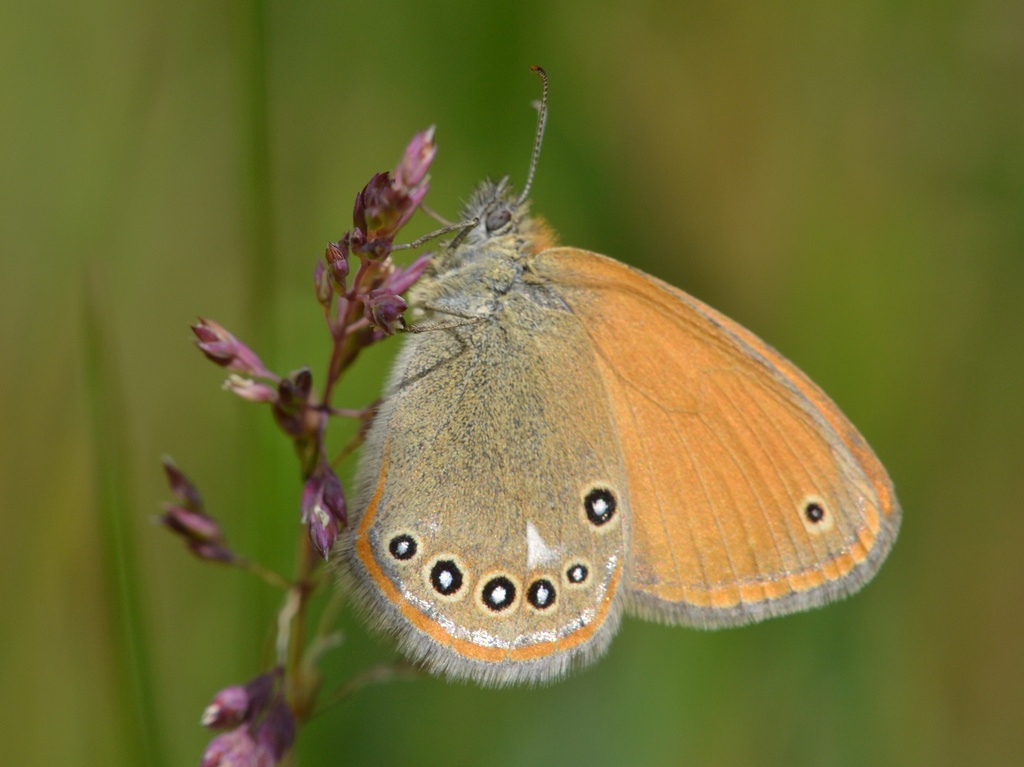
Chestnut Heath
Coenonympha glycerion
Coenonympha glycerion, the chestnut heath, is a butterfly species belonging to the family Nymphalidae. It is also known as Coenonympha iphis. It can be found in Eastern Europe and east across the Palearctic to Siberia and the Caucasus to North Korea.
From the article Coenonympha glycerion on Wikipedia (CC BY-SA), quoted section by section
Description
C. glycerion is a small orange-brown butterfly, similar in size to a small heath but with distinct eye-spots (ocelli) on its hindwing. The hindwing has several ocelli on the underside, often five or six. Beyond the middle are two large irregular white sinuous patches, either separate or thinly connected. The underside of the forewing is meanwhile either entirely without ocelli, or has a small, pale, ocellus near the tip of the wing. There is some variation between sexes: the disc of the forewing of the male on the upperside is washed with copper-brown, while that of the female is yellowish brown, in varying shades. The hindwing is uniformly blackish brown. The Larva is dull green with a blue-green head, a dark dorsal stripe, a pale lateral one, as well as a red anal fork; the spiracles yellowish red. The pupa is green with white-spotted abdomen and dark-edged wing-cases.
Range & habitat
C. glycerion is found throughout Central and a large part of Northern Europe, as well as in North and Central Asia.
Wikipedia: “Distribution”
What it does
The larvae feed on various grasses, and can be found on them through spring until May. The adult butterflies fly in one generation from June to August.
Wikipedia: “Life Cycle”
Listen
Looking for field recordings…
Where it lives
Recorded sightings
—
geo-referenced records in GBIF, from museums, herbaria and field observers.
Drag the globe to turn it. Dots are where records exist, not a range map; darker means more records.
In the stacks
Searching the stacks…
Every page naming Coenonympha glycerion in the Biodiversity Heritage Library →
This page is assembled live from iNaturalist, GBIF, Wikipedia, the Source Library and the Internet Archive. It is not yet part of the hand-edited codex. iNaturalist taxon 349275.