- Animals
- ›Chordates
- ›Vertebrates
- ›Reptiles
- ›Snakes and Lizards
- ›Snakes
- ›Elapid Snakes
- ›Australian Elapids (inc. Sea Snakes)
- ›True sea snakes
- ›Aipysurus
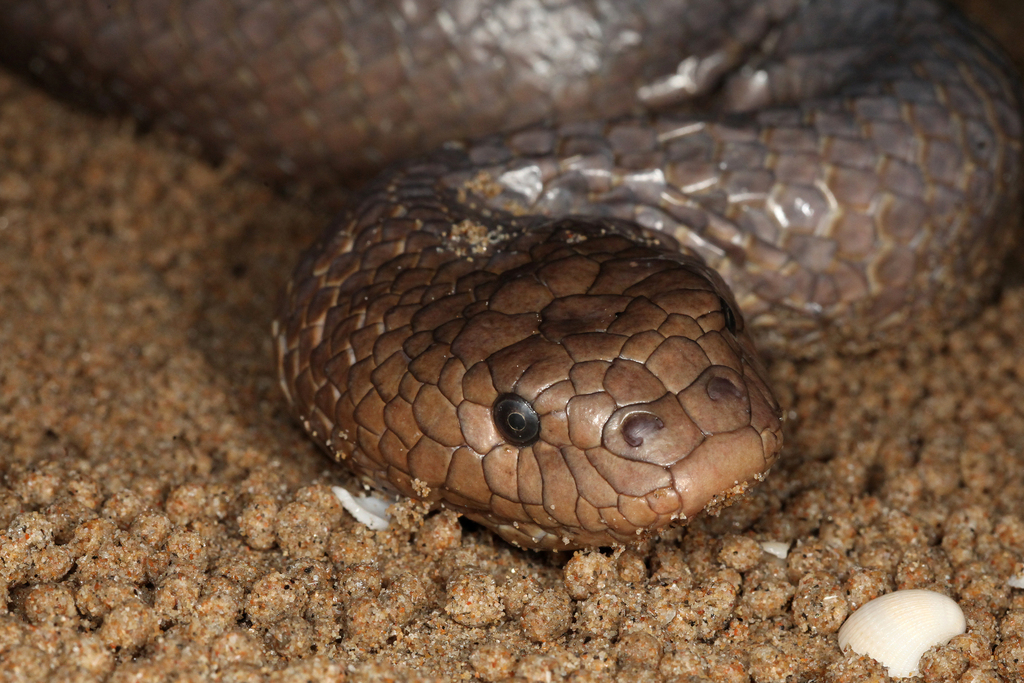
Olive Sea Snake
Aipysurus laevis
Aipysurus laevis is a species of venomous sea snake found in the Indo-Pacific. Its common names include golden sea snake, olive sea snake, and olive-brown sea snake.
From the article Aipysurus laevis on Wikipedia (CC BY-SA), quoted section by section
Description
The olive sea snake swims using a paddle-like tail. It has brownish and purple scales along the top of its body whilst its underside is a white color. It can grow up to a meter in length, and in some cases up to two meters.
Range & habitat
It is a common, widespread species that lives on coral reefs, including the Great Barrier Reef. It can be found in the tropical eastern Indian Ocean and the western Pacific Ocean, from Indonesia to New Caledonia. The snake hides in small coves or protective coral areas if not hunting or surfacing to breathe.
Wikipedia: “Distribution and habitat”
What it does
The snake feeds on crustaceans (such as crabs and prawns), fish, and fish eggs. It uses venom to incapacitate its prey. This venom is rich in enzymes that facilitate the internal breakdown of the prey, simplifying the digestion process. The venom also affects both the muscles and nerves of the prey. The snake usually hunts in coral reef areas, searching for food by poking its head into crevices. The creature usually stays away from open water as a hunting ground. Aipysurus laevis has been found to have photoreceptors in the skin of its tail, allowing it to detect light and presumably ensuring it is completely hidden, including its tail, inside coral holes during the day. While other species have not been tested, A. laevis possibly is not unique among sea snakes in this respect. Dermal light sensitivity is found in all the major animal phyla. While it can be aggressive towards prey, attacks on divers or larger animals are rare, though if provoked it will engage the attacker. The snake's main predators are sharks and ospreys.
Wikipedia: “Behavior”
In human culture
Aipysurus derives from the Greek aipys "high and steep" and oura "tail"; the term loosely meaning "high tail" was coined to denote "the laterally compressed tail that is higher than the depth of the body". Laevis, a variant form of Latin levis, means "smooth". The specific name, pooleorum (masculine, genitive plural), is in honor of Australian fishermen "W. and W. Poole" who collected the holotype.
Wikipedia: “Etymology”
Where it lives
Recorded sightings
—
geo-referenced records in GBIF, from museums, herbaria and field observers.
Drag the globe to turn it. Dots are where records exist, not a range map; darker means more records.
In the stacks
Searching the stacks…
Every page naming Aipysurus laevis in the Biodiversity Heritage Library →
This page is assembled live from iNaturalist, GBIF, Wikipedia, the Source Library and the Internet Archive. It is not yet part of the hand-edited codex. iNaturalist taxon 35260.