- Animals
- ›Chordates
- ›Vertebrates
- ›Reptiles
- ›Snakes and Lizards
- ›Snakes
- ›Elapid Snakes
- ›Australian Elapids (inc. Sea Snakes)
- ›True sea snakes
- ›Aipysurus
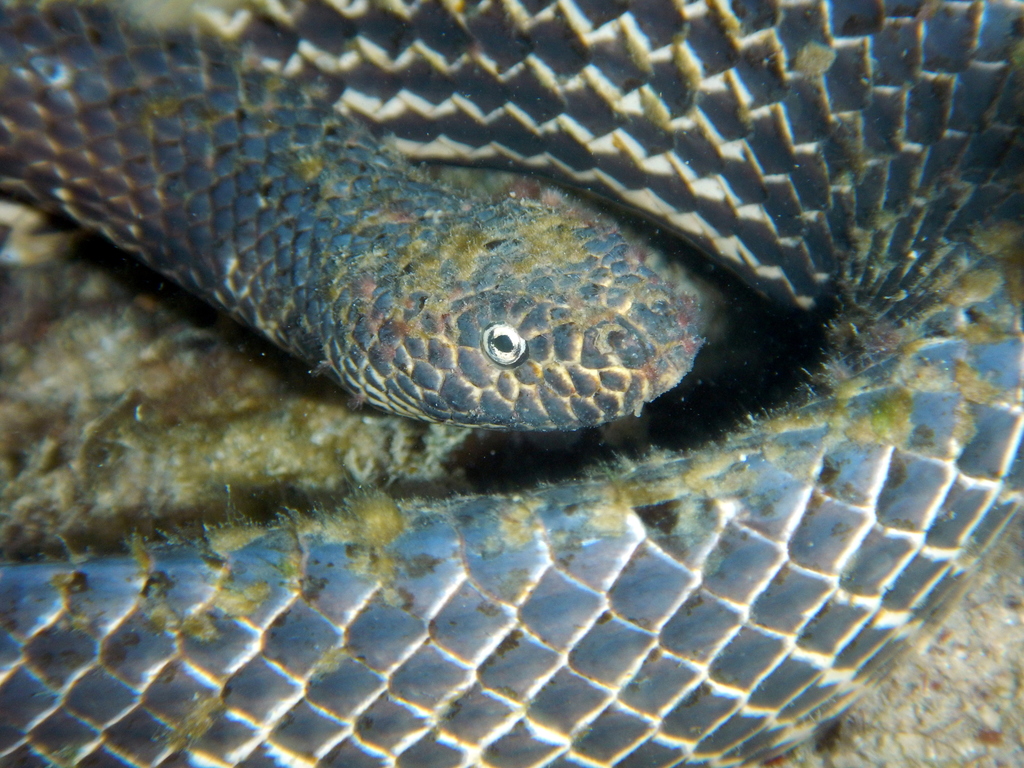
Reef Shallows Sea Snake
Aipysurus duboisii
Aipysurus duboisii, also known commonly as Dubois' sea snake and the reef shallows sea snake, is a species of extremely venomous snake in the subfamily Hydrophiinae of the family Elapidae. Its geographic range includes Papua New Guinea, New Caledonia, and the northern, eastern, and western coastal areas of Australia, that is the Coral Sea, Arafura Sea, Timor Sea, and Indian Ocean. It lives to depths of 80 m (262 ft) in coral reef flats, sandy and silty sediments, which contain seaweed, invertebrates and corals or sponges that can serve as shelter. It preys upon moray eels and various fish that live on the seafloor, up to 110 cm (3.6 ft) in size. A. duboisii is viviparous, giving birth to live young rather than laying eggs. It displays medium aggressiveness, i.e., will bite if provoked, but not spontaneously. The fangs are 1.8 mm long, which are relatively short for a snake, and the venom yield is 0.43 mg. Aipysurus duboisii is a crepuscular species, meaning that it is most active at dawn and dusk.
It is the most venomous sea snake, and one of the top three most venomous snakes in the world.
From the article Aipysurus duboisii on Wikipedia (CC BY-SA), quoted section by section
Description
Adults of A. duboisii grow up to 148 cm (4.86 ft) in total length (including tail), but usually to around 80 cm (2.6 ft). The head is slightly wider than the neck with nostrils on its upper part and nasals contacting each other. Eyes are separated from supralabial scales by a row of large subocular scales. Dorsal scales are usually smooth, but sometimes have a small keel or small knobs. Individuals vary significantly in color and body pattern. The tail is relatively long; the chin and throat have lighter color than rest of the body.
Toxicity
The acute toxicity of snake venom is conventionally tested on laboratory animals and is evaluated in terms of the median lethal dose (LD50), that is, the dose required to kill half the members of a tested population divided by the weight of the tested animal. The LD50 depends on the animal. Rabbits are about twice as sensitive to sea snake venom as mice, and fish and frogs are even more susceptible. The LD50 for subcutaneous injection of A. duboisii venom into mice is 0.044 mg/kg of body weight. This makes A. duboisii the most venomous sea snake tested, and the third-most venomous snake overall, behind the inland taipan (Oxyuranus microlepidotus, LD50=0.025 mg/kg) and the eastern brown snake (Pseudonaja textilis, LD50=0.036 mg/kg).
Wikipedia: “Venom”
In human culture
The specific name, duboisii, is in honor of Belgian naturalist Charles Frédéric Dubois.
Wikipedia: “Etymology”
Where it lives
Recorded sightings
—
geo-referenced records in GBIF, from museums, herbaria and field observers.
Drag the globe to turn it. Dots are where records exist, not a range map; darker means more records.
In the stacks
Searching the stacks…
Every page naming Aipysurus duboisii in the Biodiversity Heritage Library →
This page is assembled live from iNaturalist, GBIF, Wikipedia, the Source Library and the Internet Archive. It is not yet part of the hand-edited codex. iNaturalist taxon 35263.