- Animals
- ›Arthropods
- ›Chelicerates
- ›Arachnids
- ›Spiders
- ›Typical Spiders
- ›Entelegyne Spiders
- ›RTA Clade Spiders
- ›Huntsman Spiders
- ›Deleninae
- ›Neosparassus
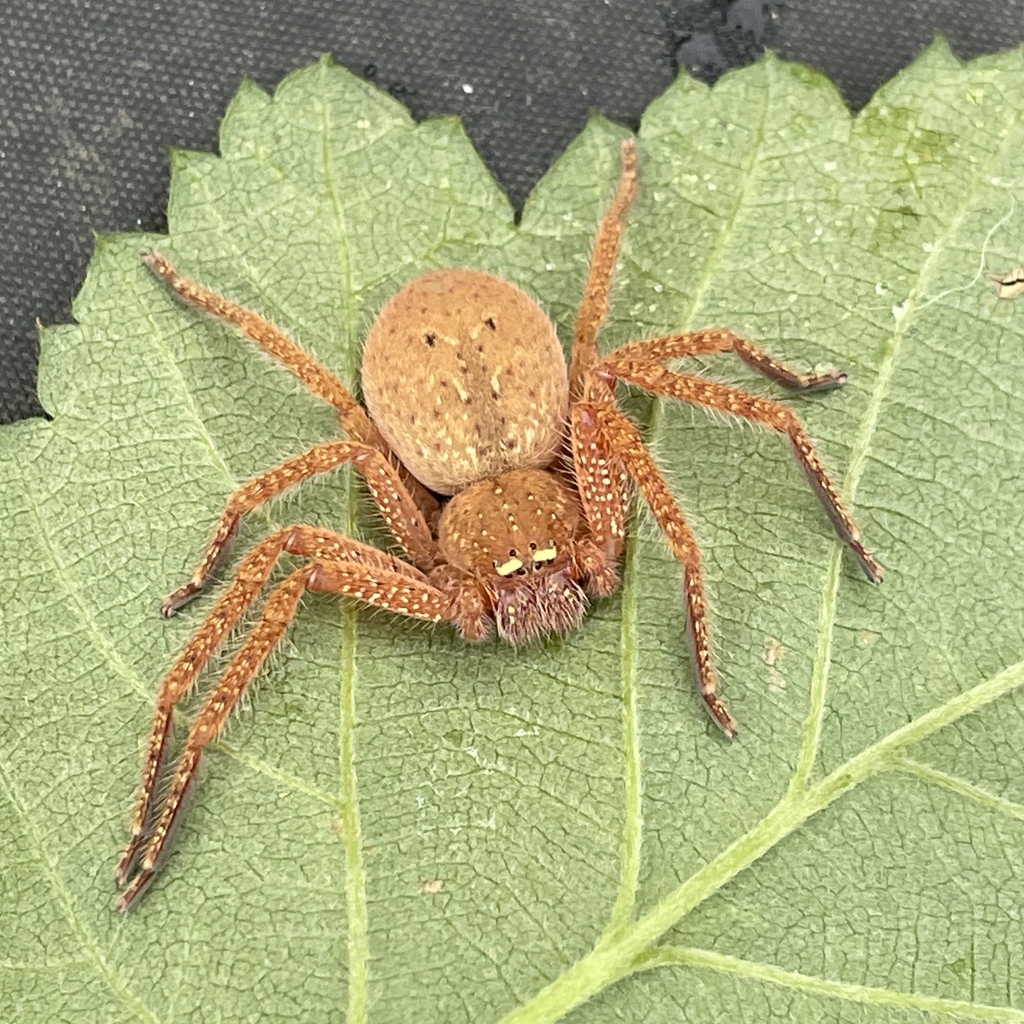
Badge Huntsman Spider
Neosparassus diana
Neosparassus diana, or the badge huntsman, is a huntsman spider native to Australia. The common name is sometimes applied to other species in the genus. N. diana is the type species of the genus.
From the article Neosparassus diana on Wikipedia (CC BY-SA), quoted section by section
Description
Like all huntsmans, the body is flattened, although to a lesser degree than in most huntsman species. Body length can be up to 20 mm in females and 16 mm in males. The front two pairs of legs are markedly longer than the back two pairs. Colour of body and legs ranges from light brown to orange to fawn, with dark brown, yellow, and white speckles on the body and legs. There is a distinctive black marking with two white spots on the underside of the abdomen; this is the "badge" referenced in their common name.
Wikipedia: “Appearance”
Range & habitat
N. diana are found throughout Australia, although they are most common in the south-east (Tasmania, Victoria, South Australia, and New South Wales), and south-west Western Australia. They are commonly found under loose bark and in small crevices.
Wikipedia: “Distribution and habitat”
What it does
N. diana are active at night, and, like all huntsmans, hunt for prey rather than making a web. They are not aggressive towards humans and will rarely bite, even when handled. Bites may be painful but only cause temporary, localised symptoms.
== References ==
Wikipedia: “Behaviour”
Where it lives
Recorded sightings
—
geo-referenced records in GBIF, from museums, herbaria and field observers.
Drag the globe to turn it. Dots are where records exist, not a range map; darker means more records.
In the stacks
Searching the stacks…
Every page naming Neosparassus diana in the Biodiversity Heritage Library →
This page is assembled live from iNaturalist, GBIF, Wikipedia, the Source Library and the Internet Archive. It is not yet part of the hand-edited codex. iNaturalist taxon 353524.