- Animals
- ›Arthropods
- ›Hexapods
- ›Insects
- ›Winged and Once-winged Insects
- ›Butterflies and Moths
- ›Lasiocampoidea
- ›Lappet Moths
- ›Lasiocampinae
- ›Pinarini
- ›Eriogaster
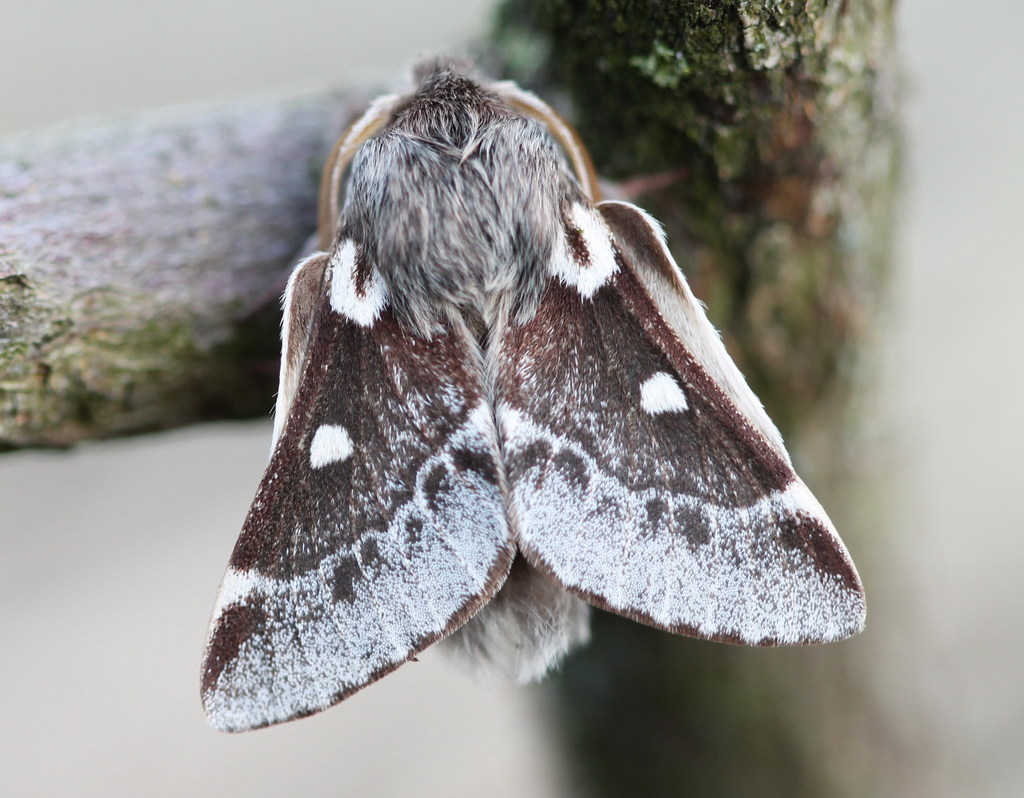
Small Eggar
Eriogaster lanestris
Eriogaster lanestris, commonly known as the small eggar, is a moth of the family Lasiocampidae that is found across the Palearctic. Unlike many other members of the Lasiocampidae, the small eggar is a social insect. Historically, only eusocial insects like ants, bees, and termites were thought to exhibit complex social organization and communication systems. However, research since the late 20th century has found that E. lanestris, among a number of other phylogenetically related moth and butterfly species, demonstrates social behaviors as well. Larvae spend nearly their entire development in colonies of about 200 individuals, and this grouped social structure offers a number of benefits, from thermoregulation to increased foraging success.
The small eggar population has been in decline since the 1970s. Landscaping practices like hedgerow cutting and intensive mowing destroy habitats and damage cocoons during pupation, leading to scattered populations and increased rarity.
From the article Eriogaster lanestris on Wikipedia (CC BY-SA), quoted section by section
Description
Small eggar moths have a wingspan of 30–40 millimeters, and females are generally larger than males. Male and female adults have a gray-brown to reddish coloration with white spotting on their upper wings, however males tend to have darker, grayer coloration than females. Additionally, males antennae are bipectinate, or feather-like. Both sexes have setae on their bodies, but females have an extra grayish tuft of hair at the base of their abdominal region. Larvae are black and hairy, developing red coloration during the later larval stages. They can reach lengths of approximately 50 mm and often have yellow coloration along the sides of their bodies throughout development.
Range & habitat
E. lanestris is found in scattered, patchy populations across the palearctic region, with most of its documentation in England, Ireland, and Wales. Due to its preference for warm, dry weather, the small eggar has a more limited range, as it cannot function properly in the cold conditions found in the northern palearctic. The moth is only active from spring to mid-summer in the temperate region of the U.K. and Ireland.
Wikipedia: “Geographic range”
What it does
E. lanestris is a highly social insect, particularly during its larval stages. Hence, small eggar larvae are categorized as gregarious caterpillars. Living in large groups may make larval colonies more apparent to visually-oriented predators, however this social structure has also allowed the small eggar to evolve a number of advantageous behaviors.
Synchronous foraging. One benefit of the grouping behavior found in E. lanestris is increased foraging efficiency, which they achieve by foraging together in a large group. Colonies of caterpillars feed several times a day, leaving their tent as a group in search of food. The exact mechanism by which larvae determine feeding times is unknown, but it likely has to do with the ability of the silk tent to transmit vibrations throughout the structure. As caterpillars mobilize to leave the tent, others are alerted by the vibrations that it is time to feed, facilitating the movement of the entire colony, allowing for synchronous foraging. Unlike many nocturnal foragers, E. lanestris feeds both during the day and at night, so it runs the risk of detection by visually-oriented predators during daytime foraging forays. …
Wikipedia: “Social behavior”
At the table
The small eggar only feeds during its larval stages of development, consuming leaves of blackthorn, hawthorn, and birch. Due to their high water and nitrogen content, young leaves, rather than more mature ones, are preferred by caterpillars. Caterpillars hatch around the time of leaf emergence in order to maximize feeding while leaves are still young and nutritious. The small eggar is a central-place forager, meaning it returns to the same nesting site after each foraging trip. This allows colonies of larval E. lanestris to communicate where the best feeding sites are located. However, as colonies develop, the closest food resources become too mature or are depleted, so caterpillars must venture further and further from their central site to feed.
Wikipedia: “Food resources”
Listen
Looking for field recordings…
Where it lives
Recorded sightings
—
geo-referenced records in GBIF, from museums, herbaria and field observers.
Drag the globe to turn it. Dots are where records exist, not a range map; darker means more records.
In the stacks
Searching the stacks…
Every page naming Eriogaster lanestris in the Biodiversity Heritage Library →
This page is assembled live from iNaturalist, GBIF, Wikipedia, the Source Library and the Internet Archive. It is not yet part of the hand-edited codex. iNaturalist taxon 354736.