- Animals
- ›Arthropods
- ›Hexapods
- ›Insects
- ›Winged and Once-winged Insects
- ›Butterflies and Moths
- ›Butterflies
- ›Skippers
- ›Spread-wing Skippers
- ›Checkered-Skippers, White-Skippers, and Allies
- ›Pyrgus
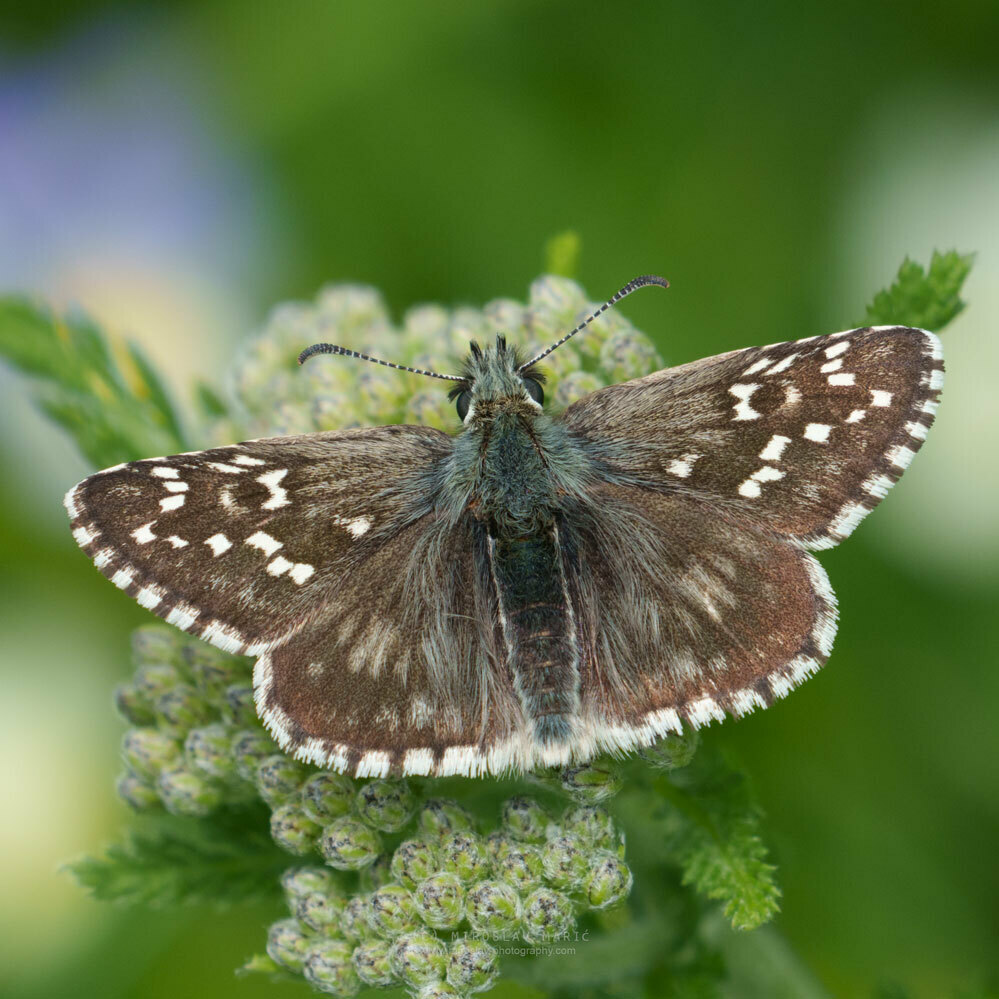
Olive Skipper
Pyrgus serratulae
The olive skipper (Pyrgus serratulae) is a species of skipper (family Hesperiidae). It is a species of the mountainous areas of Europe but is absent from the British Isles and Scandinavia.
From the article Olive skipper on Wikipedia (CC BY-SA), quoted section by section
Description
This is a relatively distinctive species by the standards of the genus, the upperside tending to be plainer than most of its congeners with only tiny white marks on the forewings and almost unmarked on the hindwings. The underside is usually mostly olive-green with paler markings. An oval basal spot on the underside of the hind wing is a mostly well-developed feature. Alpine individuals often have a strong, almost completely reduced pattern of bright points on the upper side of the wing. The wingspan is 24–28 mm which means that Pyrgus serratulae is a medium-sized Pyrgus species. Basically, there is a great possibility of confusion with butterflies of the Pyrgus alveus complex, which can also occur syntopically with P. serratulae, as well as the other species of the genus Pyrgus. Safe separation is possible through the genitals.
Range & habitat
It is a species of the mountainous areas of Europe but is absent from the British Isles and Scandinavia. P. serratulae is distributed from the southern European mountains through western, central and eastern Europe via south-western Siberia to Mongolia and northern China. In addition, Asia Minor, Transcaucasia as far as north-west Iran and north-east Iraq are populated. In north-west Germany the occurrences reach as far as East Westphalia and in north-east Germany to the vicinity of the Baltic Sea.
Wikipedia: “Range”
What it does
The adults are on the wing in July and August. The phenology of Pyrgus serratulae differs over a long period of time due to its wide altitude distribution. While the flight time in the Alps begins from mid-June (in above-average warm springs from the beginning of June) with the peak in July and numerous records still in August to the beginning of September, the imagos appear in the lower elevations of northern Bavaria a month earlier, usually in May (in very warm springs from the end of April) with a focus on June. The last imagos can be found in some years until the end of July. The imagos of Pyrgus serratulae obviously orient themselves optically on smaller or larger rocks, rock edges or banks or on other open ground structures. The oviposition takes place in very gappy or vegetation-poor locations, usually on individually standing cinquefoil plants. Proven caterpillar forage plants are Potentilla tabernaemontani [= Potentilla neumanniana, Potentilla verna], Potentilla heptaphylla, Potentilla recta, Potentilla aurea, Potentilla crantzii, Potentilla hirta, Potentilla pusilla, Potentilla reptans, Sibbaldia montanumbens and Heliantum reptanumbens. The eggs are deposited individually on the underside of the leaves. As the oviposition observations and caterpillar finds show, larval development takes place in full sun and quickly warming locations. …
Wikipedia: “Ecology”
In human culture
"Serratula" As with most Pyrgus species, the plant genus mentioned in the species name has nothing to do with the caterpillar's diet.
Wikipedia: “Etymology”
Listen
Looking for field recordings…
Where it lives
Recorded sightings
—
geo-referenced records in GBIF, from museums, herbaria and field observers.
Drag the globe to turn it. Dots are where records exist, not a range map; darker means more records.
In the stacks
Searching the stacks…
Every page naming Pyrgus serratulae in the Biodiversity Heritage Library →
This page is assembled live from iNaturalist, GBIF, Wikipedia, the Source Library and the Internet Archive. It is not yet part of the hand-edited codex. iNaturalist taxon 357291.