- Animals
- ›Arthropods
- ›Chelicerates
- ›Arachnids
- ›Spiders
- ›Typical Spiders
- ›Entelegyne Spiders
- ›Salticoid Spiders
- ›Jumping Spiders
- ›Typical Jumping Spiders
- ›Plexippini
- ›Harmochirina
- ›Harmochirus
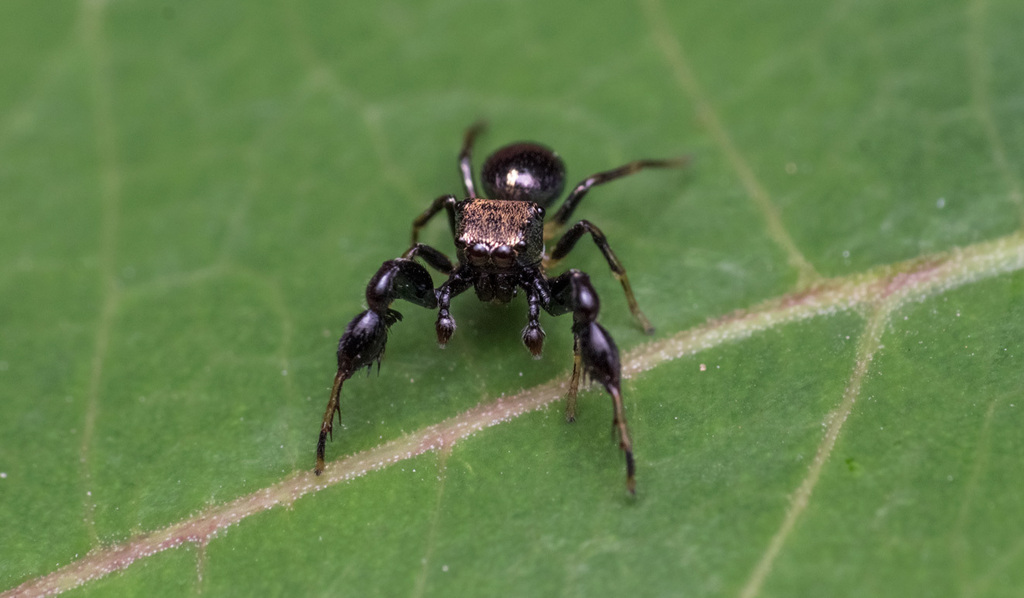
Harmochirus brachiatus
Harmochirus brachiatus is a species of jumping spider in the family Salticidae. It is the type species of the genus Harmochirus and is widely distributed across Asia.
From the article Harmochirus brachiatus on Wikipedia (CC BY-SA), quoted section by section
Description
Harmochirus brachiatus exhibits the characteristic appearance typical of the genus Harmochirus. The species shows significant sexual dimorphism, with males being particularly distinctive.
Male. Males have a flat eye field that is rhomboidal in shape and broadest at the posterior lateral eyes. The thoracic portion of the carapace is steep and almost vertical. The abdomen is oval and relatively short, approximately as long as the carapace, with the dorsal surface covered by a dark scutum. The most striking feature of males is their enlarged first pair of legs, which have long, broad femora, patellae, and ovoid tibiae that contrast sharply with the thin, elongated metatarsi and tarsi. The width of the tibiae is further enhanced by rows of long, dense black setae. The male palpus has a nearly round bulbus, except for the anterior portion which is flattened transversally. The tibial apophysis is approximately as long as the bulbus, relatively narrow throughout its length, and gently curved upward without basal broadening.
Female. Females are less distinctive than males but can be identified by their epigyne structure. The epigyne has a complex internal structure with complicated copulatory ducts. The sclerotized ducts form broad, flattened loops before connecting to spherical, apparently two-chambered spermathecae. …
Range & habitat
H. brachiatus has a wide Asian distribution, having been recorded from India, Bhutan, Bangladesh, China, Taiwan, Korea, Thailand, Vietnam, Malaysia, and Indonesia. The species appears to be particularly common in Southeast Asia, where it has been extensively studied in countries such as the Philippines, Indonesia, and Malaysia.
Wikipedia: “Distribution”
What it does
H. brachiatus plays an important ecological role as a predator in agricultural ecosystems, particularly in rice cultivation systems across Asia. The species has been extensively documented as a beneficial predator that helps control pest insects in rice fields.
== References ==
Wikipedia: “Ecology”
Where it lives
Recorded sightings
—
geo-referenced records in GBIF, from museums, herbaria and field observers.
Drag the globe to turn it. Dots are where records exist, not a range map; darker means more records.
In the stacks
Searching the stacks…
Every page naming Harmochirus brachiatus in the Biodiversity Heritage Library →
This page is assembled live from iNaturalist, GBIF, Wikipedia, the Source Library and the Internet Archive. It is not yet part of the hand-edited codex. iNaturalist taxon 358015.