 NL·0302
Herbarium of the Nature Library
- Name
- Chrysochroa fulgidissima
- Family
- Buprestidae
- Native to
- Japan, Korea, Taiwan and parts of eastern China
- Habitat
- Temperate broadleaf forest, Parks and temple groves
Japanese jewel beetle
Chrysochroa fulgidissima
Also calledTamamushi (Japanese) · Bidan-beolle (Korean) · Jídīng chóng (Chinese, jewel beetles generally)
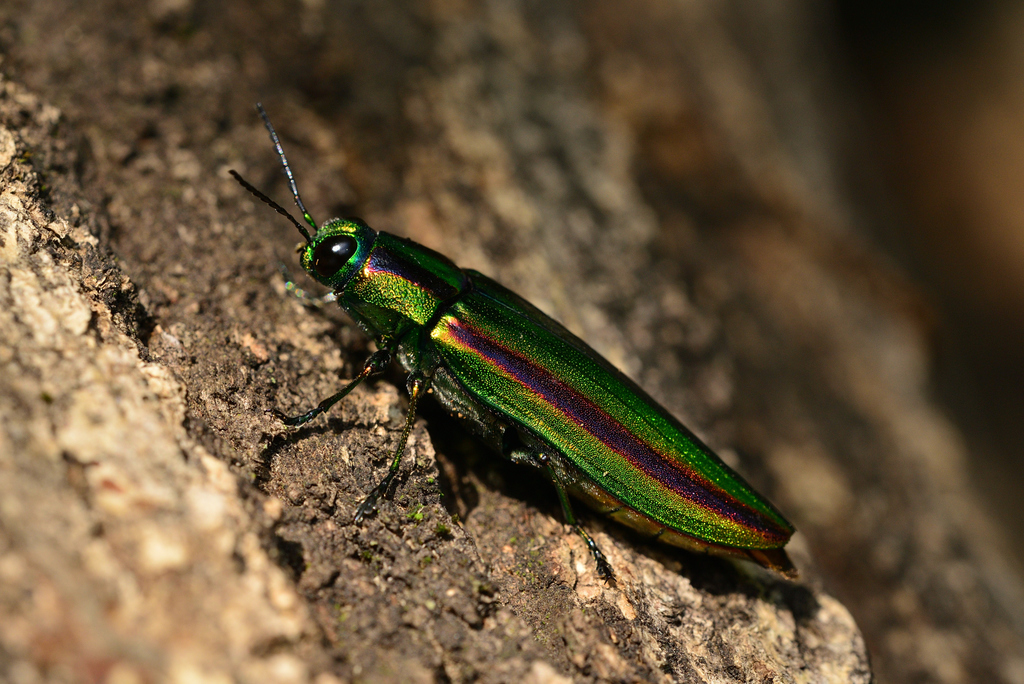
A brilliant metallic-green jewel beetle with rainbow stripes, whose colour comes from structure rather than pigment and never fades. Its wing cases decorate a 7th-century Buddhist shrine in Japan.
Chrysochroa fulgidissima, "jewel beetle" or Yamato tamamushi in Japanese (ヤマトタマムシ) is a metallic woodboring beetle of the family Buprestidae. Wikipedia
What it can do
- iIridescent colour produced by microscopic layers in the cuticle, so it lasts for centuries
- iiLarvae bore into dead and dying wood
- iiiAdults fly in bright sunshine around the tops of tall trees
In the field
Field marks
- aElongated, bullet-shaped beetle
- bBrilliant metallic green body
- cTwo purple-red stripes running the length of the wing cases and thorax
- dFlight high around tree crowns in sunshine
- Not to be confused with
- Other Chrysochroa jewel beetles of Southeast Asia and the Ryukyus (e.g. C. alternans) differ in the colour and pattern of their stripes and in range.
- Where to see it
- Temple and shrine groves and parks in Japan with old zelkova and hackberry trees.
- When
- Adults June–August, peaking in late July
Listen
Looking for field recordings…
Life & habits
- Diet
- Adults eat leaves of Zelkova, hackberry (Celtis) and cherry; larvae feed in the dead wood of these and other broadleaves
- Habitat
- Broadleaf woods, shrine and temple groves, and parks with old trees
- Size
- About 3–4 cm
On hot summer days adults circle the crowns of tall zelkova and hackberry trees, flashing green in the sun.
Where it lives
Recorded sightings
—
geo-referenced records in GBIF, from museums, herbaria and field observers.
Native range
Japan, Korea, Taiwan and parts of eastern China
Drag the globe to turn it. Dots are where records exist, not a range map; darker means more records.
In the stacks
Searching the stacks…
Every page naming Chrysochroa fulgidissima in the Biodiversity Heritage Library →
Marginalia
The Tamamushi Shrine at Hōryū-ji, Nara, made in the 7th century, was originally decorated with thousands of these beetles' wing cases set under its metal openwork. Wings of jewel beetles also adorned horse harness from 5th-century Silla tombs in Korea.
Curiosity
Because the colour is made by stacked nanoscale layers rather than pigment, the beetle wings on the 1,300-year-old Tamamushi Shrine can still shimmer where they survive.
Kinship




Fact-checked: 1 correction made to this sheet. Photographs: iNaturalist contributors under the licences shown. Records: GBIF.org. Historical plates: Source Library (CC BY-SA 4.0; originals public domain). Summary text: Nature Library editors and Wikipedia (CC BY-SA). Medicinal and edibility notes are historical and educational, not advice. iNaturalist taxon 360062.