- Animals
- ›Arthropods
- ›Hexapods
- ›Insects
- ›Winged and Once-winged Insects
- ›Butterflies and Moths
- ›Butterflies
- ›Gossamer-winged Butterflies
- ›Blues
- ›Typical Blues
- ›Polyommatina
- ›Polyommatus
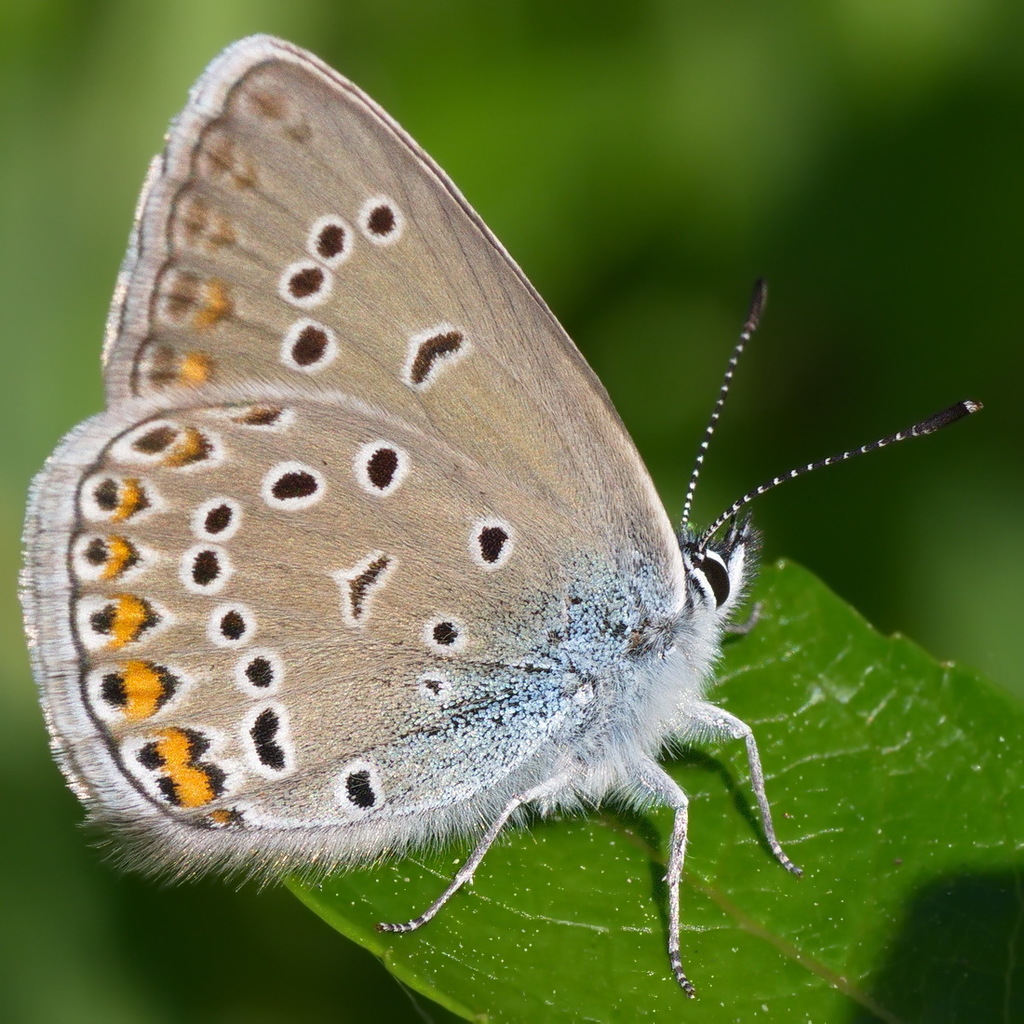
Amanda's Blue
Polyommatus amandus
Polyommatus amandus, the Amanda's blue, is a butterfly of the family Lycaenidae. It is found in the Palearctic ecozone.
From the article Polyommatus amandus on Wikipedia (CC BY-SA), quoted section by section
Description
With a wingspan of 29 to 35 mm (1.1 to 1.4 in), Amanda's blue is noticeably larger than most of the "blue" butterflies, which is particularly apparent when they are flying. The upperside of the male's wings is a silvery blue or sky blue, often, but not always, with a broad dark border and a narrow black marginal line with an outermost white line. The upperside of the female's wings is in some populations dark blue edged with brown but in other populations is medium brown with a row of orange half-moon shaped lunules near the edges. The hind margin has red blotches. The underside of the male's wings are light grey with white-edged black blotches. The underside of the female's wings is similar but they are a rich creamy-brown colour with red blotches, especially on the margins of the hindwings and a series of black spots with white rims, often touching, forming a row parallel to the margin of the wings. The basal areas of the underwings are turquoise. The wingspan is 28 to 36 mm (1.1 to 1.4 in).
Range & habitat
Amanda's blue is native to much of central and northern Europe and across the Palearctic to the Russian Far East. Its habitat is meadows, heaths, grassland, roadsides and other open areas and places where the larval food plants grow and usually at altitudes of at least 1,000 metres (3,300 ft).
Wikipedia: “Distribution and habitat”
What it does
This butterfly flies from May to August. The larvae feed on species of vetch, often meadow vetchling (Lathyrus pratensis) and tufted vetch (Vicia cracca). The males fly around near the host plants waiting for females to arrive. The females lay their eggs singly on the leaves of the host plant. The caterpillars have glands which secrete a sugary fluid that attracts ants and the presence of these protects the larvae from predators.
== References ==
Wikipedia: “Life cycle”
Listen
Looking for field recordings…
Where it lives
Recorded sightings
—
geo-referenced records in GBIF, from museums, herbaria and field observers.
Drag the globe to turn it. Dots are where records exist, not a range map; darker means more records.
In the stacks
Searching the stacks…
Every page naming Polyommatus amandus in the Biodiversity Heritage Library →
This page is assembled live from iNaturalist, GBIF, Wikipedia, the Source Library and the Internet Archive. It is not yet part of the hand-edited codex. iNaturalist taxon 362078.