- Plants
- ›Vascular Plants
- ›flowering plants
- ›monocots
- ›palms, bullanocks, and allies
- ›palms
- ›Calamoideae
- ›Lepidocaryeae
- ›Raphia
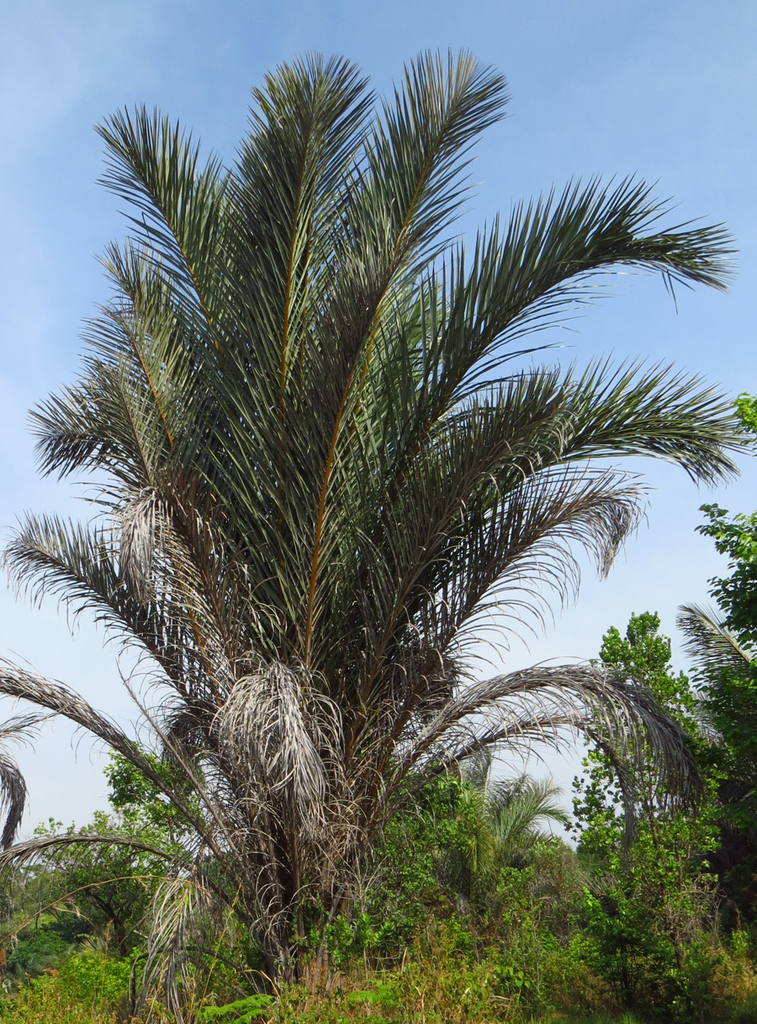
Raphia farinifera
Raphia farinifera is a tropical African palm tree occurring in lowland riparian and swamp forest, also around human habitations and cultivated locations, on stream banks and other moist situations at altitudes of 50–1000 m. Found in Angola, Benin, Burkina Faso, Cameroon, Gambia, Ghana, Guinea, Ivory Coast, Kenya, Madagascar, Malawi, Mauritius, Mozambique, Nigeria, Réunion, Senegal, Seychelles, Sierra Leone, Tanzania, Togo, Uganda, Zambia and Zimbabwe, and naturalised in east lowlands of Madagascar. Its generic epithet is derived from raphis = 'needle', probably in reference to the 4 mm long yellowish spines on the margins and main veins of the leaflets. The specific name refers to a type of starchy flour obtained from the trunk pith – farina = 'flour', fera = 'bearing'.
It is one of 26 species of the genus Raphia currently recognised, all native to Africa and Madagascar, with one species, R. taedigera also found in Central and South America. Their fronds, botanically a single leaf, are among the longest in the plant kingdom, those of R. regalis reaching a length of 25 m.
From the article Raphia farinifera on Wikipedia (CC BY-SA), quoted section by section
At the table
This species is strongly associated with human migration throughout the tropics, leaves being used for thatching, the leaflets for plaiting, and the midribs being a useful material for hut construction, furniture, fences, sweeping-brushes, floats for fishing nets, ladders and poles. The epidermis on the upper surfaces of young leaflets yields raffia, a strong, commercially important fibre, used as cordage in horticulture and handicrafts, and in weaving hats, baskets, mats, shoes, bags, fishing nets, hammocks, curtains and textiles. The midveins of the leaflets are used to construct fishing nets and articles for domestic use. The terminal portion of the core is eaten as a vegetable. The young inflorescences are tapped for a sugary sap which lessens flowering and hastens death. The sap is turned into palm wine, and either further distilled into strong alcohol or used as baking yeast. Fruit pulp is also turned into an alcoholic beverage. Oil extracted from the mesocarp (24%) and seed (1%), and sometimes marketed as 'bamboo oil', produces raphia butter, and soap and stearin. The hard outer shell of the fruit is used for making snuffboxes and buttons, or simply for ornamentation. Wax derived from the lower surfaces of the leaflets is turned into floor and shoe polish, and candles. …
Wikipedia: “Uses”
Where it lives
Recorded sightings
—
geo-referenced records in GBIF, from museums, herbaria and field observers.
Drag the globe to turn it. Dots are where records exist, not a range map; darker means more records.
In the stacks
Searching the stacks…
Every page naming Raphia farinifera in the Biodiversity Heritage Library →
This page is assembled live from iNaturalist, GBIF, Wikipedia, the Source Library and the Internet Archive. It is not yet part of the hand-edited codex. iNaturalist taxon 362997.