- Plants
- ›Vascular Plants
- ›flowering plants
- ›monocots
- ›palms, bullanocks, and allies
- ›palms
- ›Calamoideae
- ›Calameae
- ›Calamus
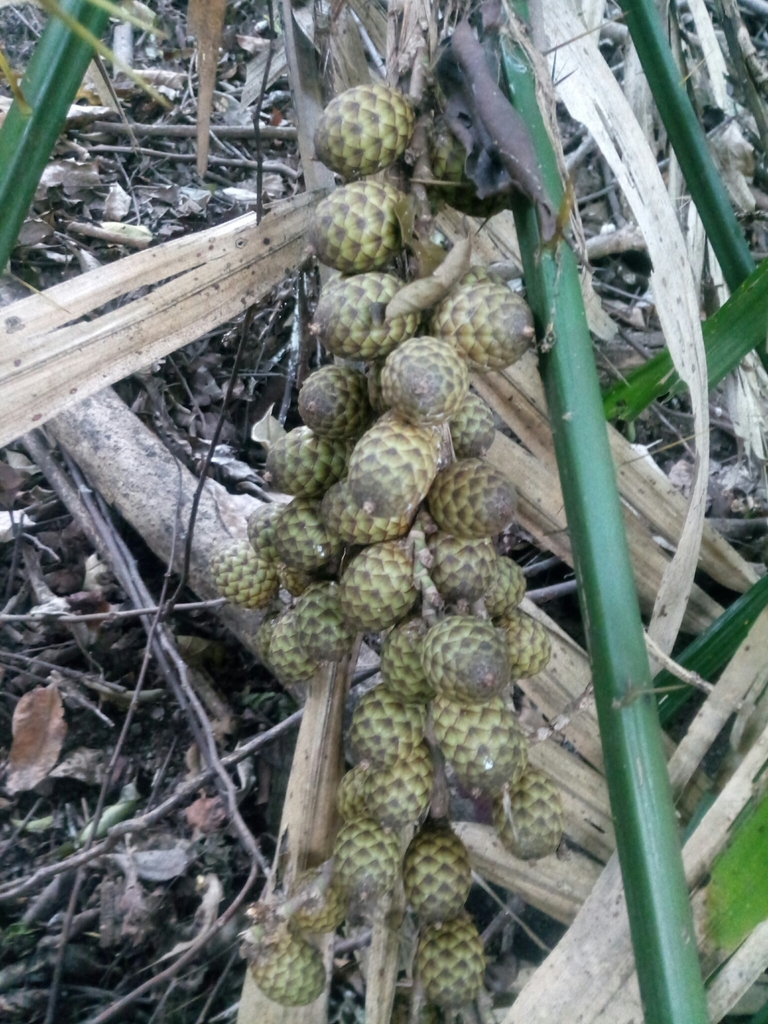
tynriew
Calamus erectus
Calamus erectus, also known as viagra palm and locally as tynriew, tara, and zhi li sheng teng, is a flowering shrub in the family Arecaceae. The specific epithet (erectus) refers to the plant's habit of growing straight rather than creeping or climbing like many species of the genus Calamus.
From the article Calamus erectus on Wikipedia (CC BY-SA), quoted section by section
Description
Calamus erectus is a rattan palm, though unlike most rattans, does not climb but rather grows straight, reaching heights of up to 3 meters (9.8 feet). It has weakly clustering stems which measure up to 6 meters (20 feet) in length and 5 centimeters (2.0 inches) in diameter. The rachis bear up to 40 narrow leaves on each side, which are regularly arranged and slightly curved. They measure 60–80 centimeters (24–31 inches) in length and 3.5–5 centimeters (1.4–2.0 inches) in width. The veins are adaxial and abaxial and the margin is bristly. The stems may be upright or leaning. The leaf sheaths are dark green in color and are covered in dark brown hairs and have short rows of brown, flattened spines which measure up to 3.5 centimeters (1.4 inches) in length. Ocreas are present and have rows of short spines split into two. Knees, flagella, and cirri are absent. The petioles and rachis have whorls of yellow to white spines. The rachis measure up to 3 meters (9.8 feet) in length and the petiole measures 1.5 meters (4.9 feet) in length. The inflorescences measure up to 2 meters (6.6 feet) in length and are not flagellate. The bracts of the inflorescences are tubular and are tattering at the tip. The calyx of the flower is 3-lobed and the lobes are apiculate, and the corolla is 3-petaled. …
Range & habitat
Calamus erectus is native to Northeast India, Nepal, Bhutan, Bangladesh, Myanmar, Thailand, Laos, and the Chinese province of Yunnan. It has been introduced to the United States. It grows wild in lower hill forests, especially on drier slopes, and is found frequently in the Tista and Rangit valleys. It also grows in lowland and montane rainforests or drier forests, especially on steep slopes, up to 1,400 meters (4,600 feet) in elevation.
Wikipedia: “Distribution and habitat”
At the table
Although the canes are not useful for making furniture due to the short internodes, the Mising people of the Assam plains sometimes use the canes and leaves to make huts and chicken coops. The fruits are sometimes used in folk medicine, as they are believed to hold antioxidant and anti-diabetic properties. The fruit is also central to the lunar new year celebrations practiced by the Meitei people, where it is offered to the deities of the Sanamahism religion. The young shoots and leaves are sometimes eaten as a vegetable. In Bangladesh, the seeds are sometimes chewed as an alternative to betel nuts.
Wikipedia: “Uses”
Where it lives
Recorded sightings
—
geo-referenced records in GBIF, from museums, herbaria and field observers.
Drag the globe to turn it. Dots are where records exist, not a range map; darker means more records.
In the stacks
Searching the stacks…
Every page naming Calamus erectus in the Biodiversity Heritage Library →
This page is assembled live from iNaturalist, GBIF, Wikipedia, the Source Library and the Internet Archive. It is not yet part of the hand-edited codex. iNaturalist taxon 364900.