- Plants
- ›Vascular Plants
- ›flowering plants
- ›monocots
- ›palms, bullanocks, and allies
- ›palms
- ›Coryphoideae
- ›Phoeniceae
- ›Phoenix
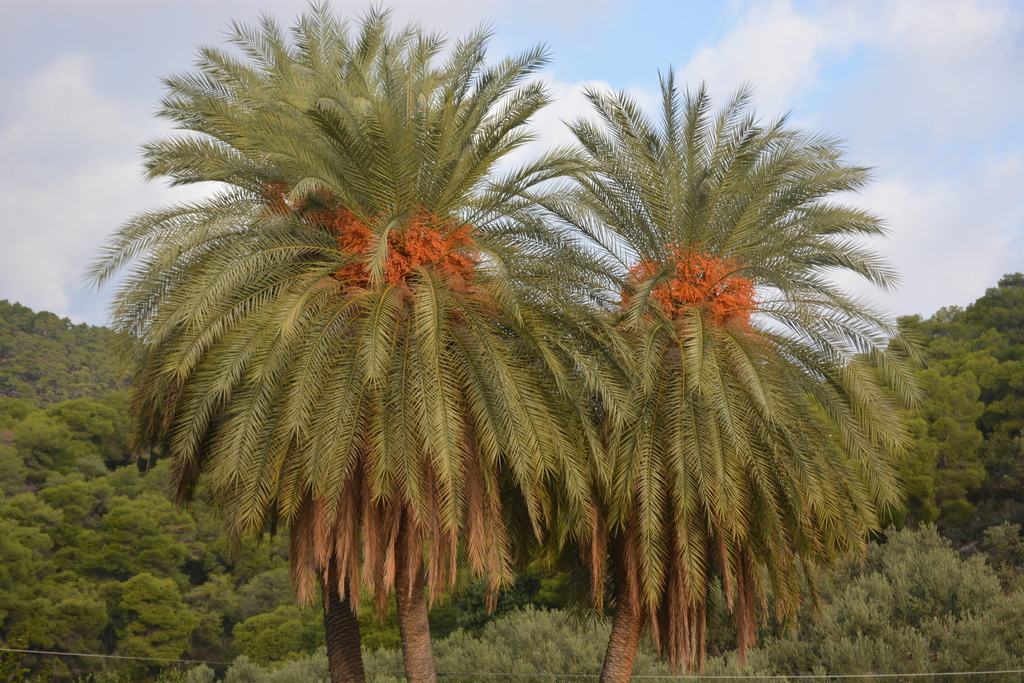
Theophrastus' Date Palm
Phoenix theophrasti
Phoenix theophrasti, the Cretan date palm, is a palm native to the eastern Mediterranean, with a very restricted distribution, confined to southern Greece, a few sites on Crete and nearby islands as well as some places on the Turkish coast. In Europe, with Chamaerops humilis (palm tree that grows in the Mediterranean) are the unique native palm trees in the continental Europe. In Turkey, it is the only native palm species; all the others—although much more...
From the article Phoenix theophrasti on Wikipedia (CC BY-SA), quoted section by section
Description
Apart from the usually inedible dates and upright fruit clusters, the Cretan species can appear quite similar to the cultivated date. Phoenix theophrasti grows up to 15 m (49 ft) tall, usually with several slender stems. The leaves are pinnate, 2–3 m (6.6–9.8 ft) long, with numerous rigid greyish-green linear leaflets 15–50 cm (6–20 in) long on each side of the central rachis. Dead leaves are marcescent, remaining attached to the stem for years after withering. The fruit is an oval yellowish-brown drupe 1.5 cm (0.6 in) long and 1 cm (0.4 in) diameter and containing a single large seed. The fruit pulp is too thin and fibrous to be of agricultural significance and has an acrid taste, though the fruits are sometimes eaten by the locals.
Range & habitat
The species has a relatively restricted distribution, mostly confined to southern Greece (a few sites on Crete and nearby islands), as well as some places on the Turkish coast.
Greece. Sites on Crete include Vai in the Lasithi Prefecture, Ayios Nikitas in Heraklion Prefecture, and Preveli gorge and Souda near Plakias, both on the south coasts of Crete in Rethymnon Prefecture. Trees are also found on Amorgos island, on Halki Island, and on the south coast of Anafi island. Recently, around 10 trees, the only natural stand on the mainland, were found in an ancient palm forest in the Epidaurus area in Peloponnese. It has been proposed that its range was much more widespread in Ancient Greece, growing from Crete to Thebes and from the Peloponnese to Delos.
Turkey. Its presence in Turkey was not described scientifically until the 1980s. There are four stands in southwest Turkey, especially on the Datça and Bodrum Peninsulas in Muğla Province and in Kumluca-Karaöz in Finike Bay. The plants form a grove in the village of Gölköy in northern Bodrum are considered by some as a subspecies, having a shorter stem (4–8 m) but longer fruit stalks (0.6–2 m).
Wikipedia: “Distribution”
Where it lives
Recorded sightings
—
geo-referenced records in GBIF, from museums, herbaria and field observers.
Drag the globe to turn it. Dots are where records exist, not a range map; darker means more records.
In the stacks
Searching the stacks…
Every page naming Phoenix theophrasti in the Biodiversity Heritage Library →
This page is assembled live from iNaturalist, GBIF, Wikipedia, the Source Library and the Internet Archive. It is not yet part of the hand-edited codex. iNaturalist taxon 365732.