Māhoe Wao
Melicytus lanceolatus
Melicytus lanceolatus, commonly called narrow-leaved māhoe or māhoe-wao, is a small tree in the family Violaceae that is endemic to New Zealand.
From the article Melicytus lanceolatus on Wikipedia (CC BY-SA), quoted section by section
Description
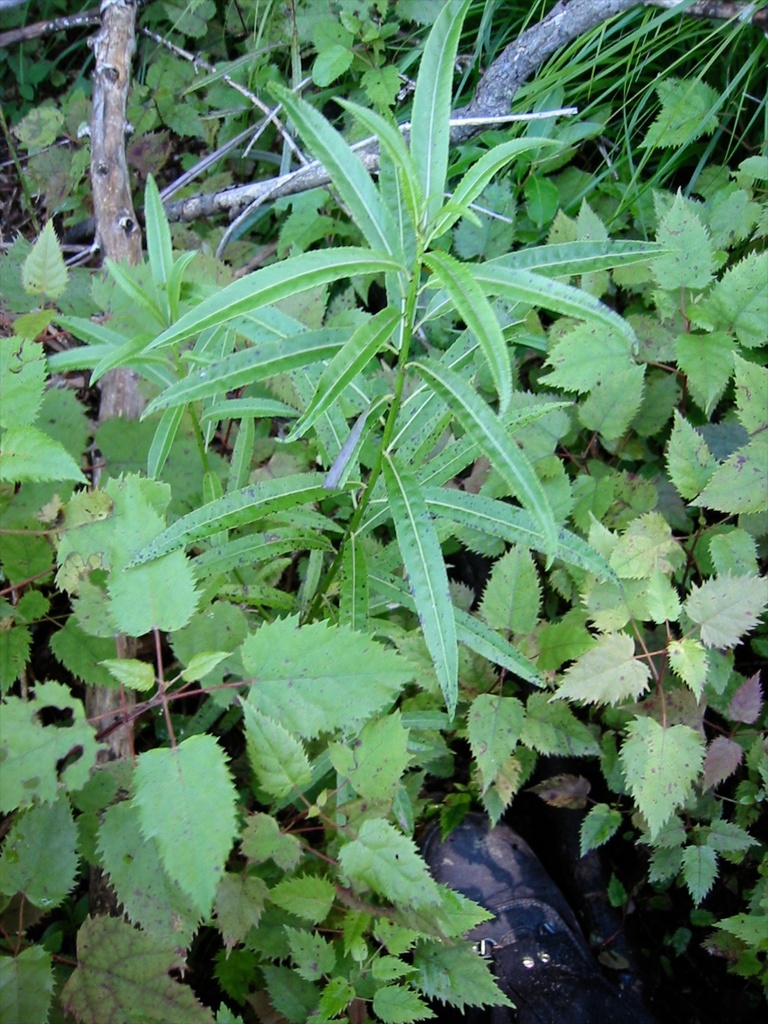
Melicytus lanceolatus is a small tree that typically appears slender, glabrous, and erect. Melicytus lanceolatus has the potential to grow up to 5–6 m tall with a trunk 30 cm in diameter. The vibrant green leaves of M. lanceolatus are simple, alternate, and have a finely serrated margin. They are lanceolate in shape, being long, thin, and narrow. Typically, the leaves are 5–16 cm long by 0.5–2 cm wide. Occasionally, the tip of the leaf will curve downward. Overall, these features can make the leaves of M. lanceolatus look a lot like willow leaves. Bark is brown to white, slightly wrinkled, and with prominent lenticels. Branches are brittle. Flowers are small, 5 mm in diameter, and have five erect petals that curve backwards. Petal colours are variable, with some being yellow, dark purple, or with hints of both. Flowers occur in clusters of two to five. They grow along bare branches below leaves but occasionally from the leaf axils. These clusters can be in such high quantity that they densely cover the branch in small flowers. Flowers are scented, being fragrant day and night. Melicytus lanceolatus produces dark purple round berries that are 4–6 mm in diameter. There is some discrepancy about the number of seeds in each berry, with some claiming between three and six seeds or six to twelve seeds.
Range & habitat
Melicytus lanceolatus is found in the North Island, South Island and Stewart Island, from a latitude of 35°30S (Northland region) southwards from sea level to 915 m. In the South Island, it is mostly found around Dunedin, in Southland, and west of the Southern Alps. Although M. lanceolatus occurs on Stewart Island, it is not very common.
Wikipedia: “New Zealand range”
In human culture
The genus name Melicytus is derived from the Greek words μέλι (méli), meaning "honey," and κῠ́τος (kútos), meaning "hollow container." Combined, this literally means “honey cave,” referencing the nectaries below the stamens. The species name lanceolatus is a Latin word meaning “shaped like a lance,” referencing the lanceolate leaves of M. lanceolatus.
Wikipedia: “Etymology”
Where it lives
Recorded sightings
—
geo-referenced records in GBIF, from museums, herbaria and field observers.
Drag the globe to turn it. Dots are where records exist, not a range map; darker means more records.
In the stacks
Searching the stacks…
Every page naming Melicytus lanceolatus in the Biodiversity Heritage Library →
This page is assembled live from iNaturalist, GBIF, Wikipedia, the Source Library and the Internet Archive. It is not yet part of the hand-edited codex. iNaturalist taxon 366618.