- Animals
- ›Arthropods
- ›Chelicerates
- ›Arachnids
- ›Spiders
- ›Typical Spiders
- ›Entelegyne Spiders
- ›Orbweavers and Allies
- ›Comb-footed Spiders
- ›Latrodectinae
- ›Steatoda
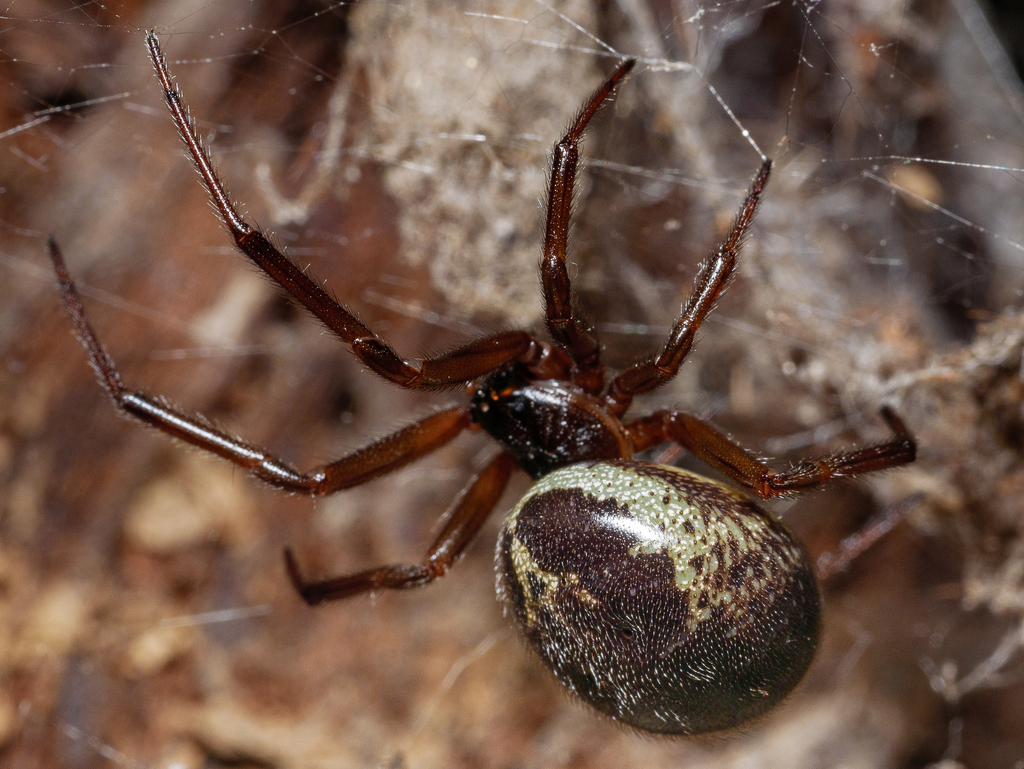
Noble False Widow
Steatoda nobilis
Steatoda nobilis is a spider in the genus Steatoda, known in the United Kingdom as the noble false widow, as it superficially resembles, and is frequently mistaken for, the black widow and other spiders in the genus Latrodectus. It is often referred to as the false widow, although "false widow" is a more general term applied to a wider group of species with this resemblance.[a] It is a moderately medically significant spider, with most bites resulting in symptoms similar to a bee or wasp sting. Some bites may cause more significant harm, partly due to pathogenic bacteria from the spiders.
S. nobilis is spotted all year round, both indoors and outdoors in a variety of habitats including cacti, roadside cuttings, and demolished buildings. The spiders prey on both invertebrates and small vertebrates using an "attack wrap" strategy where silk is wrapped around the victim.
From the article Steatoda nobilis on Wikipedia (CC BY-SA), quoted section by section
Description
Steatoda nobilis has a brown bulbous abdomen with cream coloured markings that are often likened to the shape of a skull. Their legs are reddish-orange. Both female and male S. nobilis can be distinguished from other spiders of the same genus by their large size and typical colouration. Females range in size from about 9.5 to 14 mm in size, while males are 7 to 11 mm. The largest females are 13.7 mm in size, while the largest males can be 11.66 mm in size. The males can be distinguished by their conformation of the palp and by their ventral abdominal markings. The females can be distinguished by their epigyne. The variation in size, shape and markings that have been observed is not thought to be due to location. Spiders found centimetres apart and siblings born from the same egg sac can look very different.
Male and female juvenile spiders are indistinguishable from each other.
Range & habitat
The spider is originally from the Canary Islands and Madeira. It is an introduced species across Europe, parts of the United States and North Africa, and likely spreading. It was found for the first time in 2011 in Cologne, Germany. In England it has been reported mostly in southern counties, but its range was reported to be expanding northwards in the 21st century. In 2011, the spider was reported as an established invasive species in the USA, in Ventura County, California. In January 2016, it was reported that Steatoda nobilis had been found in Chile, the first time that the species had been recorded in the southern hemisphere. Research published in December 2018 showed that it was also established in Colombia and Ecuador. The spider has been in New Zealand since at least 2023. It is considered to be one of the world's most invasive species of spider. Seaside cities and villages with a temperate climate are especially favourable habitats for S. nobilis. The first recorded observation of S. nobilis in England dates back to 1879. The first recorded observation of S. nobilis in Ecuador was in 2014 at several locations as high as 2800 meters. Between 1985 and 2010 there was no reporting of large numbers of S. nobilis anywhere, and scientists consider this to be a typical lag phase that is a phenomenon observed in many invasive species. …
Wikipedia: “Distribution”
What it does
S. nobilis can eat both vertebrates and invertebrates. In Ireland, they were observed to eat woodlice. All of S. nobilis’s liquid requirements are observed to come from its prey. In laboratories they seem to thrive without water and in extremely dry conditions. In Ireland they have been observed to prey on protected reptile species. In southern England, an adult female was observed to haul up and digest a pygmy shrew ten times the spider's size.
Wikipedia: “Adult diet”
Toxicity
Two thirds of the venom is composed of latrodectus-like toxins. Their venom is mainly composed of peptidase, serine protease, alpha latrotoxin and delta lactroinsectotoxin. Peptidase and serine protease are both pancreatic lipases and chitinases (enzymes) that help with digestion. Alpha-latrotoxin and delta latroinsectotoxin are toxins. About 49% of the venom is toxins, 15% are enzymes, 18% are proteins with other functions and 18% are proteins with unknown functions. Alpha-latrotoxin works by creating a pore in the neurons and allowing an influx of Ca2+. This triggers an efflux of neurotransmitters, and once all the neurotransmitters leave, the signals between nerve and muscles are blocked. This leads to neuromuscular paralysis. The venom of S. nobilis serves two functions: immobilisation of prey or predators and the predigestion of prey. The spider is able to efficiently and safely capture prey that are often much larger or stronger than themselves via the rapid paralysis and immobilisation tactic. Their venom is fast acting and can subdue both invertebrate and vertebrate prey. The range of enzymes in the venom suggest that the venom also functions to pre-digest the prey. One example is the enzyme Chitinase which can breakdown the exoskeleton (shell) of arthropods.
Wikipedia: “Venom”
Where it lives
Recorded sightings
—
geo-referenced records in GBIF, from museums, herbaria and field observers.
Drag the globe to turn it. Dots are where records exist, not a range map; darker means more records.
In the stacks
Searching the stacks…
Every page naming Steatoda nobilis in the Biodiversity Heritage Library →
This page is assembled live from iNaturalist, GBIF, Wikipedia, the Source Library and the Internet Archive. It is not yet part of the hand-edited codex. iNaturalist taxon 366894.