- Plants
- ›Vascular Plants
- ›flowering plants
- ›monocots
- ›Agaves, Orchids, Irises, and Allies
- ›Orchids
- ›Pogonias and vanilla orchids
- ›vanilla orchid tribe
- ›Pseudovanilla
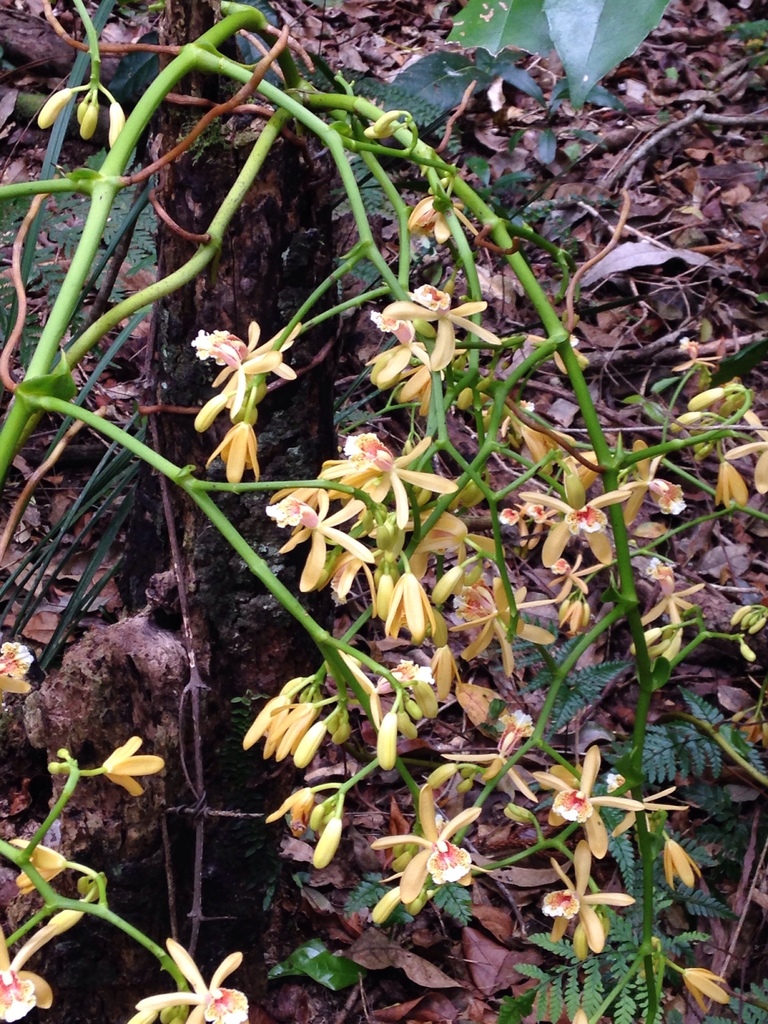
Great Climbing Orchid
Pseudovanilla foliata
Pseudovanilla foliata, commonly known as the great climbing orchid, is a plant in the orchid family native to Australia (Queensland and New South Wales) and New Guinea. It is a terrestrial orchid with a vining vegetative habit, climbing by means of adventitious roots produced at nodes. Its leaves are reduced, and the species is considered to be at least partially mycoheterotrophic.
From the article Pseudovanilla foliata on Wikipedia (CC BY-SA), quoted section by section
Description
Pseudovanilla foliata is a terrestrial, perennial, entirely glabrous vine. Its yellow-green stem may be up to 0.9 cm (0.35 in) in diameter and 15 m (49 ft) in length; it is flexuose and terete. Adventitious roots (roots that arise from the stem), which are thinly elongated and flexuose, extend from the nodes and are always accompanied by an opposite bract, a useful distinguishing feature. The leaves, sparsely interspersed between nodes, are elliptical, acute or subacute and slightly fleshy, up to 8 cm (3.1 in) in length and 2.5 cm (0.98 in) in width. P. foliata bears a lax but highly branching inflorescence with 4 to 8 flowers at the apex of each offshoot. The rachis is slightly swollen, and the floral bracts are minute and triangular. The flowers have yellow sepals and petals, as well as a ruffled white labellum with orange to pink markings. The sepals are oblong to strap-shaped and obtuse, 2.6 cm (1.0 in) in length and 0.6 cm (0.24 in) in width. The petals are narrow, slightly curved and strap-shaped, with the mid-vein on outside thickened; they are as long as the sepals and 0.4 cm (0.16 in) wide. The lip, 2.1 cm (0.83 in) in length and 1.6 cm (0.63 in) in width, is broadly elliptic, with its base adnate (fused) to the column. …
Range & habitat
Pseudovanilla foliata is found in Queensland as far north as Cape York Peninsula, as well as in the northeast and central east. Its southernmost distribution reaches coastal central New South Wales, and populations also exist in New Guinea. The plant has been found at elevations ranging from sea level to 1,000 m (3,000 ft) in well-developed lowland and upland rainforest, often growing on live trunks or rotting wood in old stumps, logs, etc.
Wikipedia: “Distribution and habitat”
What it does
Pseudovanilla foliata is capable only of limited photosynthesis in its stems and bracts and relies heavily on mycoheterotrophic sources of nutrition by parasitizing fungi in decaying wood. Its seeds germinate on decomposing fallen wood, and as such, plants are usually found in areas following ecological disturbance, such as forests impacted by cyclones or logging. Though P. foliata can massively proliferate on fallen wood, its heavy dependence on decomposing fungi results in its eventual decline as the timber disintegrates. P. foliata is pollinated by small native bees.
Wikipedia: “Ecology”
Where it lives
Recorded sightings
—
geo-referenced records in GBIF, from museums, herbaria and field observers.
Drag the globe to turn it. Dots are where records exist, not a range map; darker means more records.
In the stacks
Searching the stacks…
Every page naming Pseudovanilla foliata in the Biodiversity Heritage Library →
This page is assembled live from iNaturalist, GBIF, Wikipedia, the Source Library and the Internet Archive. It is not yet part of the hand-edited codex. iNaturalist taxon 369246.