- Plants
- ›Vascular Plants
- ›flowering plants
- ›Dicots
- ›Nances, Willows, and Allies
- ›Leaf-flower Family
- ›Phyllanthoideae
- ›Phyllantheae
- ›Phyllanthus
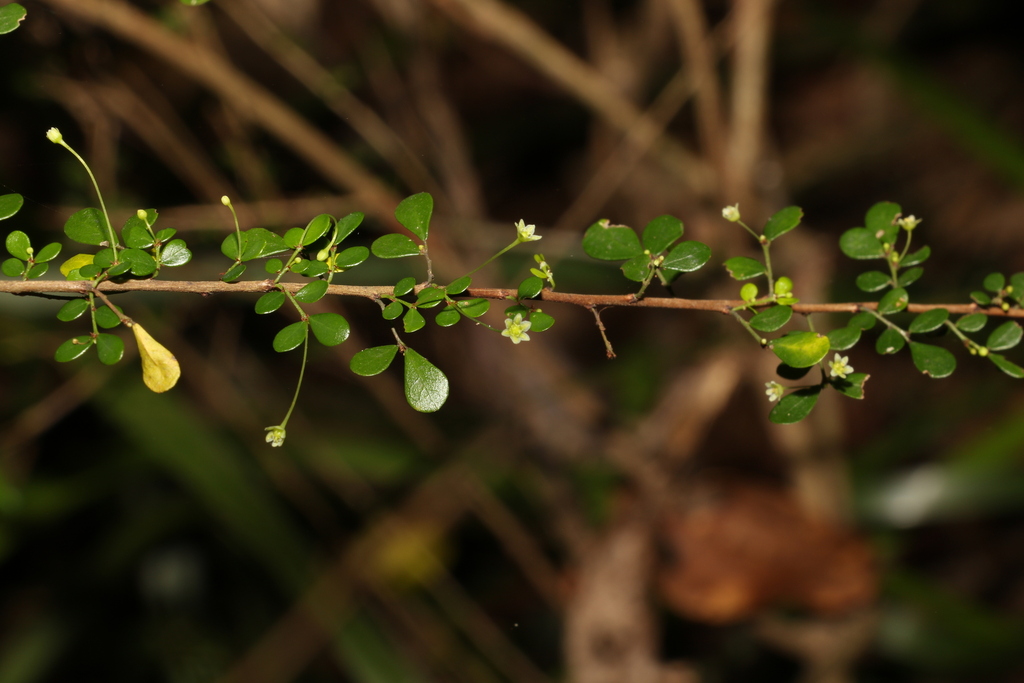
Brush Sauropus
Phyllanthus microcladus
Phyllanthus microcladus, commonly known as the brush sauropus or small-leaved Phyllanthus, is a plant in the family Phyllanthaceae found in tropical and sub tropical areas of eastern Queensland and northeastern New South Wales in Australia. It is listed as endangered in New South Wales, but in Queensland it is assessed as least concern. It occurs by streams in rainforest, from near Grafton northwards to around Cairns.
From the article Phyllanthus microcladus on Wikipedia (CC BY-SA), quoted section by section
Description
The brush sauropus is a small evergreen shrub which reaches a height of 35 cm (14 in) in the southern parts of its range, but may grow to 2 m (6 ft 7 in) in the north. The leaves are simple and opposite, and clustered on short branchlets. They usually measure between 2 and 9 mm (0.08 and 0.35 in) long and are somewhat egg-shaped with the narrower end attached to the twig on a petiole about 1 mm (0.04 in) long. The inflorescences are produced in the leaf axils, and may consist of a single flower or a small cluster. The flowers are either male or female and in most cases both sexes occur on the one plant. They are about 4 mm (0.16 in) diameter, the male flowers held on a fine stem up to 10 mm (0.39 in) long and the female ones on a stem up to 20 mm (0.79 in) long. The fruit is a smooth round capsule about 3 mm (0.12 in) diameter.
Range & habitat
Phyllanthus microcladus is found in scattered populations from near Mossman in northeast Queensland to the Northern Rivers region of New South Wales. The preferred habitat is alongside creeks and rivers in tropical and subtropical rainforest. In New South Wales much of the former habitat areas have been cleared for agriculture and housing. Populations are small and fragmented, and they are threatened by invasive weeds and by being crushed by domestic animals such as cattle. Stream erosion also threatens their habitat.
Wikipedia: “Distribution and habitat”
Where it lives
Recorded sightings
—
geo-referenced records in GBIF, from museums, herbaria and field observers.
Drag the globe to turn it. Dots are where records exist, not a range map; darker means more records.
In the stacks
Searching the stacks…
Every page naming Phyllanthus microcladus in the Biodiversity Heritage Library →
This page is assembled live from iNaturalist, GBIF, Wikipedia, the Source Library and the Internet Archive. It is not yet part of the hand-edited codex. iNaturalist taxon 369939.