- Animals
- ›Arthropods
- ›Hexapods
- ›Insects
- ›Winged and Once-winged Insects
- ›Butterflies and Moths
- ›Geometrid and Swallowtail Moths
- ›Geometer Moths
- ›Ennominae
- ›Ennomini
- ›Tetracis
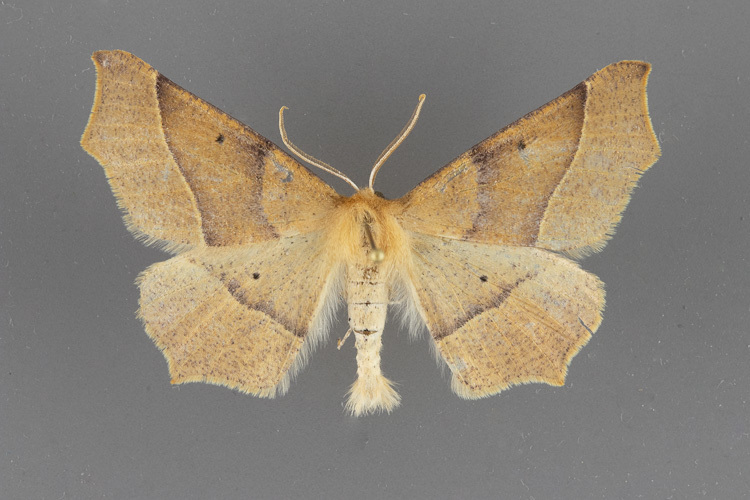
Tetracis barnesii
Tetracis barnesii is a moth in the family Geometridae. This clay-colored moth is found in western North America. Adults are seen in the autumn, flying from early September to late October. T. barnesii was previously named Gonodontis barnesii (Hulst, 1896) and Synaxis barnesii (McDunnough, 1938).
From the article Tetracis barnesii on Wikipedia (CC BY-SA), quoted section by section
Description
The length of the forewings 19–23 mm. Tetracis moths come in varying shades of warm earth tones. The outer margins of the wing arches at vein M3. The forewing wingtips are usually falcate and hingwings come to a single point midwing. T. barnesii can be distinguished by its dark ochreous (orangish-tan to yellowish-brown) wings and body; Two thin, brown crosslines with 'smeared' inward shading at the ends where the lines meets the outer edge of the wing (costal margin); And a sinuous postmedial line with narrow, pale yellow-ochre shading below. The hindwings may have a faint brown median line with pale shading distally. Males have feathery bipectinate antenna, while females have narrow, hair-like (filiform) antennae. Ferris and Schmidt give a anatomical description in "Revision of the North American Genera Tetracis...".
"Antenna nearly white dorsally, bipectinate in male, nearly filiform in female and densely setose ventrally. Palpi narrow, porrect but terminal segments decurved, slightly longer than eye width, mixed dark ochreous and brown scales, tips darker. Head, abdomen, legs ochreous, varying in hue across individuals. Ventral abdomen and legs paler; legs with scattered dark brown scales. Thorax dorsally and ventrally orange-ochreous and very setose. Wings: Base color ochreous orange-brown.
FW apex weakly falcate. …
Range & habitat
It ranges from the high-desert riparian canyons of Colorado and Utah, the sierras of California, to the dry coniferous forest in Oregon. It is found at altitudes between 1,555 and 1,905 meters. This moth has been reported in Arizona, California, Utah, New Mexico, Nevada, Colorado, Montana and Oregon.
Wikipedia: “Range and Habitat”
Listen
Looking for field recordings…
Where it lives
Recorded sightings
—
geo-referenced records in GBIF, from museums, herbaria and field observers.
Drag the globe to turn it. Dots are where records exist, not a range map; darker means more records.
In the stacks
Searching the stacks…
Every page naming Tetracis barnesii in the Biodiversity Heritage Library →
This page is assembled live from iNaturalist, GBIF, Wikipedia, the Source Library and the Internet Archive. It is not yet part of the hand-edited codex. iNaturalist taxon 371052.