- Animals
- ›Arthropods
- ›Chelicerates
- ›Arachnids
- ›Spiders
- ›Typical Spiders
- ›Entelegyne Spiders
- ›Salticoid Spiders
- ›Jumping Spiders
- ›Spiny-legged Jumpers
- ›Spartaeini
- ›Spartaeina
- ›Portia
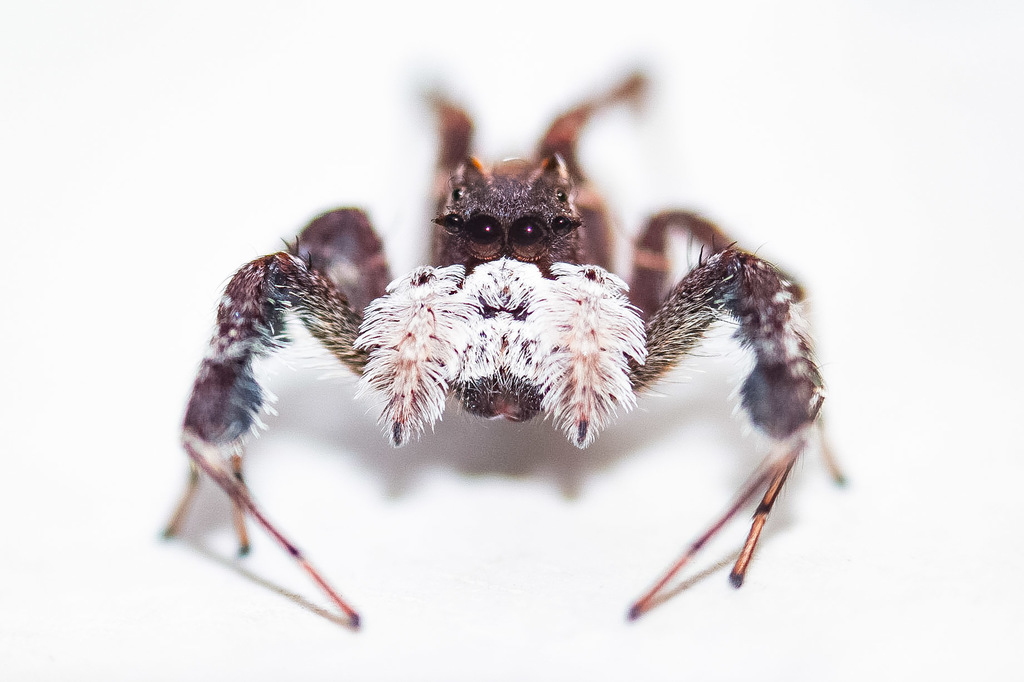
White-Moustached Portia
Portia labiata
Portia labiata is a jumping spider (family Salticidae) found in Sri Lanka, India, southern China, Burma (Myanmar), Malaysia, Singapore, Java, Sumatra and the Philippines. In this medium-sized jumping spider, the front part is orange-brown and the back part is brownish. The conspicuous main eyes provide vision more acute than a cat's during the day and 10 times more acute than a dragonfly's, and this is essential in P. labiata′s navigation, hunting and mating.
The genus Portia has been called "eight-legged cats", as their hunting tactics are as versatile and adaptable as a lion's. All members of Portia have instinctive hunting tactics for their most common prey, but often can improvise by trial and error against unfamiliar prey or in unfamiliar situations, and then remember the new approach. While most jumping spiders prey mainly on insects and by active hunting, females of Portia also build webs to catch prey directly and sometimes join their own webs on to those of web-based spiders. Both females and males prefer web spiders as prey, followed by other jumping spiders, and finally insects. In all cases females are more effective predators than males.
From the article Portia labiata on Wikipedia (CC BY-SA), quoted section by section
What it does
Before courtship, a male Portia spins a small web between boughs or twigs, and he hangs under that and ejaculates on to it. He then soaks the semen into reservoirs on his pedipalps, which are larger than those of females. Females of many spider species, including P. labiata, emit volatile pheromones into the air, and these generally attract males from a distance. The silk draglines of female jumping spiders also contain pheromones, which stimulate males to court females and may give information about each female's status, for example whether the female is juvenile, subadult or mature. Pheromones may help to find jumping spiders' nests, which are usually hidden under rocks or in rolled leaves, making them difficult to be seen. Portia species sometimes use "propulsive displays", with which a member threatens a rival of the same species and sex, and unreceptive females also threaten males in this way. A propulsive display is a series of sudden, quick movements including striking, charging, ramming and leaps. A laboratory test showed how males of P. labiata minimise the risk of meeting each other, by recognising fresh pieces with blotting paper, some containing their own silk draglines and some containing another male's. Males also were attracted by fresh blotting paper containing females' draglines, while females do not response to fresh blotting paper containing males' draglines. …
Wikipedia: “Reproduction and lifecycle”
In human culture
P. labiata features prominently in the science fiction novel Children of Time by Adrian Tchaikovsky.
Wikipedia: “In popular culture”
Where it lives
Recorded sightings
—
geo-referenced records in GBIF, from museums, herbaria and field observers.
Drag the globe to turn it. Dots are where records exist, not a range map; darker means more records.
In the stacks
Searching the stacks…
Every page naming Portia labiata in the Biodiversity Heritage Library →
This page is assembled live from iNaturalist, GBIF, Wikipedia, the Source Library and the Internet Archive. It is not yet part of the hand-edited codex. iNaturalist taxon 372259.