- Animals
- ›Arthropods
- ›Chelicerates
- ›Arachnids
- ›Spiders
- ›Typical Spiders
- ›Entelegyne Spiders
- ›Orbweavers and Allies
- ›Orbweavers
- ›Typical Orbweavers
- ›Caerostris
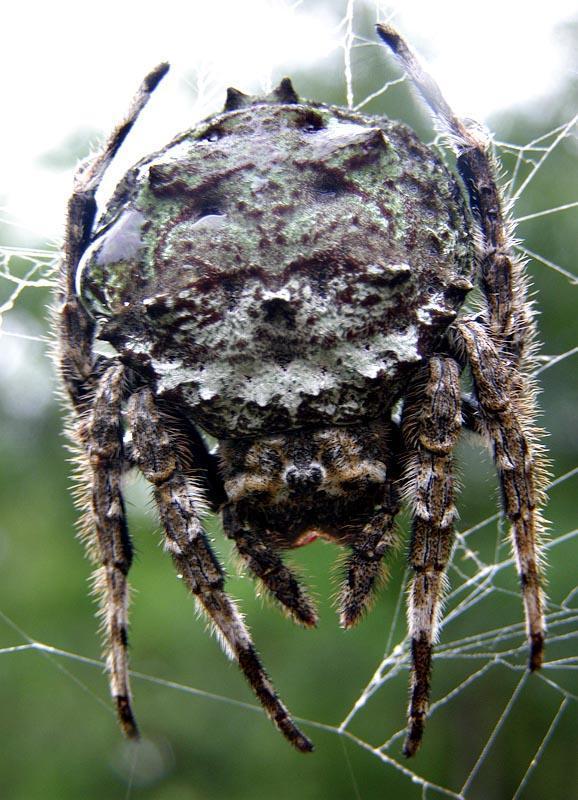
Caerostris vicina
Caerostris vicina is a species of spider in the family Araneidae. It is endemic to Africa and is commonly known as the rugose bark spider.
From the article Caerostris vicina on Wikipedia (CC BY-SA), quoted section by section
Description
In the female, the carapace is greyish brown with tubercles in the eye region. The abdomen is dorsally flattened with small tubercles and ventrally without distinct white spots. The legs are the same colour as the carapace, with femur IV bearing spatulate setae on the posterior edge.
Range & habitat
Caerostris vicina is known from several countries throughout sub-Saharan Africa. In South Africa, the species is known from three provinces at elevations ranging from 20 to 893 m above sea level.
Wikipedia: “Distribution”
What it does
The species constructs large orb webs 1.0-1.5 m in diameter during the night. The web is removed early in the morning, with only a strong bridge line remaining between trees during the day when the female retreats to a branch. With legs arranged neatly around the body, the spider blends in well with its surroundings. The species inhabits Forest and Savanna biomes.
Wikipedia: “Habitat and ecology”
Where it lives
Recorded sightings
—
geo-referenced records in GBIF, from museums, herbaria and field observers.
Drag the globe to turn it. Dots are where records exist, not a range map; darker means more records.
In the stacks
Searching the stacks…
Every page naming Caerostris vicina in the Biodiversity Heritage Library →
This page is assembled live from iNaturalist, GBIF, Wikipedia, the Source Library and the Internet Archive. It is not yet part of the hand-edited codex. iNaturalist taxon 372701.