- Animals
- ›Arthropods
- ›Hexapods
- ›Insects
- ›Winged and Once-winged Insects
- ›Butterflies and Moths
- ›Geometrid and Swallowtail Moths
- ›Geometer Moths
- ›Carpet Moths
- ›Austrocidaria
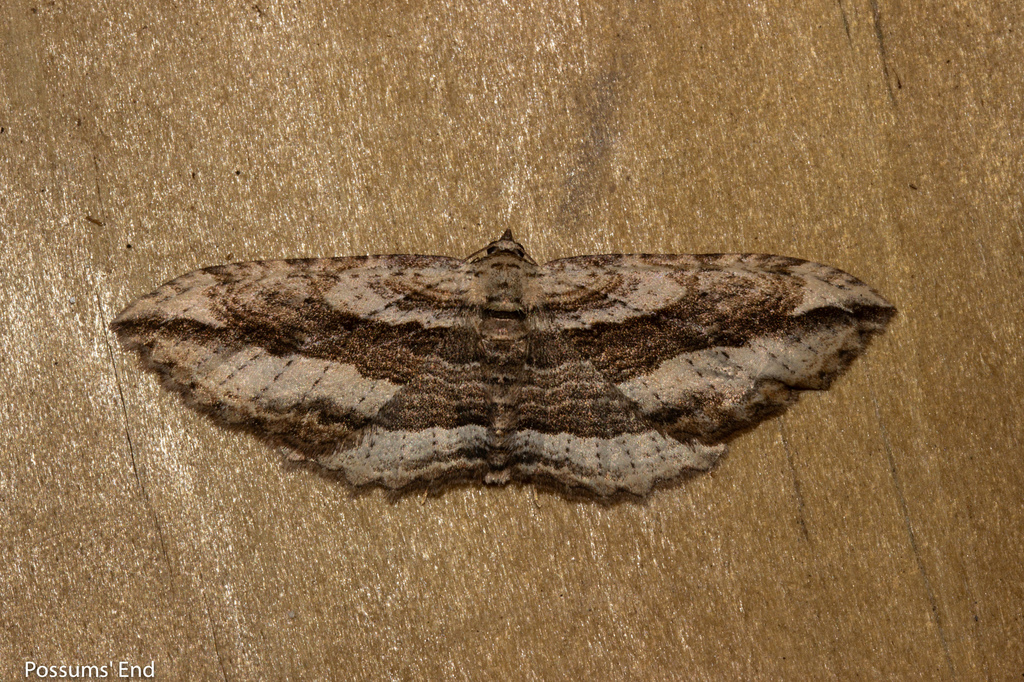
Barred Coprosma Carpet
Austrocidaria gobiata
Austrocidaria gobiata, also known as the barred Coprosma carpet or the pale oblique-barred moth, is a species of moth of the family Geometridae. It is endemic to New Zealand and is found throughout the country. It inhabits native forest, particular areas where its larval host plant, Coprosma areolata, is common. The larvae of this species feed at night and are well camouflaged as a result of their external morphology during the day when they rest. A. gobiata pupate in the leaf litter or amongst the leaves of their host plant. Adults are on the wing all year but are commonly observed from October to April. Adults are nocturnal and are attracted to light. The larvae of this species play host to the fly Pales aurea.
From the article Austrocidaria gobiata on Wikipedia (CC BY-SA), quoted section by section
Description
Hudson described the larva of this species as follows:
... about 1 inch in length, moderately stout, slightly attenuated at each end; pale dull brownish-green obscurely streaked and mottled with pale reddish-brown and blackish; there are two very large humps on segments 8 and 9; the skin is considerably wrinkled with a few scattered short bristles. Hudson regarded larvae of A. gobiata as being well adapted for concealment amongst the twigs of its food plant, Coprosma areolata.
Hudson also described the adults of this species as follows:
The expansion of the wings is 1+1⁄4 inches. The fore-wings, which have the costa rather strongly arched and the termen slightly oblique, are very pale purplish-grey with dark brown and pale reddish-brown markings; there are two very oblique, wavy, dark brown transverse lines on the dorsum at about 1⁄8 and 1⁄3 which reach a little more than half way to the costa; between these two lines there are several fainter reddish-brown lines; a very conspicuous oblique line runs from the apex to the middle of dorsum; this line is double near the middle of its course where it encloses a small oval space; on either side of this oblique line there are numerous paler brown wavy lines which become considerably stronger and more reddish towards the termen; all the veins are dotted in brown. …
Range & habitat
This species is endemic to New Zealand. A. gobiata has been observed in the North, South and Stewart Islands.
Wikipedia: “Distribution”
What it does
Adults are nocturnal and are attracted to light. Hudson hypothesised that there were two broods per year and that the species passed the winter months in its larval stage. He regarded the larvae of A. gobiata as sluggish in behaviour. The larvae are well camouflaged and are nocturnal in behaviour, feeding only at night and resting during the day. A. gobiata pupate in leaf litter under their larval host plant or alternatively amongst the host plant leaves. Adults are on the wing all months of the year but are most commonly observed from October to April.
Wikipedia: “Behaviour”
Listen
Looking for field recordings…
Where it lives
Recorded sightings
—
geo-referenced records in GBIF, from museums, herbaria and field observers.
Drag the globe to turn it. Dots are where records exist, not a range map; darker means more records.
In the stacks
Searching the stacks…
Every page naming Austrocidaria gobiata in the Biodiversity Heritage Library →
This page is assembled live from iNaturalist, GBIF, Wikipedia, the Source Library and the Internet Archive. It is not yet part of the hand-edited codex. iNaturalist taxon 379975.