- Animals
- ›Arthropods
- ›Hexapods
- ›Insects
- ›Winged and Once-winged Insects
- ›Butterflies and Moths
- ›Pyralid and Crambid Snout Moths
- ›Crambid Snout Moths
- ›Moss-eating Crambid Snout Moths
- ›Antiscopa
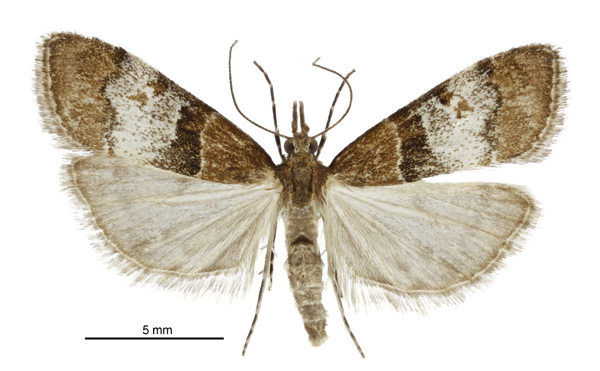
Antiscopa acompa
Antiscopa acompa is a moth in the family Crambidae. It was first described by Edward Meyrick in 1884. It is endemic to New Zealand and is found both the North and South Islands. The species inhabits native forest and adult moths are attracted to light.
From the article Antiscopa acompa on Wikipedia (CC BY-SA), quoted section by section
Description
In 1885 Meyrick gave a detailed description of the species as follows:
Male. — 17+1⁄2-19 mm. Head, antennae, and thorax ochreous-fuscous, shoulders suffusedly dark fuscous; antennas deeply dentate, ciliations 2⁄3. Palpi 3, ochreous-fuscous irrorated with blackish, internally and on basal joint white. Abdomen whitish-ochreous. Legs whitish-ochreous, irrorated with dark fuscous, tibiaa and tarsi banded with dark fuscous. Forewings triangular, costa gently arched, apex round-pointed, hindmargin almost straight, oblique; ochreous-fuscous; base irrorated with dark fuscous; first line very slender, obscure, whitish, posteriorly finely blackish-margined, not oblique, somewhat curved, sinuate inwards above inner margin; space between first and second lines fuscous, irrorated with dark fuscous, with a few pale scales; orbicular and claviform both round, ochreous-brown, obscurely blackish-margined, touching first line; reniform 8-shaped, white, suffusedly blackish-margined; second line very slender, obscure, whitish, anteriorly finely blackish-margined, rather abruptly curved above middle; subterminal obsolete; a slender interrupted white hindmarginal line : cilia ochreous-whitish, with two dark grey lines. …
Range & habitat
This species is endemic to New Zealand. It has been collected in both the North and South Islands.
Wikipedia: “Distribution”
What it does
Adults have been recorded on wing from October to February. Adults of this species are attracted to light.
== References ==
Wikipedia: “Behaviour”
Listen
Looking for field recordings…
Where it lives
Recorded sightings
—
geo-referenced records in GBIF, from museums, herbaria and field observers.
Drag the globe to turn it. Dots are where records exist, not a range map; darker means more records.
In the stacks
Searching the stacks…
Every page naming Antiscopa acompa in the Biodiversity Heritage Library →
This page is assembled live from iNaturalist, GBIF, Wikipedia, the Source Library and the Internet Archive. It is not yet part of the hand-edited codex. iNaturalist taxon 385787.