- Animals
- ›Arthropods
- ›Hexapods
- ›Insects
- ›Winged and Once-winged Insects
- ›Butterflies and Moths
- ›Curved-horn Moths
- ›Twirler Moths
- ›Anomologinae
- ›Aristotelia
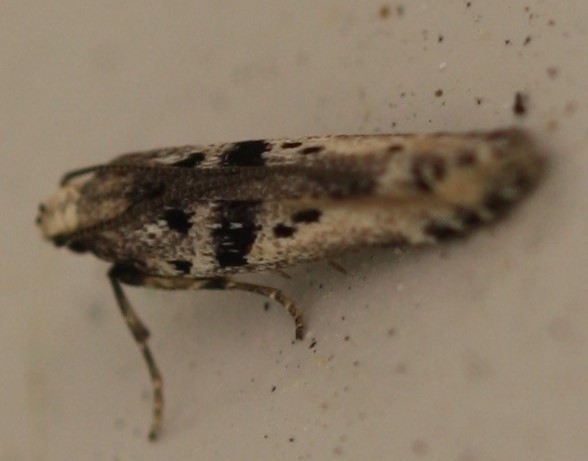
Aristotelia paradesma
Aristotelia paradesma is a moth of the family Gelechiidae. It was described by Edward Meyrick in 1885 and is endemic to New Zealand. This species has been observed on both the North and South Islands. The larvae feed on Coprosma species creating and living in stem galls. The adults are on the wing from November to March and are attracted to light.
From the article Aristotelia paradesma on Wikipedia (CC BY-SA), quoted section by section
Description
The wingspan is about 17 mm. The forewings are whitish, irregularly irrorated (sprinkled) with light grey and with a grey suffusion along the inner margin from the base to the anal angle. There is a small blackish spot on the costa almost at the base and a black dot beneath the costa at one-fifth, and a second larger one beneath it on the fold. A thick blackish transverse somewhat oblique streak is found at one-third, reaching from beneath the costa to the fold, the margins irregular. There are also two black dots nearly longitudinally placed in the middle of the disc, and a third in the disc at three-fourths. The hindwings are grey.
Range & habitat
This species is endemic to New Zealand and has been observed in both the North and South Islands. Both Hudson and T. H Davies were of the opinion that this species was rare but more recently this species has been regarded as being relatively common.
Wikipedia: “Distribution”
What it does
Adults of this species are on the wing from November to March. They are attracted to light and have been collected via light trapping.
Wikipedia: “Behaviour”
Listen
Looking for field recordings…
Where it lives
Recorded sightings
—
geo-referenced records in GBIF, from museums, herbaria and field observers.
Drag the globe to turn it. Dots are where records exist, not a range map; darker means more records.
In the stacks
Searching the stacks…
Every page naming Aristotelia paradesma in the Biodiversity Heritage Library →
This page is assembled live from iNaturalist, GBIF, Wikipedia, the Source Library and the Internet Archive. It is not yet part of the hand-edited codex. iNaturalist taxon 386069.