- Animals
- ›Arthropods
- ›Hexapods
- ›Insects
- ›Winged and Once-winged Insects
- ›Butterflies and Moths
- ›Geometrid and Swallowtail Moths
- ›Geometer Moths
- ›Carpet Moths
- ›Asaphodes
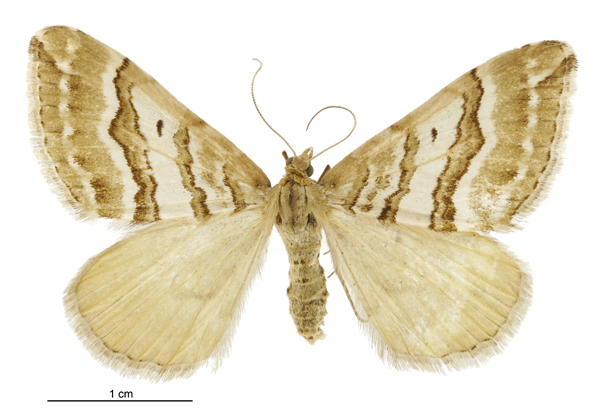
Western Brown Carpet
Asaphodes cataphracta
Asaphodes cataphracta, also known as the western brown carpet moth, is a moth in the family Geometridae. It is endemic to New Zealand and is found in the North and South Island. This species prefers grassy or tussock covered mountain side slopes as habitat. The adults of this species are on the wing from December until March. The larvae of A. cataphracta is known to consume native mountain buttercups (Ranunculaceae).
From the article Asaphodes cataphracta on Wikipedia (CC BY-SA), quoted section by section
Description
Hudson described the species as follows:
The fore-wings are dull yellowish-brown, with numerous slightly waved oblique black and white transverse bands; one very broad white band is situated near the middle, and another at about three-fourths; there is a broad longitudinal reddish-brown line on the costal edge, in which the transverse lines almost disappear; there is also a pale, somewhat triangular, area at the apex. The hind-wings are very pale greyish-ochreous. The cilia of all the wings are very pale ochreous. The female is duller and paler than the male.
Range & habitat
A. cataphracta is endemic to New Zealand. It can be found in the North Island and the South Island. It prefers grassy mountain side slopes as habitat. Specimens of this species have been collected in the North Canterbury (NC) and Westland (WD) specimen collection localities as described by Crosby et al. The species was collected in February in the Mount Cook district by Alfred Philpott as well as at Arthur's Pass to Lake Wakatipu up to 1200m by Meyrick. Hudson stated the species occurred in abundance in the Humboldt mountains. Specimens were also collected in tussock country near the Homer saddle by George Howes.
Wikipedia: “Distribution and habitat”
What it does
The adults of this species are on the wing from December until March. They are a day flying moth.
Wikipedia: “Behaviour”
Listen
Looking for field recordings…
Where it lives
Recorded sightings
—
geo-referenced records in GBIF, from museums, herbaria and field observers.
Drag the globe to turn it. Dots are where records exist, not a range map; darker means more records.
In the stacks
Searching the stacks…
Every page naming Asaphodes cataphracta in the Biodiversity Heritage Library →
This page is assembled live from iNaturalist, GBIF, Wikipedia, the Source Library and the Internet Archive. It is not yet part of the hand-edited codex. iNaturalist taxon 386104.