- Animals
- ›Arthropods
- ›Hexapods
- ›Insects
- ›Winged and Once-winged Insects
- ›Butterflies and Moths
- ›Geometrid and Swallowtail Moths
- ›Geometer Moths
- ›Carpet Moths
- ›Asaphodes
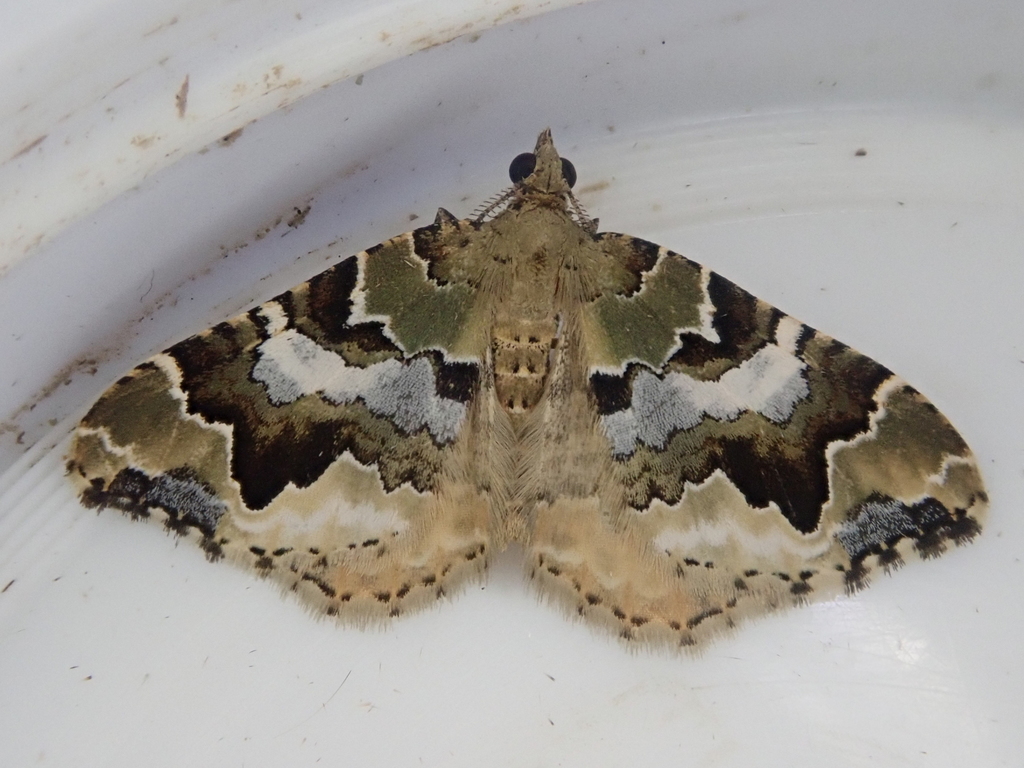
Blue Carpet
Asaphodes obarata
Asaphodes obarata, also known as the blue carpet moth, is a moth in the family Geometridae. It is endemic to New Zealand and has been collected in both the North and South Islands. It seems to inhabit the margins of native forest and also frequents plains, with an affinity for gorse hedges. The host plants of the larvae of this species are unknown. The adults are on the wing in December and January. It is classified as critically endangered by the Department of Conservation. There has been a contraction of range of A. obarata with it now being regarded as locally extinct in both Dunedin and Invercargill.
From the article Asaphodes obarata on Wikipedia (CC BY-SA), quoted section by section
Description
Hudson described A. obarata as follows:
The expansion of the wings is barely 1 inch. The fore-wings are pale greyish-ochreous; there is an interrupted reddish-brown transverse band near the base; two faint, interrupted shaded blackish hues, one at about one-third and the other at about two-thirds, enclosing between them a large central area, which contains a very distinct black dot above the middle, and several irregular shaded black marks; beyond this there is a wavy reddish-brown band; the apex of the wing is somewhat projecting, and the termen is considerably bowed. The hind-wings are pale grey, with a paler central band, and numerous faint, wavy, darker grey lines. The cilia of all the wings are white, banded with dark grey.
Range & habitat
Asaphodes obarata is endemic to New Zealand. As well as Nelson, it has been collected in Wellington, Christchurch and at the foot of Mount Hutt. It has also been collected at Waimarino and Ohakune in the North Island as well as in Akaroa, Otira, Dunedin, Queenstown and Invercargill in the South Island. This species is regarded as being rare. There has been a contraction of range in Dunedin and Southland; and this species is now considered locally extinct in both Dunedin and Invercargill.
Wikipedia: “Distribution”
What it does
Hudson states that this species could be found on the margins of forests and R. W. Fereday communicated that it was a plain-frequenting species that has an affinity for gorse hedges. Hudson also stated that adult moths were on the wing in December and January.
Wikipedia: “Ecology and habitat”
Listen
Looking for field recordings…
Where it lives
Recorded sightings
—
geo-referenced records in GBIF, from museums, herbaria and field observers.
Drag the globe to turn it. Dots are where records exist, not a range map; darker means more records.
In the stacks
Searching the stacks…
Every page naming Asaphodes obarata in the Biodiversity Heritage Library →
This page is assembled live from iNaturalist, GBIF, Wikipedia, the Source Library and the Internet Archive. It is not yet part of the hand-edited codex. iNaturalist taxon 386149.