- Animals
- ›Arthropods
- ›Hexapods
- ›Insects
- ›Winged and Once-winged Insects
- ›Butterflies and Moths
- ›Ermine Moths and Allies
- ›Sedge and False Diamondback Moths and Allies
- ›Chrysorthenches
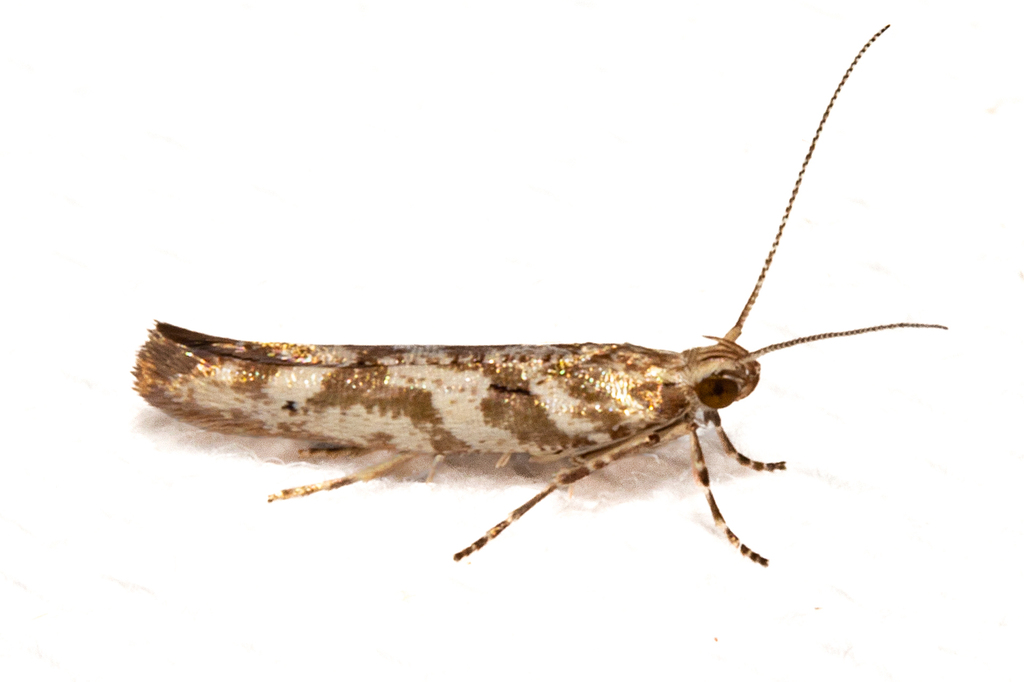
Chrysorthenches porphyritis
Chrysorthenches porphyritis is a species of moth in the family Plutellidae. It was first described by Edward Meyrick in 1885 and is endemic to New Zealand. This species is found on both the North and South Islands in open native forests and scrubs at altitudes ranging from sea level to 1370 m. The larvae feed on Podocarpus laetus, P. totara, P. nivalis, and Phyllocladus alpinus. The larvae create shelters by loosely spinning together the leaves of their host plants and can be found feeding in groups. The pupa develops inside a thin cocoon. Hudson believed this species had two broods a year. Adult moths are active throughout the year. The adults of this species, particularly the females, exhibit variability in coloration and forewing patterns.
From the article Chrysorthenches porphyritis on Wikipedia (CC BY-SA), quoted section by section
Description
Meyrick described the larvae of the species as follows:
Larva 16-legged, moderate, cylindrical, rather tapering at both ends; dull light greenish - ochreous; dorsal narrow, ochreous-whitish, bordered on each side by a slender dull reddish-fuscous streak, coalescing towards extremities; head brownish-ochreous Meyrick described the adults of the species as follows:
Male, female. — 11-14 mm. Head light ochreous. Palpi long, light ochreous or whitish, externally suffused with dark fuscous, terminal joint twice as long as second. Antennae whitish, annulated with dark fuscous. Thorax ochreous, mixed and suffused with purplish and dark fuscous. Abdomen grey. Legs dark fuscous, apex of joints and posterior tibiae whitish. Forewings elongate, narrow, costa arched, apex acute, hind-margin very obliquely sinuate; brownish-ochreous, with purple or coppery reflections, sometimes mixed with grey-whitish; an irregular irroration of small dark fuscous spots; markings suffused, deep bronzy or violet-fuscous, very variable; normally a fascia-like rather oblique streak from costa at 1⁄4, usually abbreviated, but sometimes reaching inner margin, an irregular median fascia parallel to this, connected by a bar with costa at 3⁄4, and a narrow fascia from costa before apex to anal angle, but these are sometimes incomplete or partially suffused; in one specimen, traces of a longitudinal white median …
Range & habitat
This species is endemic to New Zealand and have been collected throughout the North and South Islands. The adult moths have been collected at altitudes from sea level up to 1370 m.
Wikipedia: “Distribution”
What it does
The larvae feed from a structure created by loosely spinning together the leaves of their host plant. They are often found feeding in groups. When pupating the insect forms a pupa inside a thin cocoon. Hudson was of the opinion that this species had two broods during each year with adults being on the wing more commonly in September and again in March. However this moth has been collected all year round.
Wikipedia: “Behaviour”
Listen
Looking for field recordings…
Where it lives
Recorded sightings
—
geo-referenced records in GBIF, from museums, herbaria and field observers.
Drag the globe to turn it. Dots are where records exist, not a range map; darker means more records.
In the stacks
Searching the stacks…
Every page naming Chrysorthenches porphyritis in the Biodiversity Heritage Library →
This page is assembled live from iNaturalist, GBIF, Wikipedia, the Source Library and the Internet Archive. It is not yet part of the hand-edited codex. iNaturalist taxon 387593.