- Animals
- ›Arthropods
- ›Hexapods
- ›Insects
- ›Winged and Once-winged Insects
- ›Butterflies and Moths
- ›Pyralid and Crambid Snout Moths
- ›Crambid Snout Moths
- ›China-mark Moths
- ›Clepsicosma
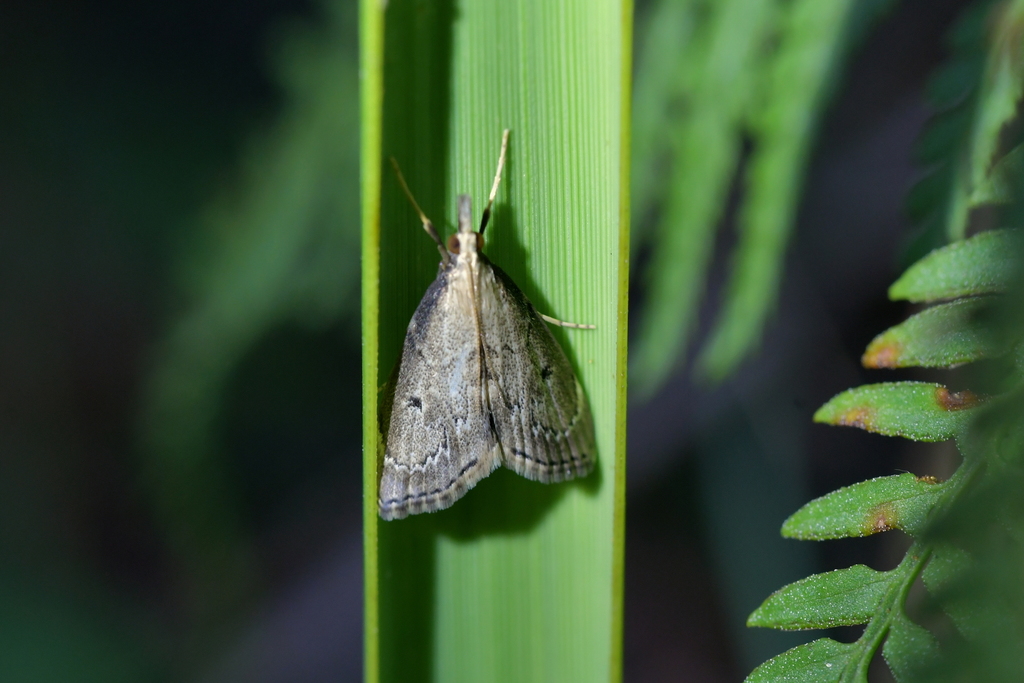
Clepsicosma iridia
Clepsicosma is a genus of moths in the family Crambidae. As at 2022, this genus contains only one described species, Clepsicosma iridia, which is endemic to New Zealand. The species inhabits native forest in the North Island as well as the northern and western parts of the South Island down to Westland. The larval host of this species is assumed to be species of Cutty grass, possibly including Gahnia setifolia and Gahnia xanthocarpa, although the life history of this species is unknown. The adults of C. iridia are on the wing from December until May. They are nocturnal, and are attracted to light. During the day the adults rest on the underside of leaves, including those Cutty grass species that may possibly be their larval hosts.
From the article Clepsicosma on Wikipedia (CC BY-SA), quoted section by section
Description
Meyrick described the genus as follows:
Forehead flat, very oblique. Ocelli present. Tongue well-developed. Antennae 3⁄4, in male — ? Labial palpi long, straight, porrected, with long loosely projecting scales, attenuated to apex, terminal joint concealed. Maxillary palpi rather long, triangularly dilated with scales, not resting on labial. Posterior tibiae with outer spurs half inner. Forewings with veins 8 and 9 stalked, 10 closely approximated to 9 towards base, 11 oblique. Hindwings somewhat broader than forewings; veins 3, 4, 5 tolerably approximated at base, 7 from a point with 6, anastomosing with 8 to 1⁄3; lower median naked, internal area loosely haired. Hudson described the species as follows:
The expansion of the wings is barely 7⁄8 inch. The forewings are very pale brownish-ochreous, almost white, with a dull brown shading on the costa near the base and a very conspicuous blackish discal spot; there is an indistinct, jagged, whitish, sub- terminal line, edged with pale brown towards base, sometimes emitting a, faint loop which almost touches the discal spot; there is a series of blackish-brown terminal marks. …
Range & habitat
This species is endemic to New Zealand. It has been observed in the North Island and in the northern and western parts of the South Island down to Westland. This species is regarded as being common.
Wikipedia: “Distribution”
What it does
The adult moths can be observed from late December until May. They are nocturnal and are attracted to light. During daylight hours they rest on the underside of leaves and have been found hiding amongst G. setifolia leaves near the ground.
== References ==
Wikipedia: “Behaviour”
Listen
Looking for field recordings…
Where it lives
Recorded sightings
—
geo-referenced records in GBIF, from museums, herbaria and field observers.
Drag the globe to turn it. Dots are where records exist, not a range map; darker means more records.
In the stacks
Searching the stacks…
Every page naming Clepsicosma iridia in the Biodiversity Heritage Library →
This page is assembled live from iNaturalist, GBIF, Wikipedia, the Source Library and the Internet Archive. It is not yet part of the hand-edited codex. iNaturalist taxon 387684.