- Animals
- ›Arthropods
- ›Hexapods
- ›Insects
- ›Winged and Once-winged Insects
- ›Butterflies and Moths
- ›Tortricid Leafroller Moths and Allies
- ›Tortricid Leafroller Moths
- ›Tortricine Leafroller Moths
- ›Cnephasiini
- ›Cnephasia
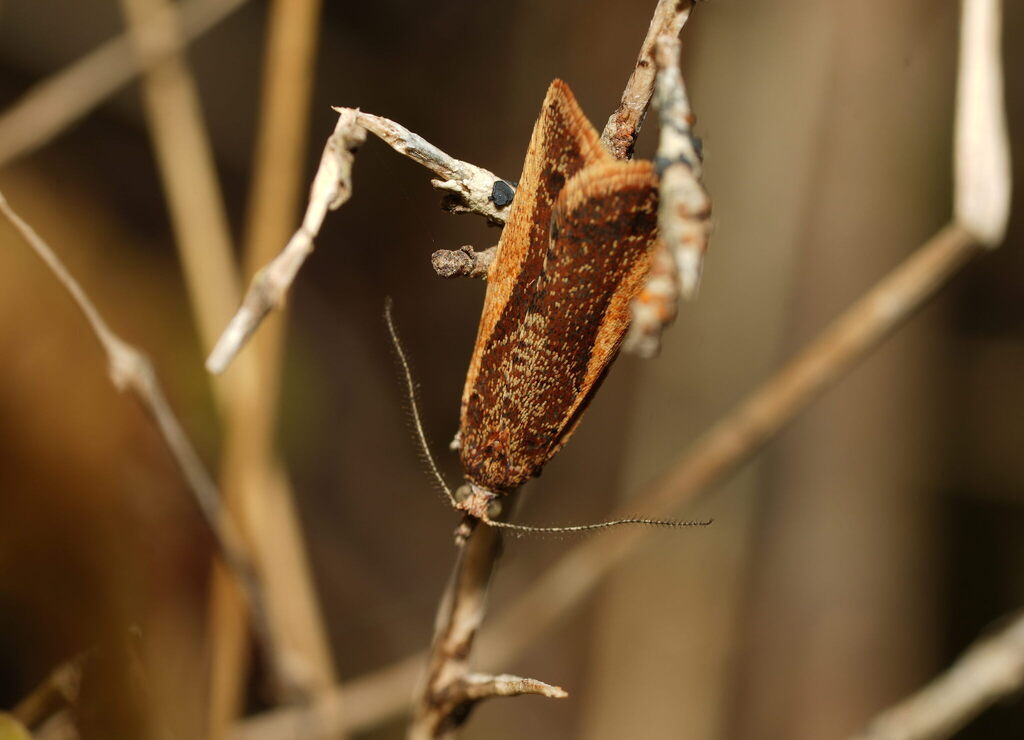
Cnephasia paterna
Cnephasia paterna is a species of moth in the Tortricidae family. It is endemic to New Zealand. This species is classified as Nationally Endangered by the Department of Conservation.
From the article Cnephasia paterna on Wikipedia (CC BY-SA), quoted section by section
Description
Philpott described the species as follows:
21 mm. Head and palpi fuscous mingled with reddish. Antennae dark fuscous, annulated with whitish, swollen at joints, ciliations 3+1⁄2. Thorax leaden-fuscous. Abdomen greyish-fuscous. Legs ochreous-white mixed with fuscous, anterior pair fuscous, tarsi narrowly annulated with white. Forewings elongate-triangular, costa slightly arched at base, thence straight, apex round-pointed, termen straight, strongly oblique; leaden fuscous, densely strigulated with blackish and with scattered reddish scales; costal fold small, about 1⁄7; a strong outwardly-oblique fascia from costa at apex of fold, yellow mixed with red; a similarly-coloured fascia, preceded by numerous red scales, from costa before middle, outwardly oblique, parallel-sided, reaching about 1⁄3 across wing; a yellow-and-red spot on costa before apex; some indefinite white marks on apical area: fringes grey with a reddish basal line. Hindwings grey strigulated with fuscous: fringes whitish-grey.
Range & habitat
This species is endemic to New Zealand and has only been found in the South Island. The type specimen remained unique until the species was rediscovered by Brian Patrick on the 28 May 2012 at Saddle Hill, Banks Peninsula. This locality remains the only site where this species has been found.
Wikipedia: “Distribution”
In human culture
Much information on biology and life cycle of this moth is yet to be discovered and the species has not yet been reared. Patrick hypothesises that the larvae of this species feed in silken tunnels and that they have an annual life-cycle. Adults emerge in the late autumn or early winter. Hudson records the insect being collectable at the end of March. The female of this species is short wings and flightless, which inhibits the dispersal of the species. The male of the species are active during the day and are regarded as fast flyers.
Wikipedia: “Life history and biology”
Listen
Looking for field recordings…
Where it lives
Recorded sightings
—
geo-referenced records in GBIF, from museums, herbaria and field observers.
Drag the globe to turn it. Dots are where records exist, not a range map; darker means more records.
In the stacks
Searching the stacks…
Every page naming Cnephasia paterna in the Biodiversity Heritage Library →
This page is assembled live from iNaturalist, GBIF, Wikipedia, the Source Library and the Internet Archive. It is not yet part of the hand-edited codex. iNaturalist taxon 387749.