- Animals
- ›Arthropods
- ›Hexapods
- ›Insects
- ›Winged and Once-winged Insects
- ›Butterflies and Moths
- ›Bagworms, Clothes Moths, and Allies
- ›Fungus Moths, Clothes Moths, & Allies
- ›Crypsitricha
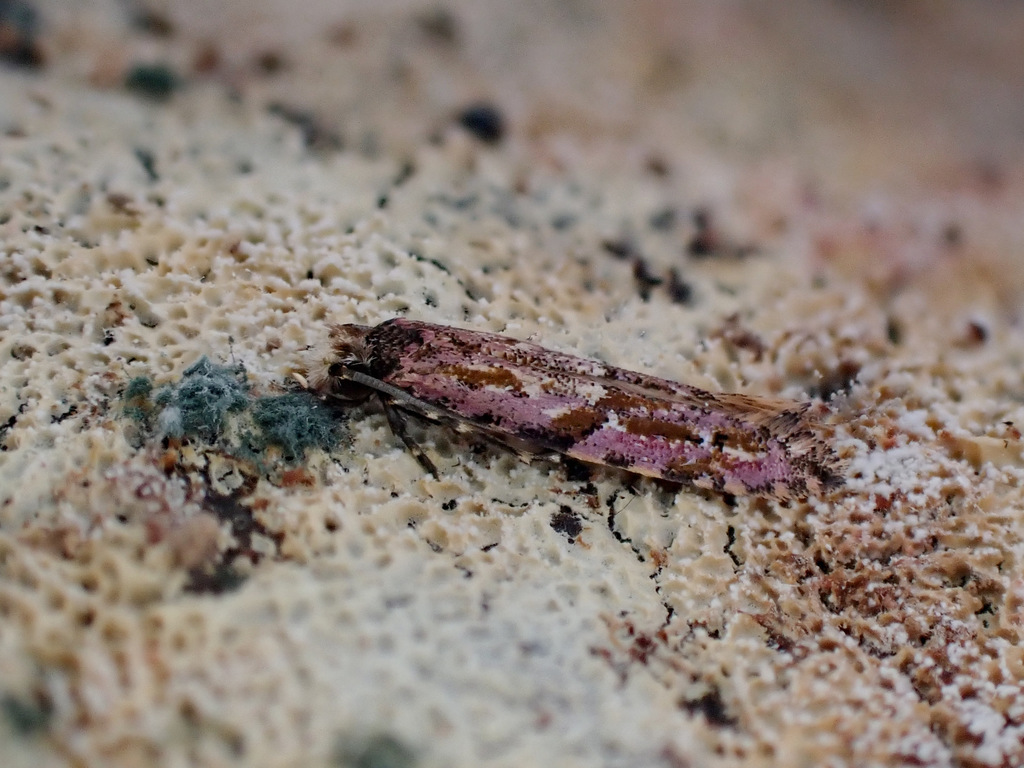
Crypsitricha roseata
Crypsitricha roseata is a species of moth in the family Tineidae. It was first described by Edward Meyrick in 1913. This species is endemic to New Zealand and has been observed in both the North and South Islands. The type locality of this species is the suburb of Wadestown, in Wellington. This species inhabits native forest and dense forest ravines. Adults are on the wing from November until February. At rest the adults can resemble minute sticks.
From the article Crypsitricha roseata on Wikipedia (CC BY-SA), quoted section by section
Description
The adult wingspan is about 12 mm. The forewings are light rosy-purple-brownish with about eight small blackish costal marks and an irregular brown mark on the fold towards the base, terminated by a few blackish scales, and edged with some whitish suffusion. There is a narrow oblique brown fascia from before the middle of the costa to beyond the middle of the dorsum, partially edged with blackish posteriorly. A streak of brown suffusion runs from the middle of the disc to the middle of the termen, including a line of black scales, and edged above posteriorly by a fine white streak. The hindwings are grey.
Range & habitat
This species is endemic to New Zealand and has been observed in both the North and South Islands.
Wikipedia: “Distribution”
What it does
Adults of this species are on the wing from September until March. They are attracted to light. Adults rest with their wings close to their body and forming a steep peak with their antennae held backwards under their wings and their foreleg feet are placed forwards. This position helps the moth resemble a tiny stick.
== Reference ==
Wikipedia: “Behaviour”
Listen
Looking for field recordings…
Where it lives
Recorded sightings
—
geo-referenced records in GBIF, from museums, herbaria and field observers.
Drag the globe to turn it. Dots are where records exist, not a range map; darker means more records.
In the stacks
Searching the stacks…
Every page naming Crypsitricha roseata in the Biodiversity Heritage Library →
This page is assembled live from iNaturalist, GBIF, Wikipedia, the Source Library and the Internet Archive. It is not yet part of the hand-edited codex. iNaturalist taxon 388065.