- Animals
- ›Arthropods
- ›Chelicerates
- ›Arachnids
- ›Spiders
- ›Typical Spiders
- ›Entelegyne Spiders
- ›RTA Clade Spiders
- ›Huntsman Spiders
- ›Deleninae
- ›Delena
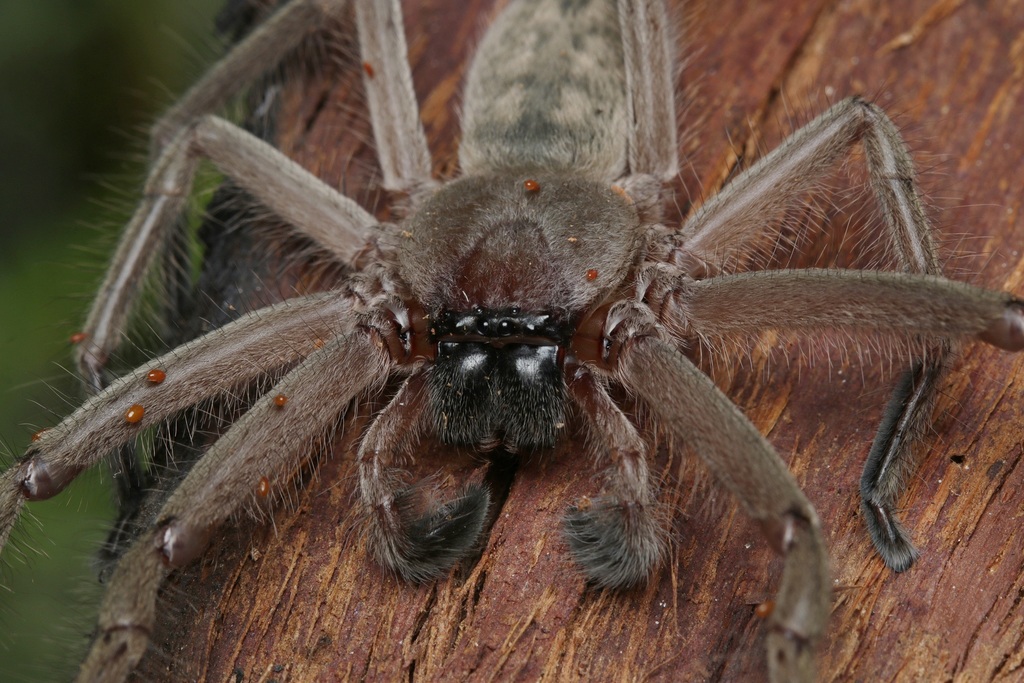
Social Huntsman Spider
Delena cancerides
Delena cancerides, the communal huntsman, flat huntsman or social huntsman, is a large, brown huntsman spider native to Australia. It has been introduced to New Zealand, where it is sometimes known as the Avondale spider. This was the species used in the Australian movie Napoleon and widely in Arachnophobia, and all films depict them as having a deadly venomous bite, but they are generally considered harmless to humans in real-life. It was first described by Charles Athanase Walckenaer in 1837.
From the article Delena cancerides on Wikipedia (CC BY-SA), quoted section by section
Description
Male D. cancerides have a body length of 20–25 millimetres (0.79–0.98 in), while females are larger, with a body length of 25–32 mm (0.98–1.26 in). The body is light brown and covered in dense, fine hairs. The legs are also hairy, and can have a span of over 15 centimetres (5.9 in). Various populations show major differences in the chromosomes, leading to the recognition of several "chromosomal subspecies", but these hybridize where in contact and there is little genetic divergence.
Wikipedia: “Appearance and genetics”
Range & habitat
The species is found all over Australia, including Tasmania. It was introduced to New Zealand in 1924. Its range in New Zealand expanded slowly out of Avondale, a suburb of Auckland, hence the alternative New Zealand common name. There is a sculpture in the Avondale shopping centre celebrating the spider.
Wikipedia: “Distribution”
What it does
Highly unusual among spiders, the flat huntsman spider is a social species, even sharing prey. They are often found under loose bark (their flat shape is an adaptation for this) in colonies up to 300, but they are highly aggressive and commonly cannibalistic toward members from other colonies. They hunt their food rather than spin webs for it. They are timid towards humans and bites are infrequent, and when they occur, symptoms are usually very minor.
Wikipedia: “Behaviour”
Where it lives
Recorded sightings
—
geo-referenced records in GBIF, from museums, herbaria and field observers.
Drag the globe to turn it. Dots are where records exist, not a range map; darker means more records.
In the stacks
Searching the stacks…
Every page naming Delena cancerides in the Biodiversity Heritage Library →
This page is assembled live from iNaturalist, GBIF, Wikipedia, the Source Library and the Internet Archive. It is not yet part of the hand-edited codex. iNaturalist taxon 388489.