- Animals
- ›Arthropods
- ›Hexapods
- ›Insects
- ›Winged and Once-winged Insects
- ›Butterflies and Moths
- ›Pyralid and Crambid Snout Moths
- ›Pyralid Snout Moths
- ›Knot-horn Moths
- ›Phycitini
- ›Etiella
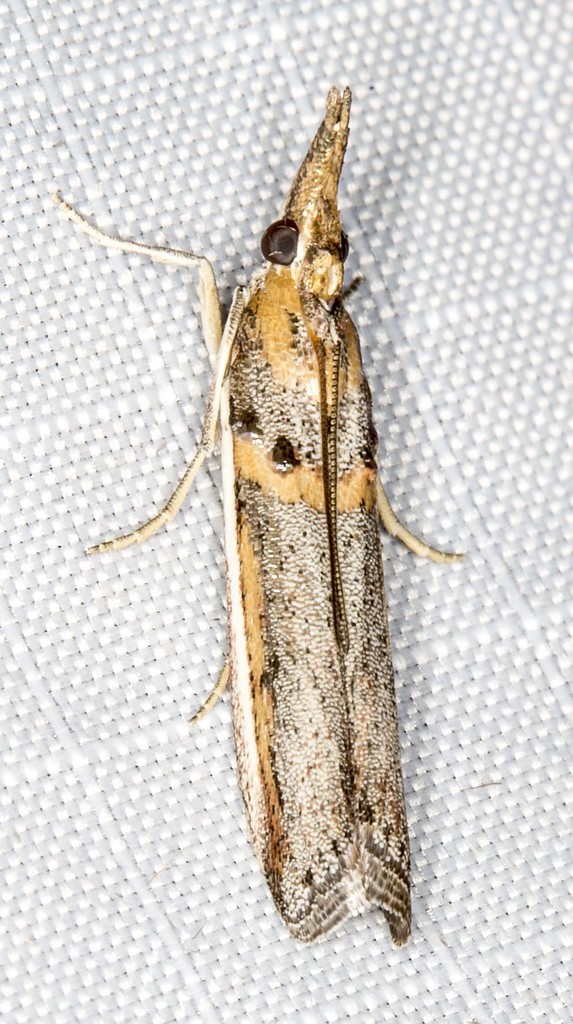
small tabby
Etiella behrii
Etiella behrii (common names include lucerne seed web moth, small tabby and pyralid moth) is a species of moth of the family Pyralidae, occurring sporadically but when present considered a serious pest of agricultural crops throughout parts of Australia.
The name "lucerne seed web moth" comes from the behaviour of a newly hatched larva spinning a protective web around itself.
From the article Etiella behrii on Wikipedia (CC BY-SA), quoted section by section
Description
The early instar larva of E. behrii is pale green with a mottled brown head and pink markings. As the caterpillars mature, they become pinker and the stripes redden. The larvae grow up to 12 mm (0.47 in) long, and have a dark brown head casing, four pairs of abdominal prolegs and one anal proleg. The eggs are oval-shaped, clear or off-white and turn to orange before hatching.
The adult lucerne seed web moth are long and slender when at rest. They have a protruding beak and are brown or grey, with a brown pattern on the forewing and a transverse orange stripe near the base. The forewings also have a white line along the leading edge or costa. The hind wings have brown veins running through satin beige/white with a dark brown outer edge. The males have knobs at the base of the antennae. The wingspan is about 10 mm (0.39 in).
Range & habitat
Etiella behrii is found in much of South East Asia including Hong Kong, Indonesia, Malaysia. and most of Australia. It also occurs throughout Australia in Northern Territory, Queensland, New South Wales, ACT, Victoria, and Western Australia. More recently E. behrii has been discovered to migrate 250 km (160 mi) over the Bass Strait to Tasmania where its detection coincides with the arrival of multiple known migratory species usually after suitable airflows for migration occur across the Bass Strait. However, it theorised that E. behrii is prevented from breeding and establishing in Tasmania due to a lack of winter diapause and the absence of observed larvae.
Wikipedia: “Distribution”
What it does
Etiella behrii as both adult and larvae feed on at least six native and 18 introduced legume species including those in the genera Lens, Lupinus and Medicago and are considered a serious but sporadic pest of lucerne seed crops (Medicago sativa) in South Australia. The larvae are considered an agricultural pest on other leguminous crops such as peanut (Arachis hypogaea), Chamaecytisus prolifer, sky lupine (Lupinus nanus), alfalfa (Medicago sativa), pea (Pisum sativum) and soybean (Glycine species). Shortly after hatching, the larvae will bore into green seed pods, creating pin-holes. During early larval development, only one seed pod will be damaged. The larva feeds initially internally but subsequently externally on seed in the seed pods. The mature larvae are known to web together multiple seed pods to continue a feeding regime. Etiella behrii is thought to live on native plants in scrubland and along roadside during spring and early summer before infesting lucerne seed crops in January.
Many infestations are slight and can go unnoticed but occasionally there is a very heavy infestation in one season. The cause of sporadic widespread E. behrii infestations in lucerne crops is relatively unknown. Multiple factors are thought to contribute to changes in the size of infestation each year, such as the timing of crops, the scarcity of native plants, and the presence of predators. …
Wikipedia: “Behaviour and ecology”
Listen
Looking for field recordings…
Where it lives
Recorded sightings
—
geo-referenced records in GBIF, from museums, herbaria and field observers.
Drag the globe to turn it. Dots are where records exist, not a range map; darker means more records.
In the stacks
Searching the stacks…
Every page naming Etiella behrii in the Biodiversity Heritage Library →
This page is assembled live from iNaturalist, GBIF, Wikipedia, the Source Library and the Internet Archive. It is not yet part of the hand-edited codex. iNaturalist taxon 389200.