- Animals
- ›Arthropods
- ›Hexapods
- ›Insects
- ›Winged and Once-winged Insects
- ›Butterflies and Moths
- ›Curved-horn Moths
- ›Timber Moths
- ›Hierodoris
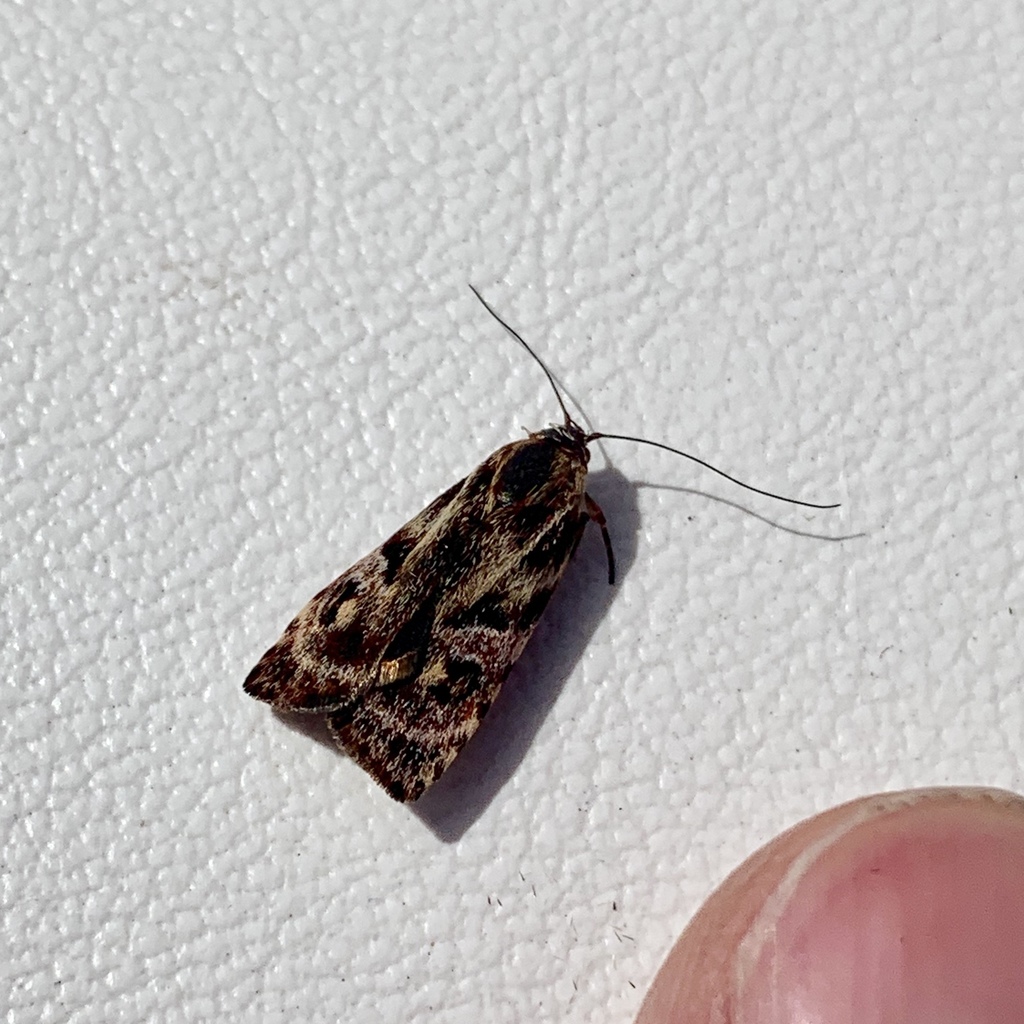
Orange Flash
Hierodoris illita
Hierodoris illita is a moth of the family Oecophoridae. It is endemic to New Zealand and is found in both the North and South Islands. However this species has not been recorded at Stewart Island / Rakiura.
The larvae feed on the inside of woody stems of Coriaria arborea. Specimens have also been reared from galls both on a stem of Muehlenbeckia australis and on a stem of Nothofagus truncata. Specimens have also been reared from the cones of the exotic species Larix decidua The larvae normally pupate within the stem of their host plant. The wingspan of adults of this species is between 20 and 30 mm with the forewings being blackish, variably overlain with reddish and whitish scales. The hindwings of the common form are blackish with orange streaks. However H. illlita is variable in appearance with some specimens having a rich reddish brown forewings without markings and a form exists that has whitish hindwing markings in thin stripes from the base of the hindwing. Adults of this species are on the wing from November until February. This species is known to fly during the day and have been observed flying over tall bushes and trees, including Coriaria ruscifolia and Kunzea ericoides, during hot, sunny days.
From the article Hierodoris illita on Wikipedia (CC BY-SA), quoted section by section
Description
Hoare described the larvae of this species as follows:
Head dark brown, marked darker longitudinally. Thorax and abdomen dorsally and laterally grey, ventrally whitish grey; broad irregular broken dorsal and subdorsal lines whitish yellow; dorsal pinacula black and shiny; A10 darker grey, mottled black. Hudson described the species as follows:
The expanse of the wings is 7⁄8 inch. The forewings are very rich dark brown, thinly speckled with elongate bluish-white scales; there are usually cloudy discal marks before and beyond the middle, and a darker curved terminal band. The hindwings are rich velvety-black, with two unequal elongate-triangular bright orange-yellow marks, and a cloud of minute yellow dots near the tornus. The cilia of the hindwings are bright orange-yellow. The wingspan is 20–30 mm with the forewings being blackish, variably overlain with reddish and whitish scales. The hindwings of the common form are blackish with orange streaks. This species is variable in appearance with some specimens having a rich reddish brown forewings without markings. There is a form with hindwing markings that are whitish in thin stripes from the base of the hindwing. It is possible to confuse H. illita with H. atychioides where specimens of the former species have very dark hindwings. This species can be distinguished from H. bilineata as it has a larger wingspan. …
Range & habitat
This species is endemic to New Zealand and is found throughout the North and South Islands. This species has not been recorded at Stewart Island / Rakiura.
Wikipedia: “Distribution”
What it does
Adults of this species are on the wing from November until February. This species is known to fly during the day and have been observed flying over tall bushes and trees, including Coriaria ruscifolia and Kunzea ericoides, during hot, sunny days.
Wikipedia: “Behaviour”
Listen
Looking for field recordings…
Where it lives
Recorded sightings
—
geo-referenced records in GBIF, from museums, herbaria and field observers.
Drag the globe to turn it. Dots are where records exist, not a range map; darker means more records.
In the stacks
Searching the stacks…
Every page naming Hierodoris illita in the Biodiversity Heritage Library →
This page is assembled live from iNaturalist, GBIF, Wikipedia, the Source Library and the Internet Archive. It is not yet part of the hand-edited codex. iNaturalist taxon 390508.