- Animals
- ›Arthropods
- ›Hexapods
- ›Insects
- ›Winged and Once-winged Insects
- ›Butterflies and Moths
- ›Curved-horn Moths
- ›Timber Moths
- ›Hierodoris
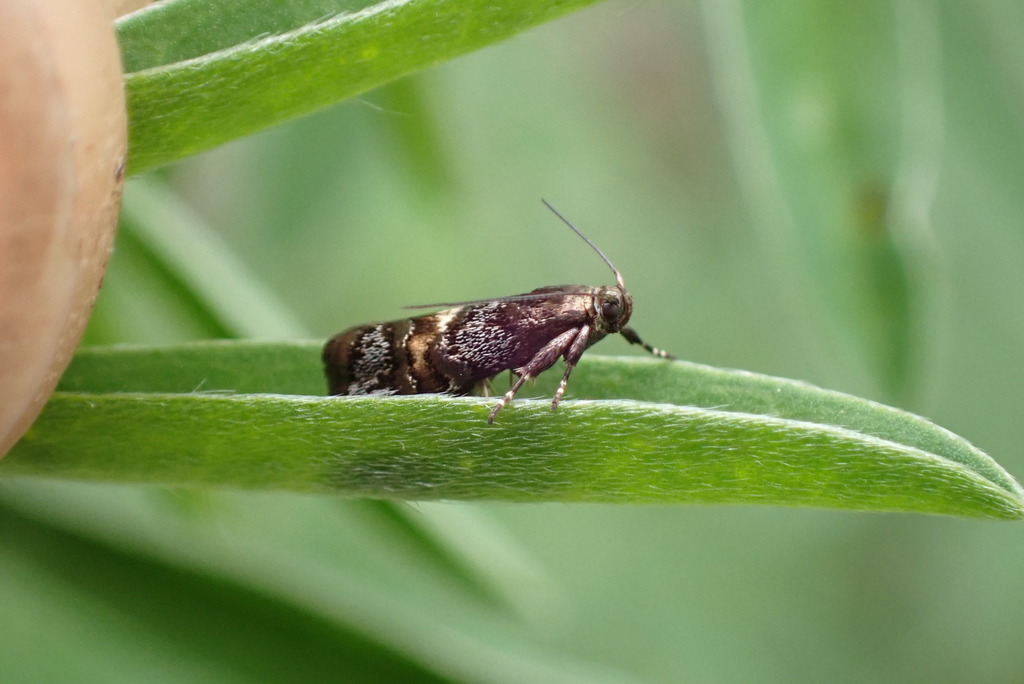
Hierodoris torrida
Hierodoris torrida is a species of moth in the family Oecophoridae. This species is endemic to New Zealand and can be found in the southern parts of the North Island, in Rangitikei and Wellington, and in the east of the South Island, in the Marlborough Sounds, Kaikōura, Mid and South Canterbury. The larvae of this species is unknown as is much of the biology of this species and its larval hosts. The adult moth prefers lowland forest habitat. It is classified as "At Risk, Relict'" by the Department of Conservation.
From the article Hierodoris torrida on Wikipedia (CC BY-SA), quoted section by section
Description
This species is similar in appearance to its close relatives Hierodoris polita and H. frigida. It can be distinguished from H. polita as H. torrida doesn't have the white forewing fascia, nor is it as yellow as H. frigida. It is also unlikely to be in the same habitat as either of these species.
Range & habitat
This species is endemic to New Zealand. It can be found in the southern parts of the North Island, in Rangitikei and Wellington, and in the east of the South Island, in the Marlborough Sounds, Kaikōura, Mid and South Canterbury.
Wikipedia: “Distribution”
Listen
Looking for field recordings…
Where it lives
Recorded sightings
—
geo-referenced records in GBIF, from museums, herbaria and field observers.
Drag the globe to turn it. Dots are where records exist, not a range map; darker means more records.
In the stacks
Searching the stacks…
Every page naming Hierodoris torrida in the Biodiversity Heritage Library →
This page is assembled live from iNaturalist, GBIF, Wikipedia, the Source Library and the Internet Archive. It is not yet part of the hand-edited codex. iNaturalist taxon 390515.