- Animals
- ›Arthropods
- ›Hexapods
- ›Insects
- ›Winged and Once-winged Insects
- ›Butterflies and Moths
- ›Geometrid and Swallowtail Moths
- ›Geometer Moths
- ›Carpet Moths
- ›Hydriomenini
- ›Hydriomena
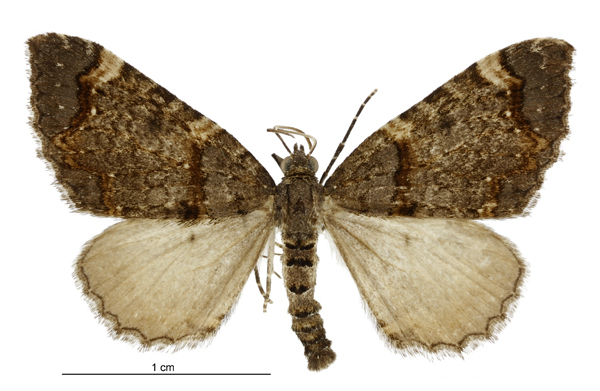
Gunnera Carpet
Hydriomena arida
Hydriomena arida, also known as the Gunnera carpet moth, is a species of moth in the family Geometridae. It was first described by Arthur Gardiner Butler in 1879. This species is endemic to New Zealand. It is found in both the South and Stewart Islands where it inhabits native forest. It has been observed at up to 3000 ft. Larvae feed on Gunnera monoica. Adults of this species are on the wing from December until February and are nocturnal and attracted to light. This species is regarded as being uncommon.
From the article Hydriomena arida on Wikipedia (CC BY-SA), quoted section by section
Description
Hudson described this species as follows:
The expansion of the wings is 1+1⁄8 inches. The fore-wings are dark blackish-grey; there are two small cream-coloured patches on the costa at 1⁄3 and 2⁄3 continued across the wing as two curved series of small cream-coloured spots; there is a subterminal series of whitish dots. In most specimens there is a very broad paler brown median band with a rounded projection below the middle almost touching the termen; this band is traversed by numerous fine wavy dark brown transverse lines and contains a conspicuous discal dot. The hind-wings are very pale brownish-grey or creamy-grey; all the cilia are nearly black. This species is variable in appearance. Hudson goes on to say that this species can be distinguished from similar appearing species as its forewings are very darkly coloured but have a broad often paler median band.
Range & habitat
This species is endemic to New Zealand. This species occurs in the South and Stewart Islands. A specimen has also been collected from Arapawa Island in the Marlborough Sounds in July. This species is regarded as being rare. In 1988 it was reported as being locally extinct in Dunedin. However in February 2022 a specimen was observed in Port Chalmers.
Wikipedia: “Distribution”
What it does
The adults of this species are on the wing most commonly from October until February and attracted to light.
== References ==
Wikipedia: “Behaviour”
Listen
Looking for field recordings…
Where it lives
Recorded sightings
—
geo-referenced records in GBIF, from museums, herbaria and field observers.
Drag the globe to turn it. Dots are where records exist, not a range map; darker means more records.
In the stacks
Searching the stacks…
Every page naming Hydriomena arida in the Biodiversity Heritage Library →
This page is assembled live from iNaturalist, GBIF, Wikipedia, the Source Library and the Internet Archive. It is not yet part of the hand-edited codex. iNaturalist taxon 390768.