- Animals
- ›Arthropods
- ›Hexapods
- ›Insects
- ›Winged and Once-winged Insects
- ›Butterflies and Moths
- ›Owlet Moths and Allies
- ›Cutworm Moths and Allies
- ›Cutworms and Dart Moths
- ›Wainscot Moths
- ›Ichneutica
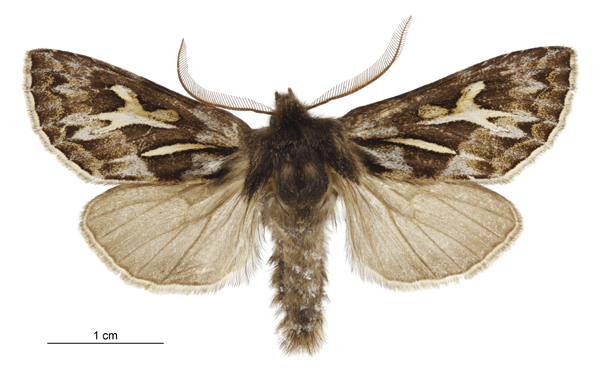
Lindsay's Alpine Owlet
Ichneutica dione
Ichneutica dione is a moth of the family Noctuidae. It is endemic to New Zealand. This moth species is closely related to I. ceraunias and is very similar in appearance to that species. However I. dione has a much more restrictive range, being found only in the alpine zone and hills of the South Island and is less commonly collected. Adults of the species are on the wing from December to February and although sometimes can be found flying during the day, they are more commonly seen at night.
From the article Ichneutica dione on Wikipedia (CC BY-SA), quoted section by section
Description
Hudson originally described the species as follows:
The expansion of the wings is 1+1⁄2 inches. The fore-wings are dull blackish-brown, darker near the middle; there is a rather oblique, white, longitudinal stripe below the middle from about one-eighth to one-third; above this there is a very conspicuous, large, elongate white mark; this mark has a semicircular indentation above, probably representing the orbicular; another indentation towards the termen, probably representing the reniform, and below this it emits two short teeth-like projections; beyond these markings the ground colour becomes paler, and is traversed by an obscure, jagged, transverse line; the cilia are grey. The hind-wings are pale grey; the cilia are also grey. The body is dark brownish-black.I. dione is very similar in appearance to I. ceraunias as the two species are closely related. The two species are both variable but were previously distinguished by I. ceraunias having a pale streak in the discal cell of the forewings. However the dissection of the genitalia of male specimens indicate that this distinguishing feature is also present on I. dione specimens. A male I. dione may have a distinctive Y-shaped marking on their forewing disk. Alternatively those male specimens that have a pale section on their forewings separated from the post discal streaks by a dark patch of wing scales are likely to be I. …
Range & habitat
This species inhabits the alpine zone of mountains and hills in the South Island. I. dione has a more restrictive range than I. ceraunias.
Wikipedia: “Habitat”
What it does
The adults of this species are on the wing from December to February. Like I. ceraunias adults of this species are sometimes found flying during the day, although it is more common to find them at night.
== References ==
Wikipedia: “Behaviour”
Listen
Looking for field recordings…
Where it lives
Recorded sightings
—
geo-referenced records in GBIF, from museums, herbaria and field observers.
Drag the globe to turn it. Dots are where records exist, not a range map; darker means more records.
In the stacks
Searching the stacks…
Every page naming Ichneutica dione in the Biodiversity Heritage Library →
This page is assembled live from iNaturalist, GBIF, Wikipedia, the Source Library and the Internet Archive. It is not yet part of the hand-edited codex. iNaturalist taxon 390924.