- Animals
- ›Arthropods
- ›Hexapods
- ›Insects
- ›Winged and Once-winged Insects
- ›Butterflies and Moths
- ›Owlet Moths and Allies
- ›Cutworm Moths and Allies
- ›Cutworms and Dart Moths
- ›Wainscot Moths
- ›Ichneutica
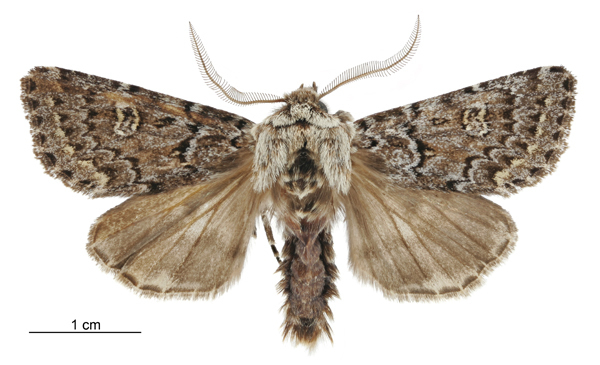
Ichneutica marmorata
Ichneutica marmorata is a moth of the family Noctuidae. This species is endemic to New Zealand and can be found in the North Island at the Tongariro National Park and at Puketitiri near the Kaweka Range. In the South Island it is widespread. It prefers alpine to subalpine habitat but occurs down to sea level altitudes in more southern locations. Adults are on the wing from late October to February. Larvae of this species may use tussock grasses in the genus Chionochloa as their host and they have been reared on Festuca novae-zelandiae.
From the article Ichneutica marmorata on Wikipedia (CC BY-SA), quoted section by section
Description
Hudson describes the female adult of the species as follows:
The expansion of the wings of the female is 1+1⁄2. The fore-wings are rather narrow with the termen moderately oblique, very slightly scalloped; reddish grey; the lines and stigmata outlined in black; the stigmatic, basal and costal region (as far as the second line) heavily suffused with white; the basal line is indicated by two short bars, one on the costa, the other below the subcostal vein; first line interrupted, very strongly waved, from 1⁄4 of costa to 1⁄3 of dorsum; claviform obscure; orbicular small, very elongate, clearly outlined in black; a conspicuous, almost elliptical black marking between orbicular and reniform; reniform large, margined with black except towards costa and dorsum, white, with two small cloudy yellowish-brown marks within; second line strongly dentate, from 2⁄3 of costa to near middle of dorsum, a very deep oblique sinuation between veins 1 and 2; subterminal line moderately dentate; beyond subterminal line there is a conspicuous series of partly confluent ochreous spots; a terminal series of small blackish lunules; the cilia are red-brown. …
Range & habitat
This species is endemic to New Zealand. It has been observed in only two areas of the North Island, Tongariro National Park and at Puketitiri. In the South Island this species is widespread.
Wikipedia: “Distribution”
What it does
Adults of this species are on the wing from late October to February, and are attracted to sugar traps.
Wikipedia: “Behaviour”
In human culture
The information on the life history of this species is not definitive. A possible host of the larvae of this moth is tussock grass as the female of I. marmorata has been seen laying eggs on Chionochloa rubra subsp. cuprea. Larvae have been reared on Festuca novae-zelandiae.
== References ==
Wikipedia: “Life history and host species”
Listen
Looking for field recordings…
Where it lives
Recorded sightings
—
geo-referenced records in GBIF, from museums, herbaria and field observers.
Drag the globe to turn it. Dots are where records exist, not a range map; darker means more records.
In the stacks
Searching the stacks…
Every page naming Ichneutica marmorata in the Biodiversity Heritage Library →
This page is assembled live from iNaturalist, GBIF, Wikipedia, the Source Library and the Internet Archive. It is not yet part of the hand-edited codex. iNaturalist taxon 390929.