- Animals
- ›Arthropods
- ›Hexapods
- ›Insects
- ›Winged and Once-winged Insects
- ›Butterflies and Moths
- ›Geometrid and Swallowtail Moths
- ›Geometer Moths
- ›Ennominae
- ›Diptychini
- ›Ischalis
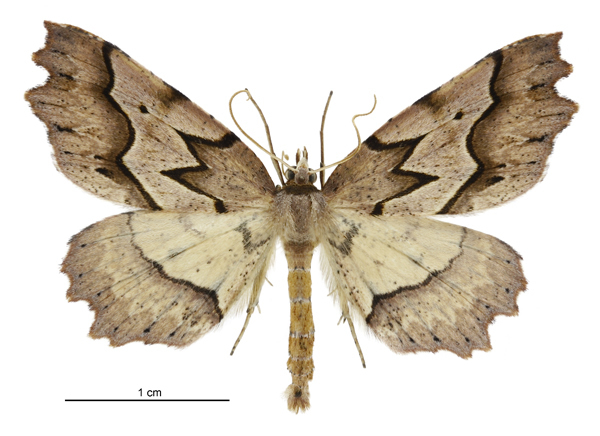
Zigzag Fern Looper
Ischalis fortinata
Ischalis fortinata (also known as the zigzag fern looper) is a species of moth in the family Geometridae. It was first described by Achille Guenée in 1868. This species is endemic to New Zealand and has been observed in both the North, South and Stewart Islands. The species inhabits native forest. The larval hosts of this species include Polystichum vestitum and Polystrichum richardii. Adults have been observed all year around but are most frequently seen from October to February.
From the article Ischalis fortinata on Wikipedia (CC BY-SA), quoted section by section
Description
Hudson describes the larva as follows:
The young larva, immediately after first moult, is about 1⁄8 inch in length, dull ochreous with a conspicuous blackish dorsal line and three or four fine, bright red, lateral lines, another blackish line being situated below the spiracles; the head is pale ochreous dotted with black, and the entire larva is clothed with father long black hairs. The mature larva of this species is a reddish-brown colour, with greenish reddish mottling, has a hairy appearance, and is between 25 and 30 mm long. Along the back of the larva there is a black edged, brown line and a number of black and white marks on a number of segments. Guenée described the adults of this species as follows:
This charming Phalenite is a most curious species. The wings are cut in an altogether peculiar manner. Superior having each at the apex two triangular excisions, the first of which is very deep (the inferior have also two excisions near the middle); they are testaceous-yellow, more or less tinged with violet, and with two deep black, well marked median lines; the first line forms, above and beneath the median nervure, two very acute angles; the second forms also two corresponding angles, but more open and blunter, and is bordered on the inside with paler; between the two lines is a brown mai-k on the costa, and a black dot beneath it; opposite to the second angle of the …
Range & habitat
This species is endemic to New Zealand. It has been recorded on the North and South Islands and is abundant in native forest in the far south of the South Island.
Wikipedia: “Distribution”
What it does
Eggs of I. fortinata are laid on the leaves of its host species. The black hairs covering the larvae ensure that it is well camouflaged when sheltering under the leaves of its host plants. The larva, when mature, forms a thin cocoon on the fronds of its host plants and overwinters as a pupa. The adult moth can be observed all year around but is most frequently seen from October to February. They are attracted to light and have been collected via a mercury vapour light trap.
Wikipedia: “Behaviour”
Listen
Looking for field recordings…
Where it lives
Recorded sightings
—
geo-referenced records in GBIF, from museums, herbaria and field observers.
Drag the globe to turn it. Dots are where records exist, not a range map; darker means more records.
In the stacks
Searching the stacks…
Every page naming Ischalis fortinata in the Biodiversity Heritage Library →
This page is assembled live from iNaturalist, GBIF, Wikipedia, the Source Library and the Internet Archive. It is not yet part of the hand-edited codex. iNaturalist taxon 391042.