- Animals
- ›Arthropods
- ›Hexapods
- ›Insects
- ›Winged and Once-winged Insects
- ›Butterflies and Moths
- ›Curved-horn Moths
- ›Twirler Moths
- ›Kiwaia
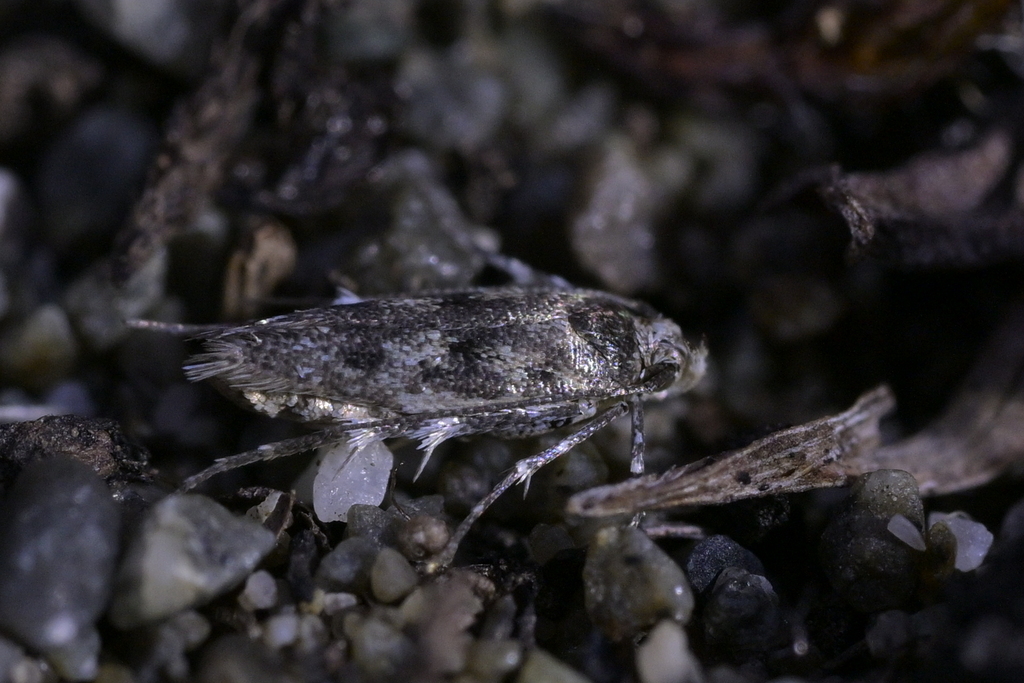
Kaitorete jumper
Kiwaia jeanae
Kiwaia jeanae, also known as the Kaitorete jumper or mat daisy jumper, is a species of moth in the family Gelechiidae. It is endemic to New Zealand. This species is classified as "At Risk, Naturally Uncommon" by the Department of Conservation. Both the males and females of this species are brachypterous.
From the article Kiwaia jeanae on Wikipedia (CC BY-SA), quoted section by section
Description
Philpott originally described the species as follows:
♂︎. 8mm. Head shining creamy white. Palpi ocherous white, apex of terminal segment blackish. Antennae brownish black. Thorax grey. Abdomen ocherous mixed with grey. Legs grey. Forewings lanceolate; whitish ocherous mixed with grey; a large subtriangular blackish blotch at 1⁄3; a round black spot in disk at 2⁄3; apex black anteriorly obscured margined with whitish; fringes ocherous grey. Hindwings greatly reduced; about a quarter the length of forewings; densely covered with long fine ocherous whitish hair-scales which radiate in all directions. It has been hypothesised that the hairs on the hind wings of the male may assist in the release of pheromones attracting the females of the species. Both the males and females of this species are brachypterous. This reduction in wing size is rare in male moths.
Range & habitat
This species is endemic to New Zealand. It is found in North and Mid Canterbury. As well as its type locality, this species has also occurred at Kaitorete Spit, Amberley beach, at Leithfield beach, both near Amberley.
Wikipedia: “Distribution”
What it does
Very little is known of the biology of this species. The adult moths of this species jump like a flea. Adult moths have been collected from January to mid April.
Wikipedia: “Biology and behaviour”
Listen
Looking for field recordings…
Where it lives
Recorded sightings
—
geo-referenced records in GBIF, from museums, herbaria and field observers.
Drag the globe to turn it. Dots are where records exist, not a range map; darker means more records.
In the stacks
Searching the stacks…
Every page naming Kiwaia jeanae in the Biodiversity Heritage Library →
This page is assembled live from iNaturalist, GBIF, Wikipedia, the Source Library and the Internet Archive. It is not yet part of the hand-edited codex. iNaturalist taxon 391208.